Cloud AI Agent Architecture Design: Far More Than Moving Local Agents to a Server
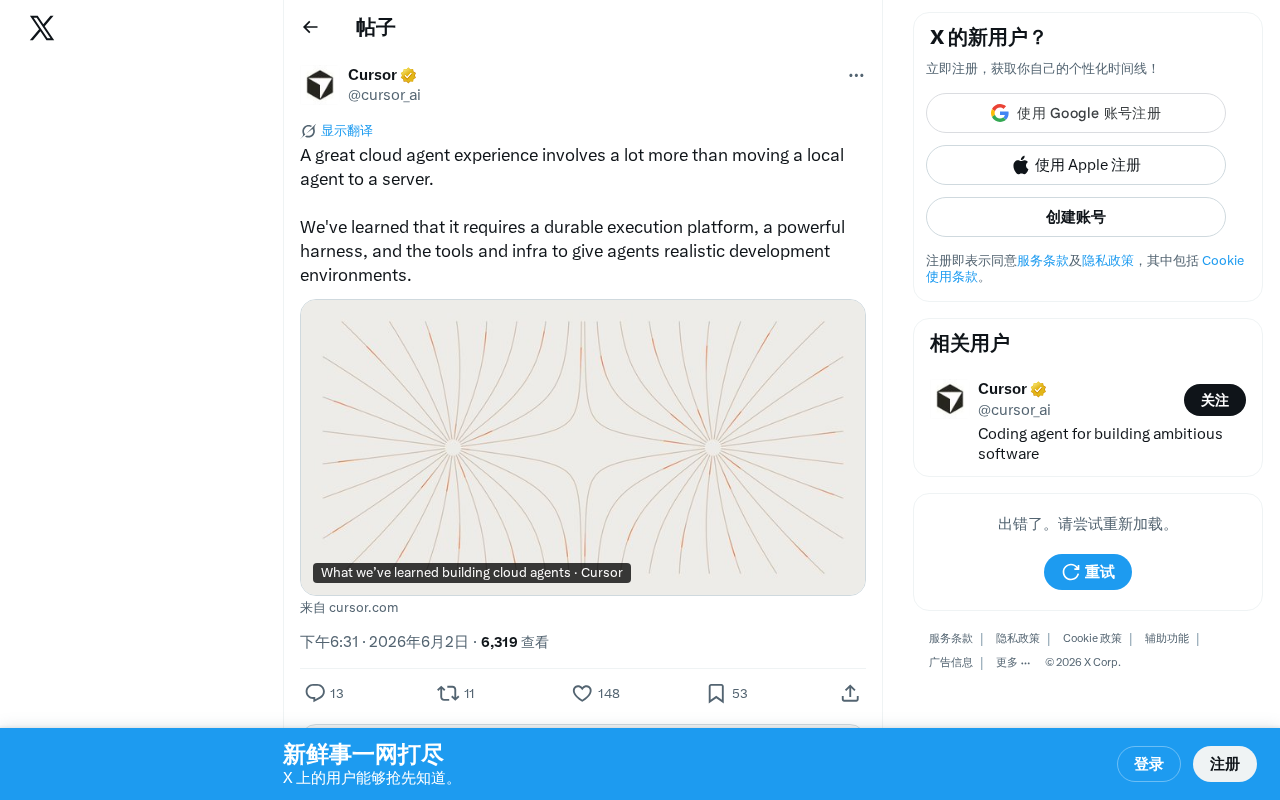
Cloud AI Agents require entirely new architectural thinking, not simply moving local Agents to a server.
Migrating local AI Agents to the cloud is a system architecture problem, not a deployment problem. Building excellent cloud Agent experiences requires three core components: a durable execution platform (ensuring state recovery and reliable operation), a powerful execution framework (handling orchestration, scheduling, and observability), and real development environment tools (providing secure sandboxes). The AI Agent space is transitioning from the prototype stage to the production engineering stage, and cloud Agent platforms will become an important infrastructure track.
Core Insight: Cloud Agents Require a Completely New Architectural Mindset
Migrating local AI Agents to the cloud is far from a simple "move." This profound insight from industry practitioners reveals the real challenges of building excellent cloud-based Agent experiences.
As the original post states: "A great cloud agent experience involves a lot more than moving a local agent to a server." This seemingly simple statement captures the core pain point of productionizing AI Agents today.
Three Critical Infrastructure Components for Cloud Agents
Based on practical experience, building an outstanding cloud Agent experience requires three core components:
Durable Execution Platform
When a local Agent runs, the process lifecycle is relatively simple—start, execute, end. But in a cloud environment, Agents may need to run for extended periods, handle interrupt recovery, manage state persistence, and deal with other complex scenarios.
A durable execution platform ensures that when Agents face network fluctuations, service restarts, timeouts, and other issues, they can reliably resume execution state rather than starting from scratch. This is especially critical for AI Agents that require multi-step reasoning and long-chain task execution.
The concept of Durable Execution originates from the distributed systems domain, with representative technologies including Temporal, Azure Durable Functions, and Restate. These systems automatically persist the state of each workflow step to a storage layer, enabling "resume from breakpoint even if the process crashes." In traditional microservice architectures, developers need to manually implement retry logic, idempotency guarantees, and state checkpoints, whereas durable execution platforms abstract this complexity as part of the programming model. Specifically, Temporal uses Event Sourcing to record every state change in a workflow, rebuilding state by replaying events when a process recovers; Restate achieves similar results using a virtual log approach. For AI Agents, a complex task may involve dozens of LLM calls, tool uses, and decision branches—failure at any step should not force the entire task chain to restart from zero. This transforms durable execution from an "optional optimization" into "essential infrastructure."
Powerful Harness (Execution Framework)
The execution framework serves as the bridge connecting Agent logic to underlying infrastructure. A powerful harness needs to handle:
- Task orchestration: Managing collaboration and communication between multiple Agents
- Resource scheduling: Allocating compute resources efficiently to avoid contention
- Error handling: Gracefully managing various exception scenarios
- Observability: Providing real-time monitoring of Agent runtime status
This isn't a problem that can be solved by simply wrapping an API call—it requires a complete runtime management system.
AI Agent orchestration frameworks are currently in a period of rapid evolution. From early frameworks like LangChain and AutoGen to more recent ones like CrewAI and LangGraph, the industry has been exploring how to effectively manage multi-Agent collaboration. However, most of these frameworks focus on Agent logic-level orchestration—defining Agent roles, designing prompt templates, managing conversation flows—with relatively weak support for underlying runtime management (such as concurrency control, backpressure handling, and resource isolation). In cloud scenarios, a true harness also needs to handle multi-tenant isolation (ensuring different users' Agents don't interfere with each other), billing and metering (precisely tracking tokens and compute resources consumed by each Agent), and rate limiting (preventing a single Agent from exhausting shared resources). This is analogous to the relationship between Kubernetes and containers—containers themselves are just a packaging format; what makes containers usable in production is the scheduling, self-healing, and service discovery capabilities that Kubernetes provides. Similarly, Agent frameworks define "what to do," while the harness determines "how to do it reliably."
Real Development Environment Tools and Infrastructure
This point is often overlooked but is critically important. AI Agents need to be developed and tested under conditions that closely approximate real production environments. This means:
- Providing sandbox environments consistent with production
- Supporting simulation or controlled access to real resources like file systems, network access, and databases
- Enabling Agents to operate complete development toolchains just like human developers
Providing real development environments for AI Agents involves deep application of sandboxing technology. Current industry approaches include: lightweight isolation environments based on micro-VMs (such as AWS Firecracker) with startup times as low as 125 milliseconds; controlled execution spaces based on containers, restricting system calls through mechanisms like seccomp and AppArmor; and secure sandboxes based on WebAssembly, providing near-native performance while achieving memory-safe isolation. For example, E2B (Engineer to Bot) provides cloud sandboxes designed specifically for AI Agents, allowing them to safely execute code, manipulate file systems, and install dependencies; platforms like Modal and Fly.io offer fast-launching micro-VMs suitable for scenarios requiring full operating system environments. The core challenge lies in balancing security with functional completeness—Agents need sufficient permissions to accomplish meaningful work (such as installing npm packages or accessing specific APIs) while being unable to breach security boundaries and cause harm (such as accessing host file systems or initiating malicious network requests). This is essentially a new interpretation of the "principle of least privilege" in the AI era, and it's more challenging than traditional scenarios because Agent behavior is non-deterministic, making it difficult to enumerate all possible operation paths in advance.
From Prototype to Production Engineering: Implications for the Industry
This perspective reflects an important transition happening in the AI Agent space: moving from the "just make it work" prototype stage to the "reliable, scalable, maintainable" production engineering stage.
Many teams currently attempting to deploy locally validated Agents to the cloud encounter unexpected difficulties. Implicit dependencies in local environments, assumptions of synchronous execution, simplifications for single-user scenarios—all of these become problems in the cloud.
From a technical perspective, migrating from local Agents to cloud Agents is essentially similar to evolving from single-machine applications to distributed systems, encountering the classic "Eight Fallacies of Distributed Computing": assumptions that the network is reliable, latency is zero, bandwidth is infinite, topology doesn't change—all of these fail in the cloud. Additionally, local Agents typically run in synchronous, single-threaded models where developers can rely on process memory to maintain conversation context and intermediate state; cloud environments need to handle concurrent requests, asynchronous callbacks, and event-driven architectures, with state management shifting from in-process memory to externalized storage (such as Redis or PostgreSQL), introducing new concerns around consistency, serialization formats, and version compatibility. Even more challenging is that during local development, an Agent typically serves only one user with no resource competition; in cloud multi-tenant scenarios, fair scheduling, priority queues, and graceful degradation strategies must be considered. These challenges explain why "simply moving" is destined to fail—it's not a deployment problem but an architectural restructuring problem.
This also means that cloud Agent platforms will become an important infrastructure track. Whoever can provide out-of-the-box durable execution, powerful orchestration frameworks, and realistic development environments will gain an early advantage in the AI Agent engineering wave. From a market landscape perspective, this track is attracting multiple participants: cloud providers (such as AWS, Azure, GCP) are extending their Serverless and workflow services to accommodate Agent scenarios; focused startups (such as Temporal, E2B, Modal) are providing vertical solutions; and AI-native platforms (such as Anthropic's tool use ecosystem and OpenAI's Assistants API) are attempting to extend downward from the model layer to cover infrastructure.
Summary
Building cloud Agents is not a simple deployment problem—it's a system architecture problem. It requires us to rethink execution models, state management, and developer experience, with all three being indispensable. As AI Agent capabilities continue to grow, the importance of underlying infrastructure will only become more prominent. As the evolution of cloud computing has shown—from initial VM rental, to container orchestration, to Serverless—each upgrade in application paradigm has given birth to new infrastructure layers. The cloudification of AI Agents is very likely catalyzing the birth of the next generation of cloud infrastructure.
Key Takeaways
- Cloud Agent experiences go far beyond migrating local agents to servers—they require entirely new architectural design
- Building excellent cloud Agents requires three core components: a durable execution platform, a powerful execution framework, and real development environments
- Durable execution platforms solve reliability problems around long-running Agents and state recovery, with representative technologies including Temporal and Restate
- The AI Agent space is transitioning from prototype validation to production engineering, facing classic distributed systems challenges
- Cloud Agent platforms will become an important infrastructure track, attracting competition from cloud providers, startups, and AI-native platforms
Related articles
 Industry Insights
AI Product Development in Practice: Model Selection, Building Moats, and Paths to Commercialization
Practical strategies for AI product development: why not to train models from scratch, when to use APIs vs. fine-tuning, building product moats, and the full path from evaluation systems to commercialization.
 Industry Insights
No Product Fits Your Needs? Building It Yourself Is the Best Starting Point for Indie Developers
Can't find a product that fits? Building from personal pain points is the best entry for indie developers. Niche needs + AI tools = rapid product creation.
 Industry Insights
OpenAI Codex Tutorials Mass-Copied on Bilibili, Highlighting AI Content Farm Problem
At least 9 Bilibili accounts mass-published identical OpenAI Codex tutorial videos, exposing content farm operations in the AI tools space.