Cursor + Codex Dual-IDE Collaboration: A Practical Methodology for Open-Source Project Customization
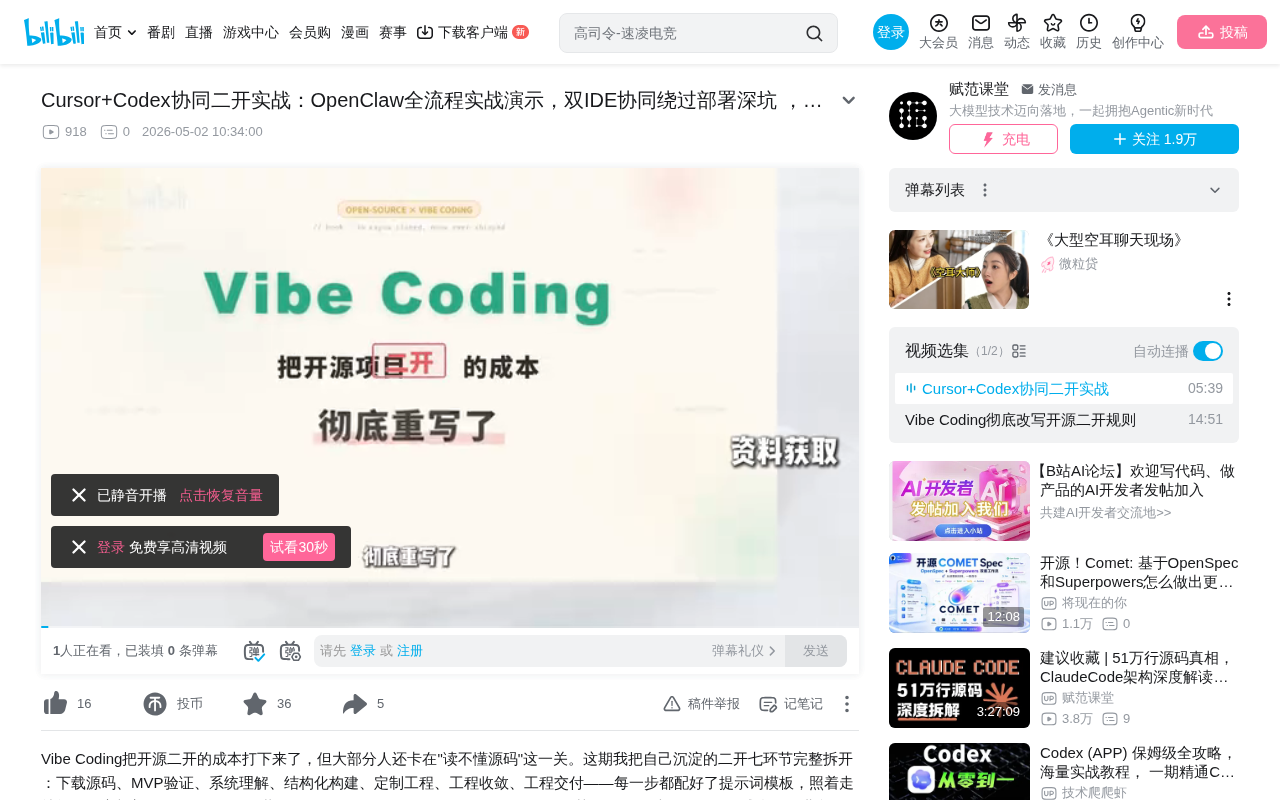
Cursor + Codex dual-IDE collaboration enables efficient open-source project customization
This article presents a structured methodology for open-source project customization in the AI era: distinguishing the fundamental difference between building from scratch and customization, following a seven-stage process (download source → MVP validation → system comprehension → structured construction → custom engineering → engineering convergence → delivery), and leveraging Cursor + Codex dual-IDE collaboration (Codex for holistic architecture understanding, Cursor for fine-grained editing) to achieve a delivery rhythm of three days to run, one week to modify, and two weeks to integrate.
Introduction: The Cost of Open-Source Customization Is Being Rewritten
As AI programming tools mature, the barrier to secondary development (customization) of open-source projects is being fundamentally rewritten. In the past, picking up an unfamiliar GitHub project required at least two weeks just to understand the source code and map out the architecture. Now, with the collaborative workflow of Cursor and Codex, this timeline can be compressed to three days to get it running, one week to modify, and two weeks to complete business integration.
This article is based on the practical sharing by Bilibili creator Muyu, systematically outlining a complete methodology for open-source project customization, along with the specific implementation path for Cursor + Codex dual-IDE collaborative development.
Building from Scratch vs. Secondary Development: The Fundamental Difference Between Two Paths
The Cognitive Gap Is the Foundation of Everything
Many developers make a common mistake: applying the mindset of building from scratch directly to customization projects. But the underlying logic of these two paths is completely different:
- Building from scratch: You create a world first. You determine the tech stack through Deep Research, draw architecture diagrams based on requirements, decompose modules, and implement them one by one. You are the creator of this world—everything is defined by you.
- Secondary development: You understand an existing world first. Someone has already built the system. You need to first understand its skeleton, then determine what can be modified and what absolutely cannot be touched. One wrong move and the whole thing collapses.
This cognitive gap determines a critical issue: if you haven't thoroughly understood the system architecture first and just let AI directly modify the open-source project's code, the result will inevitably be a mess. It's not that AI is incapable—it's that you haven't given it the correct context and constraints. When LLMs generate code, they follow probability distributions—generating code based on the most common patterns in their training data. But without understanding the specific architectural constraints of the current project, the generated code may be syntactically correct and logically sound, yet fundamentally contradict the project's overall design philosophy, causing coupling to spike or breaking existing module boundaries.
Decision Criteria for Scenario Selection
Muyu summarized a simple decision framework from practice: if a business need can be addressed by building on an open-source project, there's no need to reinvent the wheel; what should be built from scratch gets built from scratch, and what can be customized gets customized. He's worked through 50 open-source projects, and only a handful were truly built from zero—not because he couldn't, but because there was no need.
However, this judgment requires accumulated experience. For example, the OpenClaw project used in this demonstration has TypeScript for both frontend and backend. If you're a Python-background engineer, just opening the folder and scanning through it is enough to give you a headache. TypeScript is a superset of JavaScript developed by Microsoft that adds a static type system to improve maintainability of large projects. When an open-source project uses TypeScript for both frontend and backend, it typically means it uses Node.js as the backend runtime, with the frontend likely based on frameworks like React or Next.js, sharing type definitions and data models between frontend and backend. The advantage of this "isomorphic" architecture is high code reuse, but for developers outside the JavaScript ecosystem, its unique package management mechanisms (npm/pnpm/yarn), build toolchains (Webpack/Vite/Turbopack), and asynchronous programming models all create additional cognitive overhead. Previously, when encountering a project with a mismatched tech stack, there were only two options: grind through it for a month, or simply give up. This is precisely the scenario where AI tools deliver enormous value in customization—they help developers working across tech stacks quickly understand unfamiliar language idioms and project structures.
The Seven Stages of Customization: A Structured Practical Methodology
Complete Process Overview
Muyu distilled years of customization experience into seven standard stages:
- Download source code — Obtain the complete project code
- MVP feasibility validation — Quickly determine whether the project is worth investing in
- System comprehension — Let AI help you understand the architecture and core logic
- Structured construction — Build a systematic cognitive map of the project
- Custom engineering — Make targeted modifications based on business requirements
- Engineering convergence — Handle edge cases and ensure stability
- Engineering delivery — Complete deployment and go live
These seven stages are interconnected—skipping any one of them may lead to pitfalls in subsequent stages. Stage two, MVP feasibility validation, is particularly easy to overlook. Many people jump straight to modifying code, only to waste enormous amounts of time on a project that was never suitable for customization in the first place.
The Deeper Significance of MVP Feasibility Validation
The MVP (Minimum Viable Product) concept originates from Lean Startup methodology, systematically articulated by Eric Ries in The Lean Startup. In the context of open-source customization, MVP validation takes on a redefined meaning: it's not about validating product-market fit, but about validating technical feasibility—whether the project can successfully run in your environment, whether core functionality is complete, and whether the dependency chain is manageable. The essence of this step is using minimal cost to eliminate the "sunk cost trap": many open-source projects may have high star counts and thorough documentation, but are actually long-neglected, with third-party service dependencies that have gone offline, or critical bugs in core functionality that remain unpatched. Spending 30 minutes to 2 hours on an MVP validation upfront can prevent days or even weeks of wasted effort downstream.
The Core Breakthrough: Using AI to Efficiently Read Source Code
These two paths share a common breakthrough point in the AI programming era: the "reading source code" phase that used to be the biggest bottleneck can now be delegated to large language models. The once-mocked "package caller" has evolved into a methodology in today's world—except now the "package" isn't a single function, but an entire Agent Runtime, an entire frontend-backend system, an entire Skills ecosystem.
Two key concepts need explanation here. Agent Runtime refers to the runtime environment for AI agents, providing infrastructure capabilities like tool invocation, memory management, and task orchestration. In current AI application architecture, it plays a role similar to an operating system kernel—determining which external tools an Agent can call, how to manage conversation context, and how to handle concurrent tasks. The Skills ecosystem refers to pluggable capability modules built around an Agent, similar to apps in a mobile app store. Each Skill encapsulates a specific capability (such as web search, code execution, or database queries), and the Agent can dynamically load and combine these Skills based on task requirements. Understanding these two concepts is crucial for open-source customization, as a large number of projects worth customizing today are precisely these types of AI Agent frameworks.
The key insight is: prompt templates are static—making them work effectively on real projects is what separates experts from beginners.
Cursor + Codex Dual-IDE Collaboration: Detailed Practical Guide
Why Dual-IDE Collaboration Is Needed
In practice, Muyu uses the combination of Cursor (running Opus 4.6) + Codex (GPT 5.3). He notes that the latest version of Codex can now rival Cursor in project comprehension capability, but most people are still working with a single IDE, failing to leverage the complementary strengths of both tools.
To understand the value of this collaboration, you need to first understand the architectural differences between the two tools. Cursor is a deeply customized AI-native code editor based on VS Code, developed by Anysphere. Its core capability lies in deeply integrating large language models into every interaction point of the editor—from code completion and multi-file editing to project-level conversational programming. It supports mounting different underlying models (such as the Claude Opus series) and provides precise context awareness by indexing the entire codebase. Codex, on the other hand, is OpenAI's programming agent product, designed more toward asynchronous task execution: you give it a task description, and it autonomously reads code, executes commands, and runs tests in a cloud sandbox environment, ultimately delivering a complete code change. Their architectural philosophies are fundamentally different—Cursor is a real-time editor for human-AI collaboration, while Codex is a delegated autonomous programming Agent. This difference creates a natural complementary relationship.
The core logic of dual-IDE collaboration is:
- Codex: Excels at holistic project understanding, architecture analysis, and code interpretation—ideal for quickly building a comprehensive understanding of the project during the early stages of customization
- Cursor: Excels at fine-grained code editing and incremental modifications within context—ideal for specific code modifications during the custom engineering stage
Using both together creates complementarity at the comprehension layer and execution layer, dramatically improving open-source customization efficiency. The specific collaboration pattern is: first use Codex to perform a global scan and architecture analysis of the entire project, generating project understanding documents and module dependency diagrams; then import these analysis results as context into Cursor, where precise code modifications and feature development take place. This division of labor avoids the capability bottleneck that any single tool faces when switching between "global understanding" and "local refinement."
Deployment Pitfalls and Workaround Strategies
Using the OpenClaw project as an example, Muyu specifically mentioned a pitfall that most people who've attempted it have encountered. Deployment issues in open-source projects are the most common roadblock in customization: dependency configurations don't match, environments won't start up, and the original author's design intent is completely unguessable.
The technical root cause of these problems is "environment drift": inevitable differences between the project author's development environment and the user's environment. These differences include OS versions, language runtime versions, system dependency library versions, environment variable configurations, and network access conditions (such as needing access to specific API services or databases). Even when a project provides a Docker containerization solution, builds may still fail due to base image updates or unreachable dependency sources. The deeper issue is that many open-source projects' README documentation only records the "happy path"—the installation steps when everything goes smoothly—while lacking explanations for exceptional situations.
The solution approach is: identify these pitfalls early during the MVP feasibility validation stage, using AI tools to quickly locate root causes—for example, having Codex analyze Dockerfile, package.json, docker-compose.yml, and other configuration files to identify potential version conflicts and environment compatibility risks, rather than waiting until you've modified a bunch of code only to discover the environment won't run at all. This is also why MVP validation is placed as the second step in the seven stages—first confirm the project can run, then decide whether to invest effort in modifying it.
Capability Leap: From Independent Development to Asset-Based Operations
The Three-Day to Two-Week Delivery Rhythm
After mastering this methodology, when facing any unfamiliar open-source project on GitHub, you can achieve:
- Within three days: Get the project running and understand the core architecture
- Within one week: Transform it into a version tailored to your business
- Within two weeks: Integrate custom LLMs, Feishu/DingTalk, and custom Skills
Behind this delivery rhythm is the efficiency improvement brought by Cursor + Codex dual-IDE collaboration, as well as the direct manifestation of the structured customization methodology. It's worth noting that "integrating Feishu/DingTalk" represents enterprise-level integration capability—connecting to enterprise IM platforms' open APIs to embed the customized AI application into the organization's daily workflow, achieving the leap from "tech demo" to "business tool." "Custom Skills" means registering new capability modules within the Agent framework, enabling the AI Agent to call internal enterprise databases, business systems, or third-party services.
The Fundamental Shift in Competitive Position
Behind this lies a deeper capability leap: going from "an engineer who can only build standalone projects" to "an engineer who can turn any open-source asset into their own weapon"—these represent two entirely different competitive positions.
Whether you're demonstrating full-stack delivery capability during job interviews, driving AI project implementation within your company, or getting started quickly as an independent developer, open-source customization capability is one of the most leveraged technical skills today. It frees you from being limited to your own tech stack, from being intimidated by unfamiliar codebases, and enables you to build rapidly by standing on the shoulders of giants. From an economics perspective, this is essentially a form of "technical arbitrage"—using AI tools to eliminate information asymmetry (the cost of understanding unfamiliar codebases), enabling developers to acquire and modify high-value open-source assets at extremely low marginal cost.
Conclusion
The evolution of AI programming tools is transforming open-source project customization from a high-barrier engineering capability into a replicable, standardized process. The dual-IDE collaboration of Cursor and Codex provides powerful tooling support for this process. But tools are merely means—the true core lies in: understanding the fundamental difference between building from scratch and customization, establishing a structured customization methodology, and continuously refining your ability to quickly understand and modify open-source projects through practice.
By mastering this Cursor + Codex collaborative workflow, combined with the standardized seven-stage process, you gain the ability to transform the vast ocean of open-source projects on GitHub into business assets. This is not just a technical improvement—it's a comprehensive upgrade in engineering thinking and delivery capability.
Key Takeaways
- The fundamental difference between building from scratch and secondary development: the former creates a world, the latter understands and modifies an existing one—confusing the two causes AI code modifications to spiral out of control
- The seven-stage customization methodology: Download source code → MVP validation → System comprehension → Structured construction → Custom engineering → Engineering convergence → Engineering delivery
- Cursor + Codex dual-IDE collaboration: Codex excels at holistic architecture understanding, Cursor excels at fine-grained code editing—their complementarity dramatically improves efficiency
- The barrier to reading source code has been drastically lowered in the AI era—what used to take two weeks of source code comprehension can now be delegated to LLMs
- After mastering the customization methodology, you can achieve a delivery rhythm of three days to get running, one week to modify, and two weeks to complete business integration
Related articles
 Tutorials
Cursor Multi-Agent in Practice: Building a Full-Stack Next.js Blog in 50 Minutes
Build a full-stack blog in 50 minutes using Cursor IDE's multi-Agent mode with Next.js, Clerk auth, and Supabase. Learn the 4-phase AI Agent workflow and key integration pitfalls.
 Tutorials
Building an AI Software Factory from Scratch: A Cursor Engineer's Hands-On Experience with Multi-Agent Collaboration
Cursor engineer Eric shares practical insights on building an AI software factory: automation levels, guardrail design, parallel Agent management, and scaling to 1000+ Agents for 24/7 development.
 Tutorials
ReAct vs. CodeAct: Two Core Approaches to Agent Tool Calling
In-depth comparison of ReAct and CodeAct — two core Agent tool-calling architectures. From paper principles to code implementation, learn the trade-offs between reasoning+action and code execution.