Cursor Multi-Agent in Practice: Building a Full-Stack Next.js Blog in 50 Minutes
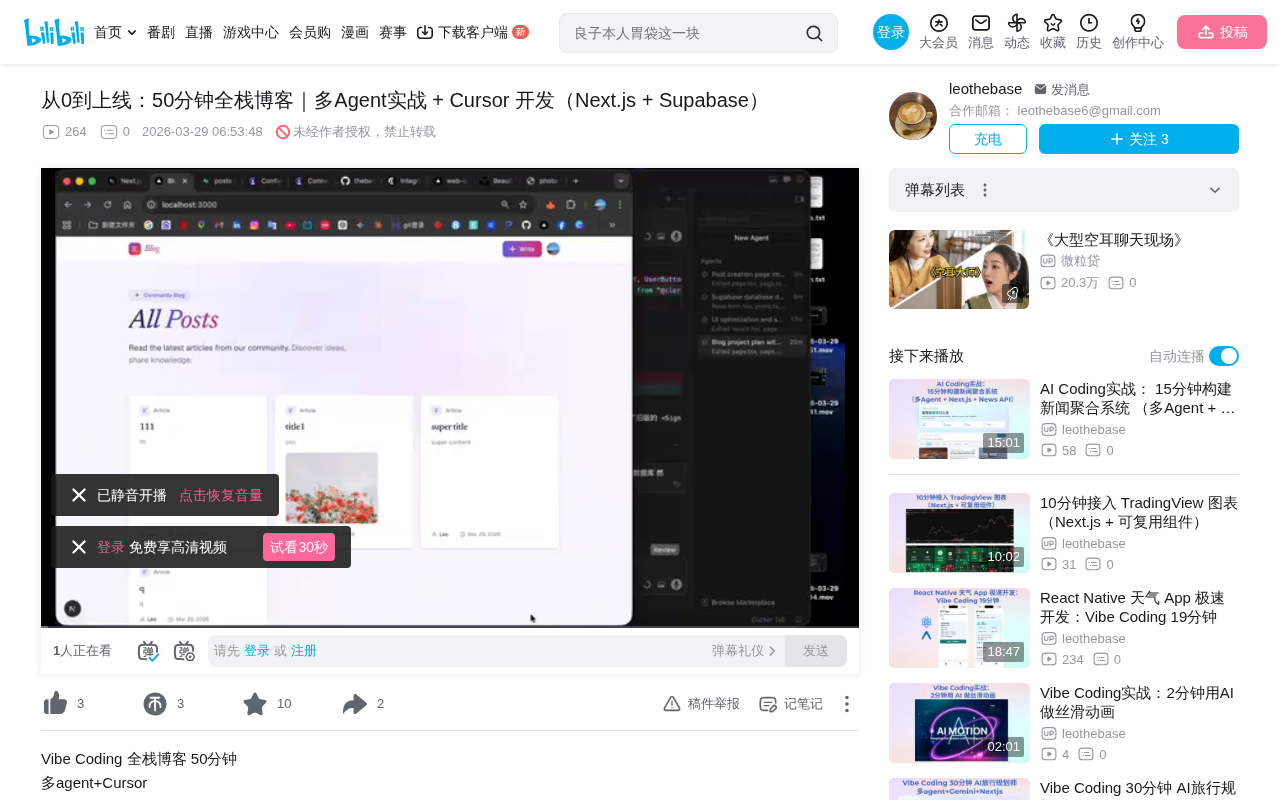
Building a full-stack Next.js blog in 50 minutes using Cursor's multi-Agent collaboration mode.
This article documents building a full-stack blog with Next.js, Supabase, and Clerk in 50 minutes using Cursor IDE's multi-Agent mode. Development was split into four phases—auth configuration, database & RLS rules, page logic, and UI optimization—each handled by an independent Agent. Key takeaways: system integration points (JWT injection, RLS configuration) require developer oversight, use strong models for planning and lighter ones for execution, and persist planning docs when switching Agents to manage context limits.
Project Overview
This is a hands-on case study of building a full-stack blog from scratch in 50 minutes using Cursor IDE's multi-Agent collaboration mode. The tech stack includes Next.js, Tailwind CSS, Clerk (authentication), and Supabase (backend database), with the entire process completed by orchestrating 4 AI Agents across different development phases.
Cursor is an AI-enhanced IDE based on VS Code. Its multi-Agent mode allows developers to launch multiple independent AI conversation instances simultaneously, each with its own context window and task scope. Unlike traditional single AI assistant conversations, multi-Agent mode simulates real team collaboration—each Agent acts as a developer focused on a specific domain. The advantage is avoiding AI performance degradation caused by single-context overload, while allowing different prompting strategies and model configurations for different phases.
Technical Architecture & Core Workflow
Feature Design
The blog system includes the following core features:
- Homepage: Fetches and displays all blog posts with responsive layout (1 column on small screens, 2 on medium, 3 on large)
- Create Page: Accessible only to logged-in users, supports title, content, and image URL input
- Detail Page: Displays individual posts via dynamic route
/blog/[id] - Auth System: Supports Email and Google login; unauthenticated users accessing protected pages are automatically redirected to the login page
Database Design
Supabase posts table structure: id, title, content, author_id (Clerk User ID), author_name, image_url, created_at, updated_at. Access control is implemented through RLS rules—anyone can read, only authenticated users can create.
Supabase is an open-source alternative to Firebase, built on PostgreSQL, providing real-time database, authentication, storage, and edge functions. Its core security mechanism, RLS (Row Level Security), is a native PostgreSQL feature that allows defining granular access control rules at the database level. RLS uses Policies to define who can perform what operations on which rows, with the WITH CHECK clause validating whether new data meets conditions during INSERT/UPDATE operations. When integrating with third-party auth providers like Clerk, custom JWT parsing functions extract user identity from tokens, ensuring only data owners can modify their own records.
Multi-Agent Development Workflow
The development process was divided into four phases, each with an independent Agent:
Agent 1: Clerk Auth Configuration
Using Clerk's official Prompt to configure user authentication and route protection middleware. The key point is installing Cursor's Clerk plugin to access the corresponding Skills and MCP Tools, enabling the AI to complete the integration more accurately.
Clerk is an Authentication-as-a-Service platform for modern web applications, offering out-of-the-box user registration, login, session management, and multi-factor authentication. Compared to self-built auth systems like NextAuth, Clerk's core advantages lie in its pre-built UI components and comprehensive JWT token management. Clerk generates JWTs containing a sub (subject) field for each authenticated user—this unique identifier can be used by downstream services like Supabase for row-level permission verification. Cursor's Clerk plugin provides the AI with up-to-date API documentation and integration patterns, reducing code errors caused by outdated docs.
Agent 2: Database & RLS Rules
Creating the Supabase database table and enabling RLS via SQL statements. A typical issue arose here: the with check syntax in the RLS rule was incorrect, causing an invalid input syntax for user id error when creating posts. The correct approach requires referencing the Supabase integration section in Clerk's documentation, using the JWT's sub field to match author_id.
In Clerk-Supabase integration, JWT injection works as follows: Clerk issues a JWT containing user information for authenticated users, and developers pass this JWT via the accessToken parameter when creating the Supabase Client. Upon receiving the request, Supabase verifies the token using pre-configured JWT keys and extracts the sub field via the auth.uid() function in RLS policies. This forms a complete trust chain: Clerk handles identity verification → JWT carries identity information → Supabase verifies the JWT and enforces permission policies. Common errors include using incorrect field extraction methods in RLS policies or misconfigured JWT templates causing missing sub fields.
Agent 3: Pages & Business Logic
Creating all page components and Supabase operation functions. All database operations are placed in the lib folder using use server, and the Supabase Client must be created with Clerk's auth token injected rather than using the service key with superuser privileges.
The 'use server' directive introduced in Next.js 13+ marks Server Actions, ensuring functions execute only on the server side—clients cannot directly access their internal logic. This is critical for security: database connection strings, API keys, and other sensitive information are never exposed to the browser. In this project, executing all Supabase operations through Server Actions means Clerk's auth token is obtained and injected server-side, database queries complete on the server with only results returned to the client, fundamentally eliminating the security risk of the frontend holding database superuser privileges (service_role key). This architectural pattern is also the officially recommended best practice for data fetching in Next.js.
Agent 4: UI Optimization
Using the frontend design and web design guideline Skills to optimize the overall visual appearance, adding gradients and icons. These Skills are essentially pre-defined system prompts containing design principles, color theory, and component layout best practices, helping the AI generate UI code that meets modern aesthetic standards.
Key Takeaways
System Integration Points Require Human Oversight
The most valuable insight from the video: the integration points between Clerk and Supabase must be understood by the developer first, then delegated to AI for execution. The author manually wrote the Client creation logic in supabase.ts, obtaining the token from Clerk's auth and injecting it into the Supabase Client—a critical connection point where AI is prone to errors.
This insight reveals a fundamental limitation of current AI-assisted development: AI excels at handling logic within a single system (like writing React components or SQL queries), but at the boundaries between two independent systems—involving auth flow handoffs, data format conversions, API version compatibility—it often lacks up-to-date integration knowledge. These integration points typically have frequently updated documentation and multiple implementation paths, and the AI's training data may already be outdated.
Model Selection Strategy
Use the strongest model (e.g., Claude Opus/Sonnet) during the Plan phase—slower but higher planning quality. For execution-phase Agents, you can use lower-tier models to improve response speed. The logic behind this layered strategy: architectural planning requires stronger reasoning capabilities and a global perspective, while specific code generation tasks are relatively formulaic and can be handled by lighter models, saving API costs and wait time.
Context Management Tips
In multi-Agent mode, monitor Context consumption. When an Agent's Context grows too large, close it promptly and create a new Agent to continue subsequent tasks, while saving the Plan file to the project for reference by later Agents. The context window (the maximum number of tokens a model can process) is a finite resource—when conversation history gets too long, the model loses early information or overall reasoning quality degrades. By persisting planning documents as project files (e.g., PLAN.md), new Agents can quickly grasp the full project picture without redundant communication—essentially an "external memory" mechanism.
Summary
This case study demonstrates the practical effectiveness of Cursor's multi-Agent workflow: splitting a full-stack project into four phases—authentication, database, business logic, and UI—for parallel development. The core lesson is that AI excels at executing well-defined tasks, but integration logic between systems and architectural decisions still require developer leadership. This human-AI collaboration model represents the current best practice direction for AI-assisted development: developers serve as architects and project managers responsible for system design, integration decisions, and quality control, while AI Agents act as efficient executors rapidly completing concrete implementations of each module.
Related articles
 Tutorials
Cursor + Codex Dual-IDE Collaboration: A Practical Methodology for Open-Source Project Customization
A complete methodology for open-source project customization based on real-world experience, detailing the Cursor+Codex dual-IDE workflow, seven-stage process, MVP validation, and AI source code reading techniques.
 Tutorials
Building an AI Software Factory from Scratch: A Cursor Engineer's Hands-On Experience with Multi-Agent Collaboration
Cursor engineer Eric shares practical insights on building an AI software factory: automation levels, guardrail design, parallel Agent management, and scaling to 1000+ Agents for 24/7 development.
 Tutorials
ReAct vs. CodeAct: Two Core Approaches to Agent Tool Calling
In-depth comparison of ReAct and CodeAct — two core Agent tool-calling architectures. From paper principles to code implementation, learn the trade-offs between reasoning+action and code execution.