Cursor Internal Data: 75% of Code Generated by AI, Engineers Transforming into Agent Managers
Cursor data shows 75% of enterprise code is now AI-generated as engineers shift to managing Agents.
At its first in-person event, Cursor disclosed that enterprise customers now have 75% of their code generated by AI, up from 15-20% a year ago. Agent requests have grown over 15x year-over-year and now surpass Tab completions. Internally, 30% of Cursor's PRs are completed end-to-end by Agents with zero human intervention. The company also ran an experiment where Agents autonomously built a browser from scratch, generating 3 million lines of code in one week.
From Film Technology to Software Revolution: A Turning Point for an Era
The Cursor team recently disclosed a stunning set of internal data at their first in-person event: among enterprise customers, the proportion of AI-generated code has surged from 15%-20% a year ago to approximately 75%, and engineers are shifting from "people who write code" to "people who manage Agents."
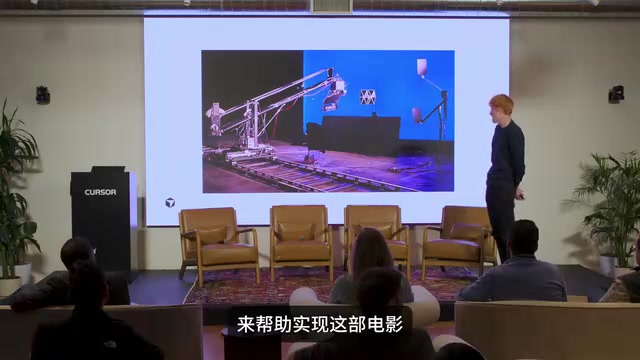
The event was held at a symbolically significant venue — the theater where Star Wars premiered in the late 1970s. The Cursor team drew a deliberate parallel: just as Star Wars redefined the film industry with its computer-controlled camera system (Dykstraflex), AI programming tools are redefining the boundaries of software development.
Dykstraflex was a computer-controlled camera system developed by visual effects pioneer John Dykstra for the 1977 film Star Wars. Before its invention, filming space battle sequences relied on manually operating cameras, making it nearly impossible to precisely repeat motion paths between takes. Dykstraflex digitally stored every camera motion parameter — pan, tilt, zoom, and more — enabling the same complex camera movement to be precisely repeated countless times, allowing multiple visual layers to be composited perfectly. This technology earned Industrial Light & Magic (ILM) an Academy Award for Technical Achievement. More importantly, it marked a paradigm shift in filmmaking from pure craftsmanship to computer-assisted creation — a transformation that shares deep structural similarities with what AI programming tools are doing to software development today.
Three Eras of Evolution: From Tab Completion to Agent Teams
The Tab Era: Line-by-Line Assistance
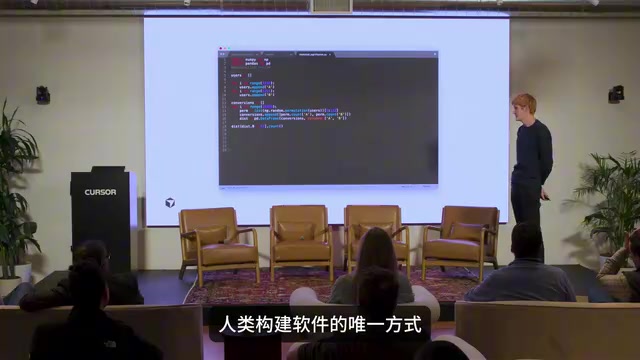
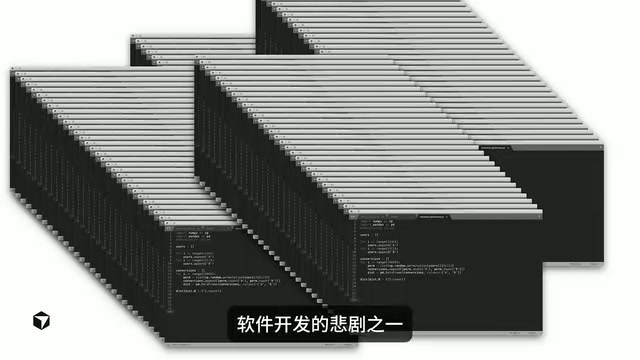
Just a few years ago, the only way to develop software was for programmers to manually write formal programming languages. A feature that could be described to a human in a few paragraphs often required tens of thousands of lines of logic to implement. Professional software engineers routinely dealt with modifying and maintaining codebases of tens of millions of lines — the fundamental reason product managers have long been frustrated with development speed.
Tab completion (autocomplete) was the first phase of AI-assisted programming. It helped programmers quickly type a few characters or lines of code, essentially improving "typing efficiency." Code autocomplete technology has gone through multiple generational evolutions: the earliest IDEs (Integrated Development Environments) like Visual Studio and Eclipse offered deterministic completion based on syntax rules and symbol tables — type an object name followed by a dot, and a list of that object's methods would appear. Around 2018, completions based on statistical language models began to emerge, capable of predicting the next token based on context. The launch of GitHub Copilot in 2021 marked the mainstream arrival of large language model-driven completion, which could predict entire lines or even entire blocks of code. Cursor further optimized context window management and codebase indexing on top of this, significantly improving completion quality. But no matter how intelligent, the essence of Tab completion remains "human-led, AI-assisted" — the programmer decides what to write, and AI helps write it faster.
The Agent Era: Wholesale Delegation
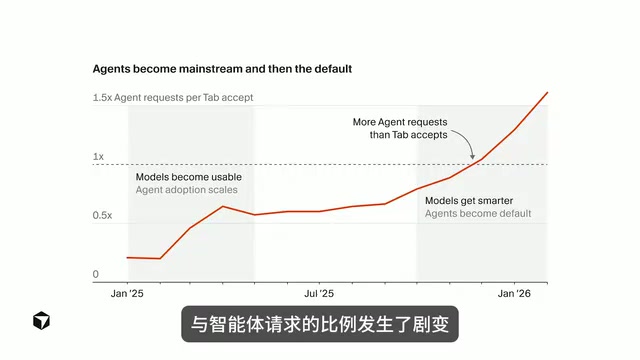
The latest data reveals a dramatic shift: Agent request volume has grown more than 15x year-over-year. At the beginning of the year, Tab completion usage was still 10x that of Agent requests; now, Agent requests have surpassed Tab completion.
The significance of this reversal goes far beyond the numbers themselves — because a single Agent request typically corresponds to a large, complete chunk of work, while a single Tab completion might be just a few characters. Engineers are no longer editing code line by line; instead, they're handing entire task descriptions to AI Agents for execution.
Understanding the difference between Agent requests and Tab completion requires looking at two dimensions: task granularity and autonomy. Tab completion is a reactive interaction: human input triggers an AI prediction, the AI generates a few tokens to a few lines of code, and the human decides whether to accept. Throughout the process, the human maintains complete control over the code flow. An Agent request is a delegative interaction: the human describes a complete task in natural language (e.g., "refactor the error handling logic in this module"), and the Agent autonomously plans execution steps, reads relevant files, writes code, runs tests, fixes errors, and delivers a complete result. Agents possess multi-step reasoning, tool-calling, and self-correction capabilities — essentially functioning as software engineering entities with bounded autonomy.
The Teams Era: Autonomous Collaboration
Even more cutting-edge changes are already happening inside Cursor: currently, 30% of the company's PRs (Pull Requests) are completed entirely end-to-end by Agents, with zero human intervention. These Agents have their own cloud computing environments and can work independently for hours or even days to complete a task.
Pull Requests are a core collaboration mechanism in modern software engineering, originating from the Git distributed version control workflow. When a developer completes a feature or fix, they commit code changes on an independent branch and then initiate a PR to request merging those changes into the main branch. A PR is not just a technical code-merging operation — it's a critical quality control checkpoint where other team members review code logic, architectural consistency, test coverage, and potential security issues. A typical PR might contain dozens to hundreds of lines of code changes across coordinated modifications to multiple files. When Cursor says 30% of PRs are completed end-to-end by Agents, it means these Agents can not only write code but also understand project context, follow coding conventions, write tests, and generate meaningful commit messages.
Traditional AI programming assistants run on a developer's local machine, constrained by local computing resources and session duration — close the laptop, and the Agent stops working. Cursor's Teams mode migrates the Agent runtime environment to cloud sandboxes (similar to GitHub Codespaces or remote development containers), where each Agent has its own independent file system, terminal, network access, and computing resources. This architecture enables Agents to work continuously for hours or even days, unconstrained by human work rhythms. More importantly, cloud environments support massive parallelism — launching dozens of Agent instances simultaneously, each handling a different task branch, with final coordination and merging through version control systems. This essentially extends the concept of Continuous Integration/Continuous Deployment (CI/CD) into the development phase itself.
This means software development is entering the "Teams Era" — your team no longer consists of just a few thousand human engineers, but simultaneously includes tens of thousands of "ghost colleagues" working in parallel.
What 75% AI-Generated Code Really Means
Among Cursor's enterprise customers, the proportion of AI-generated code has leaped from approximately 15%-20% about a year ago to 75% today. Human engineers are barely touching code syntax directly anymore, instead delegating work to Agents.
The core implications of this data:
- Role transformation: Engineers are becoming "Agent managers," with core responsibilities shifting to delegating tasks, reviewing results, and managing parallel workflows
- Time allocation shift: Engineers spend more time on code review, testing builds, and quality control
- Increased parallelism: From the Agent era's 1-3 simultaneous Agents (limited by local computing environments) to the Teams era's ability to coordinate dozens of independently working Agents
Risks and Challenges: Speed Does Not Equal Quality
The Cursor team also candidly pointed out the risks in this transformation. Pushing automation forward without proper controls could lead to:
- Generating large volumes of unsustainable code
- Poor architectural decisions
- Bug-ridden deliverables
As a result, the human engineer's review role has become more important than ever. This isn't a story about "AI replacing humans" — it's a story about "human value shifting from execution to judgment." There's a classic problem in software engineering known as "technical debt": rapidly generated code that lacks sound architectural design and consistency creates exponentially growing modification costs during subsequent maintenance. When AI generates code at unprecedented speed, the rate of technical debt accumulation can multiply as well. This requires human engineers to not only review individual PRs for correctness but also maintain system-level oversight of architectural evolution, module boundary definitions, and long-term maintainability — precisely the high-level decisions that current AI struggles most to make autonomously.
The Ultimate Experiment: Fully Autonomous Development Without Human Involvement
Cursor also shared a highly forward-looking experiment: having an Agent team spend an entire week building a web browser from scratch with absolutely no human involvement.
Experiment results:
- 3 million lines of code generated
- Multiple Agents collaborating concurrently
- From being unable to correctly render apple.com on day one, to ultimately producing a basically functional web rendering system
Building a web browser from scratch is widely recognized as one of the most complex engineering challenges in computer science. A modern browser needs to implement an HTML parser, CSS layout engine, JavaScript runtime, network protocol stack, GPU-accelerated rendering pipeline, security sandbox, and dozens of other subsystems. Chromium (Chrome's open-source foundation) contains over 35 million lines of code, developed by thousands of engineers over more than a decade. While the 3 million lines of code generated by Agents in Cursor's experiment fall far short of a production-grade browser's completeness, the fact that it could "basically render web pages correctly" is itself profoundly significant — it proves that multi-Agent collaborative systems can handle complex engineering tasks requiring deep systems-level knowledge and cross-module coordination, rather than being limited to isolated, small-scale programming problems.
The team emphasized that this experiment is "very early stage and not ready for production," but it explores the boundaries of what fully autonomous development can achieve and provides important reference points for Cursor's product design in the Teams era.
Implications for the Industry
These data points reveal not just the evolution of a tool, but a fundamental shift in the working paradigm of the entire software industry:
- Changing hiring logic: The future demands not just engineers who are "great at writing code," but talent who excels at "decomposing tasks, reviewing code, and managing AI workflows"
- Organizational restructuring: When each human engineer can manage dozens of Agent colleagues, the relationship between team size and output will be redefined
- Reassessing development velocity: "A team of a few people building products that previously required hundreds" is no longer a slogan — it's a reality unfolding right now
Software development is experiencing its "Star Wars moment" — technology is not merely improving efficiency quantitatively, but qualitatively redefining how the entire industry operates.
Key Takeaways
Related articles
Vibe Coding in Practice: A Junior Student Uses Cursor to Build a Multi-Agent System with 51 AI Officials Based on the Three Departments and Six Ministries Framework
A junior student uses Cursor and Vibe Coding to build a multi-agent system with 51 AI officials modeled on China's Three Departments and Six Ministries, featuring task distribution, approval workflows, and Token cost visualization.

How to Connect Codex to DeepSeek Models: Free Switching via CC Switch
Learn how to connect OpenAI Codex to DeepSeek models via CC Switch, enabling free switching between DeepSeek and GPT with complete setup and routing guide.

AI Coding Deployment Guide: A Complete Hands-On Workflow from Local Demo to Live Website
Most AI Coding tutorials stop at local demos. This guide walks through 8 key steps to deploy an AI-powered 3D figurine website from Codex coding to live server deployment.