Deep Dive into Claude Code's Open-Source Architecture: Six Core Design Principles and Engineering Practices Revealed

Claude Code's open-source reveals complete engineering practices for building industrial-grade AI Agents
Claude Code's "passive open-sourcing" of 510,000 lines of code provides an industrial-grade reference standard for AI Agent development. Its core architecture includes a dual-loop system, seven-step tool execution pipeline, four-layer permission protection, progressive token compression strategies, tool-based multi-agent collaboration, and a tiered memory system, demonstrating how to transform a probabilistic system into a reliable production system through layered engineering safeguards.
A "Passive Open-Sourcing" That Changed the Agent Landscape
The open-sourcing of Claude Code marks a milestone in the AI Agent field. Unlike Meta's Llama open-sourcing that sparked China's "hundred-model war," or DeepSeek R1's open-sourcing that popularized chain-of-thought models, Claude Code represents a "passive open-sourcing" — exposing top-tier industrial-grade Agent engineering practices directly to developers.
By "passive open-sourcing," we mean that Anthropic didn't proactively open-source Claude Code for strategic promotion purposes. Rather, since the CLI tool was distributed as an npm package, the code was technically decompilable and auditable, and the community had already begun extensively analyzing its internal implementation. Under these circumstances, Anthropic chose to officially release the source code, enabling developers to legally and completely study its engineering practices. This stands in stark contrast to Meta's proactive Llama open-sourcing to capture ecosystem share, or DeepSeek's R1 open-sourcing to demonstrate technical prowess.
What does this mean? Just as Llama taught everyone "how to build large models," Claude Code teaches everyone "how to build industrial-grade Agents." We can expect high-quality Agent framework reproductions to spring up rapidly, with domestic Agent development capabilities quickly catching up to international standards.
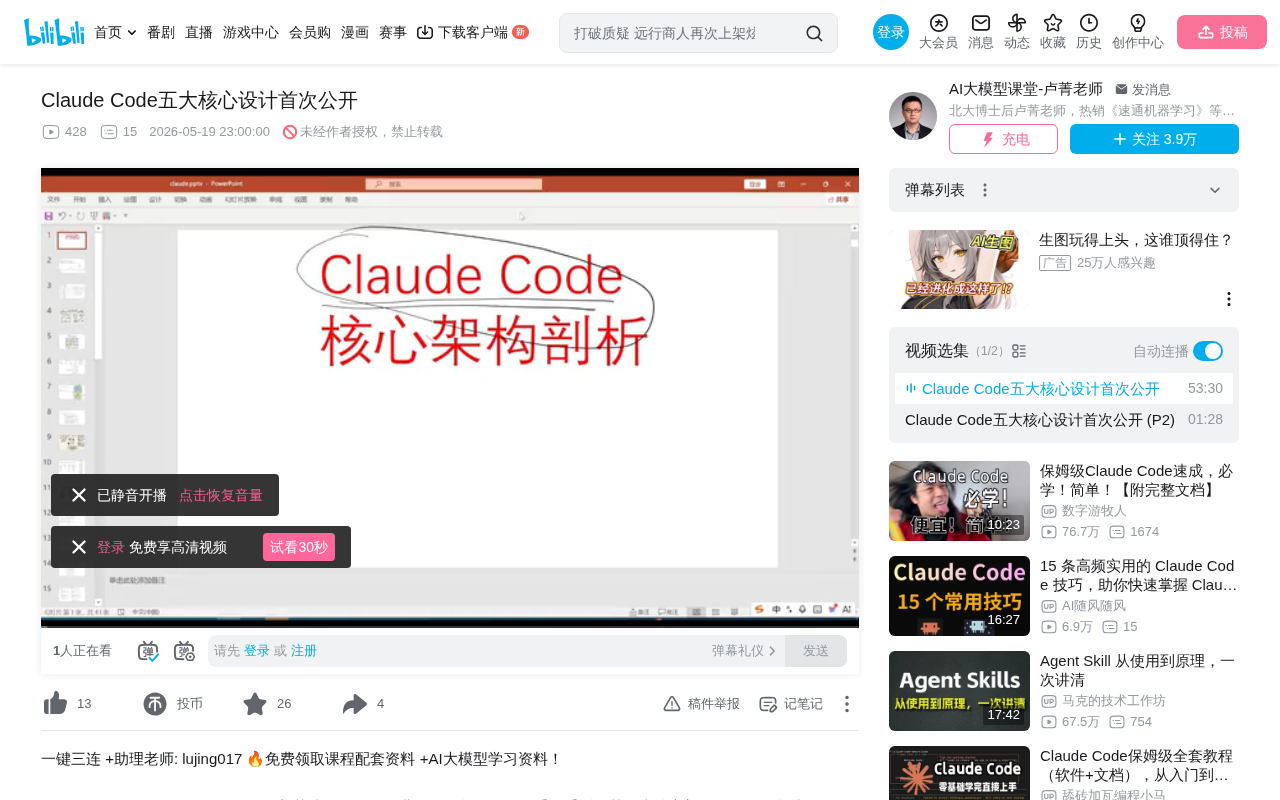
Six Design Principles: Platform-Oriented Agent Architecture
With over 510,000 lines of code, Claude Code's overall architecture embodies six core design principles:
1. Platform, Not a Single Product: Claude Code is fundamentally a platform that provides services through multiple interfaces — command line, SDK, MCP, and more — rather than a closed, monolithic tool. MCP (Model Context Protocol) is an open standard protocol introduced by Anthropic in late 2024, designed to unify communication between large models and external data sources/tools. Similar to how USB-C unified physical connectors, MCP aims to standardize tool interfaces for AI applications, allowing developers to wrap any service as a standardized tool for Agent invocation.
2. Strict Tool Governance Pipeline: Permission management and execution control for tools reaches an extreme level of sophistication — this is the most critical engineering highlight.
3. Institutionalized Behavior: All specifications must be written into documentation (such as claude.md), preventing the model's randomness from taking over and maintaining highly consistent behavior.
4. Controlled Context Management: Through compression and memory systems, context is always kept within manageable bounds.
5. Specialized Sub-Agent Division of Labor: Seven or eight types of sub-agents are designed, each responsible for different types of work.
6. Ecosystem-Aware Extension: Newly added tools, MCPs, or Skills are automatically registered and discoverable.
This design is essentially what the industry calls a "Harness" — a comprehensive set of protective technologies built around stable Agent operation. In the AI Agent domain, a Harness refers to the complete set of engineering safeguards and management mechanisms built around the core Agent loop, including permission control, error recovery, resource management, audit logging, and other non-functional but production-critical components. The quality of the Harness directly determines whether an Agent can graduate from a lab prototype to a reliable production system — this is also the biggest gap between academic Agent research and industrial Agent products.
Dual-Loop Architecture: The Leap from Simple to Industrial-Grade
Core Loop Mechanism
Claude Code's runtime architecture is a classic dual-loop system:
- Outer Loop: Multi-turn interaction with the user — user asks, system responds
- Inner Loop: Tool execution loop — a single user instruction may trigger multiple tool calls
The simplest Agent implementation is a Function Call loop: receive message → call LLM → determine whether to invoke a tool → execute tool → loop. Function Call is the core mechanism for LLM-external tool interaction — when a model determines it needs to perform an operation (like reading a file or searching the web), it doesn't output the result directly but generates a structured function call request containing the function name and parameters. The external system executes the function and returns the result for the model to continue reasoning. OpenAI first introduced this mechanism in June 2023, and it has since become the foundational paradigm for Agent development.
But Claude Code layers over a dozen protective mechanisms on top of this simple loop, addressing four core problems:
- Execution Risk: Security incidents like accidental file deletion or misoperations
- Context Overflow: Token overflow from long-running tasks
- Unexpected Interruptions: Work loss due to network failures, power outages, etc.
- Efficiency Issues: Queuing problems from serial execution across multiple users
Three Checkpoint Mechanisms
Each loop iteration includes three critical checkpoints:
- Cost Check: Whether tokens have exceeded the budget cap
- Context Overflow Check: Triggers proactive compression
- Progress Persistence: Writes to disk to prevent accidental loss
This explains why Claude Code "burns money" — reportedly someone spent over $1,000 in a single morning demo. But it's precisely these safeguards that transform the system from a "random system" into a "stable system."
Tool Execution Pipeline: Seven-Step Security Assurance
Streaming Parallel Innovation
Claude Code introduces an important innovation in tool execution: streaming execution mode. Traditional Agent frameworks like LangChain use a "batch execution" approach: waiting for the LLM to fully output all tool call plans before uniformly dispatching execution. This approach is simple to implement but has higher latency, since tool execution must wait for model generation to complete.
Claude Code's streaming execution borrows from the streaming processing philosophy — the LLM outputs token by token, and when the system detects the first complete tool call structure, it immediately begins execution while the model continues generating subsequent calls. This "semi-parallel" strategy significantly reduces end-to-end latency while maintaining safety.
Tools are classified into two categories:
- Concurrency-safe: Such as file read operations, which can execute in parallel
- Non-concurrency-safe: Such as write operations, which must execute serially
Seven-Step Execution Pipeline Explained
Every tool call goes through a strict seven-step process:
- Parameter Validation: Checks whether input parameters are compliant
- Security Audit: Security-level inspection
- Hook Script Interception: Secondary judgment from external interception requests
- Permission Verification: Confirms operation permissions
- Tool Execution: Actually performs the operation
- Post-processing: Modifies and optimizes execution results
- Logging: Complete recording of the operation process
Four-Layer Permission Protection System
The permission system features four layers of protection, analogous to corporate security:
- Layer 1 (Corporate Security Policy): Global security rules, e.g., cannot delete databases
- Layer 2 (Badge Access): Specific permission configurations
- Layer 3 (Security Guard Inquiry): Real-time user confirmation for dangerous operations
- Layer 4 (Tool Self-Check): The tool's own permission verification
Token Management: Four-Layer Progressive Compression Strategy
50 rounds of conversation can reach 100,000 tokens — an astonishing consumption rate. Even though the most advanced models now support 128K or even 200K context windows, token consumption remains a core bottleneck in real Agent scenarios. A single file read might produce thousands of tokens, a code search result might consume tens of thousands, and combined with multi-turn conversation history accumulation, consumption far exceeds expectations. More critically, token count directly correlates with API call costs — taking Claude 3.5 Sonnet as an example, a single call with 100K input tokens costs approximately $0.30, and costs accumulate rapidly under high-frequency usage.
Claude Code designed four progressively heavier compression strategies to address this challenge:
- Deduplication: Remove duplicate tool call results (simplest, pure code implementation)
- Keep Only Final Results: Delete intermediate processes, retain only the tool's final output
- Content Offloading to Disk: Store content in disk files, keeping only file pointers in the window, reading back when needed (progressive loading)
- Summary Compression: Call the LLM to summarize old history while preserving the completeness of recent conversations
The first three don't require LLM calls and can be implemented with simple code; only the fourth requires model involvement, embodying the engineering philosophy of "save where you can." The core logic of this layered design is: each compression layer loses some information precision, so lightweight methods with minimal information loss are prioritized, and heavier strategies are only escalated when lightweight methods cannot meet space requirements.
Multi-Agent System: Tool-Based Collaboration Model
Four Isolation Modes
Claude Code treats sub-agents as a special type of tool, designing four runtime isolation modes:
- Lightweight Isolation: Inherits the main agent's context
- Directory Isolation: Each agent can only modify specific modules, avoiding conflicts
- Process Isolation: Distributed execution, tasks can run on different machines
- Logical Isolation: Collaboration and information exchange between teams
This design philosophy of treating sub-agents as tools is fundamentally different from popular academic multi-agent frameworks (like AutoGen, CrewAI). The latter typically model agents as autonomous entities with independent personalities and goals, completing tasks through conversational negotiation. Claude Code's approach is more engineering-oriented — a sub-agent is simply a callable function with clear input/output contracts, and the main agent has complete control over it. This design sacrifices some flexibility but gains higher predictability and debuggability.
Six Functional Roles
Specific agents are divided into six functional roles:
- General task execution
- Exploration and research (read-only permissions)
- Planning (structured output)
- Verification (testing code correctness)
- Usage guidance
- State configuration
Memory System: Simple but Practical Tiered Design
claude.md Tiered Loading
The core of the memory system is the claude.md file, prioritized as follows:
- User-level: Personal coding preferences
- Project-level: Team-wide standards (higher priority than user-level)
- Local notes
- Subdirectory-level: Closest to the current task, highest priority
Loading rule: The closer to the current task scope and the narrower the rule, the higher its priority. This design borrows from the classic "configuration override" pattern in software engineering — similar to CSS cascading rules or Git's local/global/system three-tier override mechanism, ensuring the most specific rules always take precedence.
Automatic Memory and the "Sleep Consolidation" Mechanism
The system automatically generates memory.md files, using indexes to point to specific memory files. The innovative "Out of Dream" mechanism runs passively in the background — when 5 new conversations occur within 24 hours, it automatically triggers memory consolidation: eliminating redundancy, resolving contradictions, and converting vague time expressions to specific timestamps.
The naming of this mechanism is inspired by neuroscience findings about how the human brain consolidates memories during sleep. Research shows that during deep sleep stages, humans consolidate, deduplicate, and reorganize information acquired during the day. Claude Code borrows this concept, automatically triggering memory consolidation during Agent inactive periods, thereby maintaining memory quality and consistency and preventing gradual memory degradation over extended use.
Memory System Limitations
Frankly, the current memory system remains quite simple: only 200 lines of storage capacity, keyword-only retrieval (no semantic search), memory silos that cannot be shared across tools, and details that are easily lost. It's essentially still short-term memory with significant room for future optimization. By comparison, the industry already has more advanced memory solutions — such as semantic retrieval based on vector databases, knowledge graph structured storage, and the hierarchical virtual memory management proposed by MemGPT. Claude Code's choice of such a simple implementation is likely driven by engineering stability considerations: simpler systems are less prone to errors, and memory system errors (like recalling incorrect information) can be more dangerous than having no memory at all.
Summary and Outlook
The core value of Claude Code's 510,000 lines of code lies not in algorithmic innovation, but in engineering excellence taken to the extreme. It demonstrates how to transform a "random system" into a "stable production system" through layer upon layer of safeguards. However, it's worth noting that much of the code is "paying down technical debt" — patching historical issues. If rebuilt from scratch, the codebase could be significantly streamlined.
The significance of this open-sourcing for the industry is clear: Agent development now has an industrial-grade reference standard. Regardless of what type of intelligent agent you're building, Claude Code's dual-loop architecture, tool governance pipeline, permission layering, and token management designs are all worth deep study. More importantly, it proves that the core challenge of Agent productization at the current stage isn't model capability, but engineering governance — how to make a probabilistic system behave as reliably as a deterministic system in real-world environments. This is a challenge every Agent developer must face.
Related articles
 Industry Insights
AI Product Development in Practice: Model Selection, Building Moats, and Paths to Commercialization
Practical strategies for AI product development: why not to train models from scratch, when to use APIs vs. fine-tuning, building product moats, and the full path from evaluation systems to commercialization.
 Industry Insights
No Product Fits Your Needs? Building It Yourself Is the Best Starting Point for Indie Developers
Can't find a product that fits? Building from personal pain points is the best entry for indie developers. Niche needs + AI tools = rapid product creation.
 Industry Insights
OpenAI Codex Tutorials Mass-Copied on Bilibili, Highlighting AI Content Farm Problem
At least 9 Bilibili accounts mass-published identical OpenAI Codex tutorial videos, exposing content farm operations in the AI tools space.