EU Energy Regulation Controversy: The Tug-of-War Between Climate Policy and Tech Productivity
EU AC restrictions spark productivity debate; tech innovation may be the key to breaking the impasse.
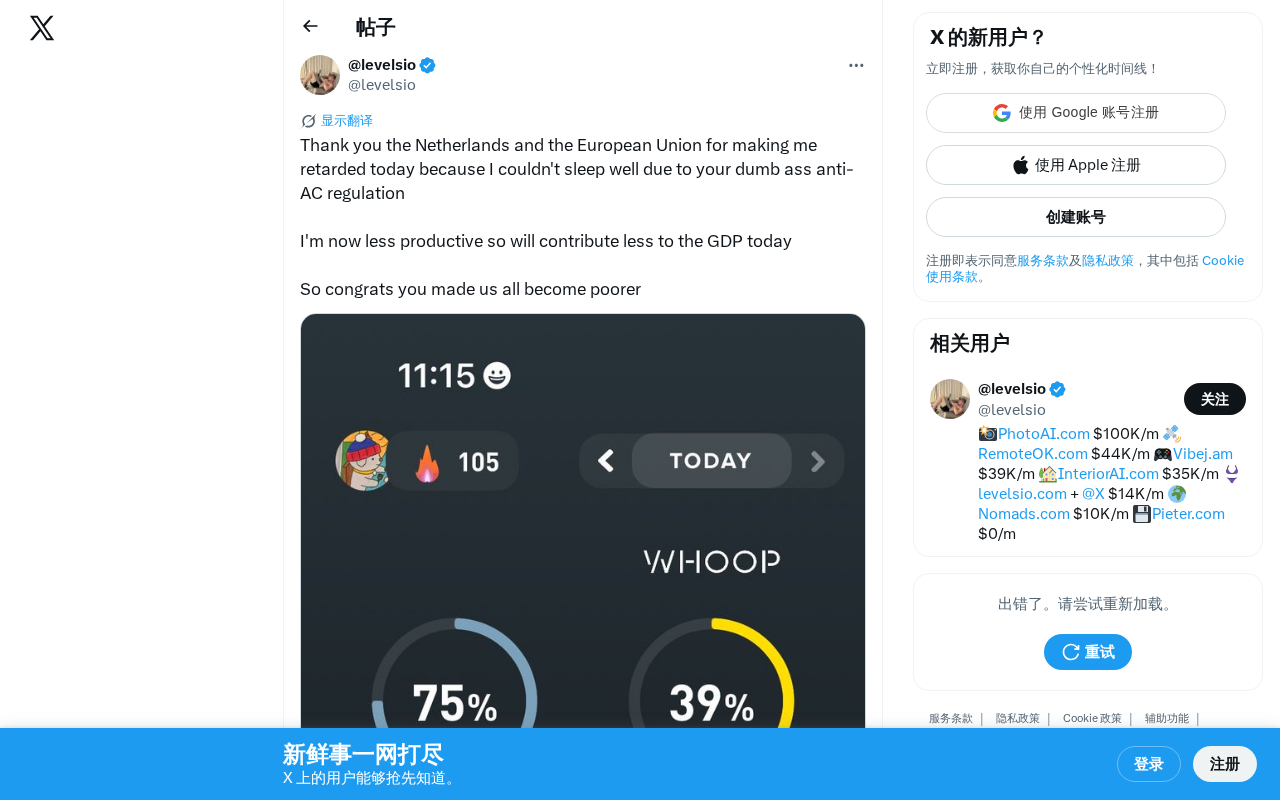
A Netherlands-based tech professional's complaint about EU air conditioning restrictions hurting sleep and work efficiency has ignited a debate over the tension between climate policy and productivity. Scientific research confirms that high temperatures impair deep sleep, directly affecting tech workers' cognitive performance. However, solutions like high-efficiency inverter ACs, AI-driven smart climate control, and radiative cooling show that sustainability and comfort need not be at odds — the key is policies that incentivize innovation rather than impose blanket restrictions.
A Tweet That Sparked a Debate: Energy Regulations vs. Productivity
Recently, a tech professional based in the Netherlands took to social media to complain that EU air conditioning restrictions were preventing them from getting a proper night's sleep, which in turn was hurting their next-day work efficiency and productivity. What might seem like an emotional rant actually touches on a deeper issue — the tension between climate and energy policy and the productivity of the tech industry.
Background on EU Energy Regulations: AC Restrictions Under Carbon Neutrality Goals
The EU has long been a global leader in climate policy. To achieve its carbon neutrality targets, the EU and its member states have introduced a series of energy-use restrictions, including energy efficiency requirements and usage standards for building air conditioning systems.
At the core of this regulatory framework is the Energy Performance of Buildings Directive (EPBD), which requires member states to assign energy efficiency ratings to buildings and gradually phase out low-efficiency structures. The 2023 revision mandates that all new buildings meet "zero-emission" standards by 2028. Additionally, the Ecodesign Regulation sets mandatory minimum energy efficiency standards for air conditioning equipment, while the EU Energy Label system guides consumers through an A-to-G rating scale. On top of this, the Netherlands has layered its own building energy performance standards (BENG standards), imposing additional limits on the cooling loads of new and renovated buildings — making it one of the strictest member states in the EU for enforcement.
The original intent of these energy regulations is to reduce carbon emissions and combat climate change. However, in practice, some provisions can impact residents' daily comfort, especially during summer heat waves.
Productivity Loss: An Underestimated Hidden Cost
The Scientific Link Between Sleep Quality and Work Efficiency
Extensive research shows that indoor temperature has a significant impact on sleep quality. The ideal sleeping temperature typically falls between 18–22°C. When ambient temperatures are too high, the body struggles to enter deep sleep, leading to reduced cognitive ability and impaired concentration the following day.
There are profound neurophysiological mechanisms behind this phenomenon. Deep sleep (slow-wave sleep) is the critical window during which the brain clears metabolic waste — including β-amyloid proteins associated with Alzheimer's disease — and is the core period for memory consolidation and synaptic pruning. Rising ambient temperatures inhibit the drop in core body temperature, which is a necessary physiological signal for triggering deep sleep. Studies show that for every 1°C increase in bedroom temperature, slow-wave sleep duration decreases by approximately 5% on average. For software engineers and AI researchers who rely on intensive logical reasoning, prefrontal cortex function is particularly sensitive to sleep deprivation, directly affecting the quality of higher-order cognitive tasks such as code review and architectural decision-making. Programming, system design, AI model tuning, and similar work are highly dependent on focus and logical thinking, and the cognitive impairment caused by sleep deprivation can translate directly into lower code quality, poor decision-making, and other tangible problems.
Macroeconomic Considerations
A Harvard University study estimated that productivity losses caused by high temperatures amount to hundreds of billions of dollars annually. When policies restrict people's means of coping with heat, these losses can be further amplified. While the tweet author's claim that regulations "make us all poorer" may be an exaggeration, the underlying economic logic is not entirely without merit.
Technical Solutions: Finding Balance Between Climate Policy and Innovation
Rather than making an either-or choice between "going green" and "staying comfortable," the tech industry is exploring a third path:
-
High-efficiency AC technology: The latest generation of inverter air conditioners has achieved a Coefficient of Performance (COP) above 5.0, dramatically reducing energy consumption. COP is the core metric for measuring AC system efficiency, representing the number of kilowatt-hours of heat transferred per kilowatt-hour of electricity consumed. Inverter technology uses permanent magnet synchronous motors and digital controls to dynamically adjust compressor speed based on real-time cooling demand, avoiding the energy waste caused by frequent start-stop cycles. Efficiency gains are especially significant under partial-load conditions, with overall energy consumption reduced by 30%–50% compared to traditional fixed-speed units.
-
Smart climate control systems: AI-driven Building Energy Management Systems (BEMS) can minimize energy consumption while maintaining comfort. Through predictive control algorithms, these systems combine weather forecasts, user behavior patterns, and building thermal inertia to proactively adjust indoor temperatures, shifting cooling loads to off-peak electricity pricing periods for dual optimization of comfort and energy savings.
-
Passive cooling technologies: Radiative cooling materials, phase-change energy storage, and other advanced material technologies offer cooling solutions that don't rely on traditional air conditioning. Radiative cooling leverages the atmospheric window (8–13 micrometer wavelength band) to radiate heat directly into outer space. Research from Stanford University has demonstrated multilayer nanophotonic thin films that can achieve passive cooling nearly 5°C below ambient temperature under direct midday sunlight — with zero electricity input. Phase Change Materials (PCMs) exploit the large amount of latent heat absorbed during solid-liquid phase transitions, storing coolness during nighttime low temperatures and releasing it during the day. This is a key technology pathway supported by the EU's "Renovation Wave" strategy.
-
Renewable energy integration: Solar-powered air conditioning systems have the most abundant energy supply precisely when cooling demand is highest, creating a natural supply-demand match that fundamentally addresses the carbon emissions problem of cooling energy consumption.
These technical solutions demonstrate that reducing carbon emissions and ensuring residential comfort are not irreconcilable. The key lies in whether policymakers are willing to leave sufficient room for technological innovation.
Conclusion: Good Energy Policy Should Incentivize Innovation, Not Apply Blanket Restrictions
While the tweet was emotionally charged, it reveals a question worth pondering: good policy shouldn't simply "ban" or "restrict" — it should leave room for technological innovation. Between climate goals and human well-being, technological innovation is the true bridge. The EU may need to focus more on how to incentivize technology upgrades when crafting energy regulations, rather than applying one-size-fits-all usage restrictions.
Key Takeaways
- EU air conditioning energy regulations (centered on the EPBD) have sparked frustration among tech professionals over productivity losses
- Sleep quality is closely linked to tech workers' cognitive performance — high temperatures directly impair prefrontal cognitive function by suppressing slow-wave sleep
- AI-driven smart climate control and high-efficiency inverter cooling technologies can strike a balance between environmental protection and comfort
- Passive technologies such as radiative cooling and phase-change energy storage represent new directions beyond the traditional AC paradigm
- Policymaking should leave room for technological innovation rather than simply restricting usage
Related articles
 Industry Insights
AI Product Development in Practice: Model Selection, Building Moats, and Paths to Commercialization
Practical strategies for AI product development: why not to train models from scratch, when to use APIs vs. fine-tuning, building product moats, and the full path from evaluation systems to commercialization.
 Industry Insights
No Product Fits Your Needs? Building It Yourself Is the Best Starting Point for Indie Developers
Can't find a product that fits? Building from personal pain points is the best entry for indie developers. Niche needs + AI tools = rapid product creation.
 Industry Insights
OpenAI Codex Tutorials Mass-Copied on Bilibili, Highlighting AI Content Farm Problem
At least 9 Bilibili accounts mass-published identical OpenAI Codex tutorial videos, exposing content farm operations in the AI tools space.