Europe's Hotel AC Limit at 23°C: When Degrowth Ideology Collides with Tech Innovation
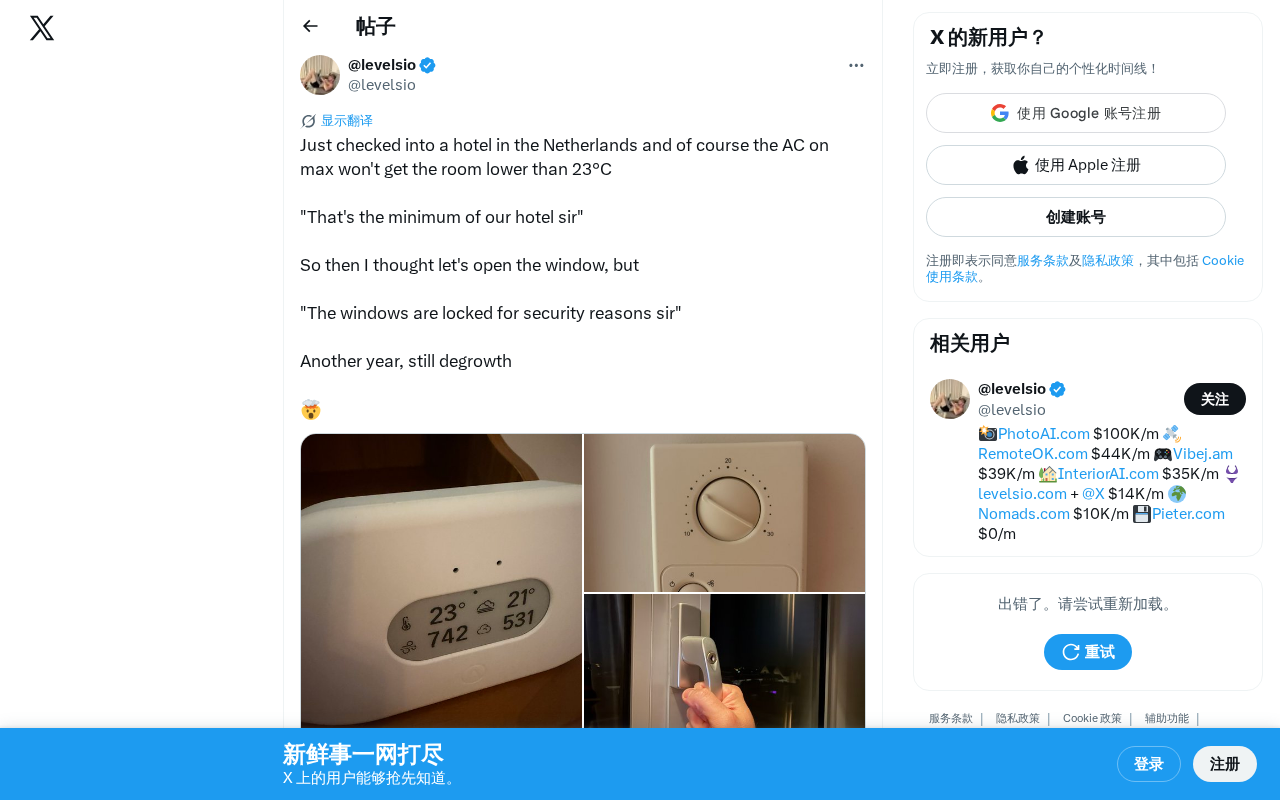
Dutch hotel AC limits spark debate on degrowth ideology versus tech innovation as energy-saving paths.
A tech professional's complaint about a Dutch hotel's 23°C minimum AC setting sparked discussion about the tension between degrowth ideology and technological innovation. Europe has institutionalized degrowth principles into building energy efficiency regulations, taking a direct consumption-limiting approach, while the tech world favors solving problems through AI and innovation — though the Jevons Paradox shows efficiency gains may be offset by consumption growth. The article argues both paths should work together, with AI smart building management potentially making hard restrictions unnecessary.
A Tweet That Sparked Reflection: The Collision Between Tech and Degrowth
Recently, a tech industry professional shared their experience staying at a Dutch hotel on social media: the air conditioning could only be set as low as 23°C, and the windows were locked shut for safety reasons. What seemed like an ordinary complaint sparked a wide-ranging discussion about the tension between "Degrowth" ideology and technological development.
What Is Degrowth? Why Does the Tech World Care So Much?
"Degrowth" isn't simply an "anti-growth" slogan — it's an economic school of thought with deep academic roots. Its theoretical origins trace back to the Club of Rome's 1972 report The Limits to Growth, as well as French philosopher Serge Latouche's systematic framework of the "degrowth" concept in the early 21st century. The core argument is that within Earth's ecological carrying capacity, GDP growth can — and perhaps should — be decoupled from human well-being, with high-consumption industries actively contracted.
At the policy level, the EU's European Green Deal and the Energy Performance of Buildings Directive (EPBD) have already partially institutionalized degrowth principles — requiring member states to set mandatory energy consumption caps for commercial buildings. The Dutch hotel's AC temperature restriction is a concrete implementation of this regulatory framework, not an isolated decision by a single hotel. This complete chain from academic concept to legislative constraint is one of the most significant differences between Europe and other regions in climate policy.
For tech professionals accustomed to the "technology solves everything" mindset, this approach of addressing problems through restriction rather than innovation often feels deeply uncomfortable. The tweet's author expressed this cultural shock with a single emoji: "🤯".
Two Energy-Saving Paths Compared: Restriction vs. Innovation
The Restriction Path: Setting Direct Energy Consumption Caps
Many European countries have adopted strategies that directly limit energy consumption. Dutch hotels setting the minimum AC temperature at 23°C is essentially a mandatory energy-saving measure. This approach is simple, direct, and produces quantifiable results — but it sacrifices user experience and personal choice.
The Technology Path: Solving Energy Problems Through Innovation
The tech industry prefers solving energy consumption problems through technological innovation — more efficient compressors, AI-driven smart climate control systems, novel cooling materials, and more. This path doesn't require sacrificing comfort, but involves long R&D cycles, high costs, and efficiency gains that are often offset by larger-scale consumption.
This involves a key economic concept — the Jevons Paradox. First proposed by British economist William Stanley Jevons in his 1865 book The Coal Question: improvements in steam engine efficiency didn't reduce Britain's coal consumption — instead, by lowering usage costs, they stimulated even larger-scale industrial expansion, causing total consumption to rise dramatically. This paradox remains highly relevant in the modern tech context: LED bulbs are 80% more efficient than incandescent ones, yet global electricity consumption for lighting hasn't declined; smartphone chip energy efficiency doubles every two years, yet global data center electricity consumption still grows at roughly 10% annually. This is the core argument degrowth supporters use to insist that "technological efficiency improvements alone cannot solve the problem," and it's key to understanding the deep tension between these two paths.
AI and Smart Energy Management: Can the Two Paths Converge?
Interestingly, AI technology is creating new possibilities for merging these two approaches. Modern Building Management Systems (BMS) have evolved from traditional timed on/off controls to multi-layered AI decision architectures: the base layer consists of IoT sensor networks collecting data on temperature, humidity, CO₂ concentration, and occupant locations; the middle layer comprises edge computing nodes handling real-time local data processing and executing millisecond-level control commands; the top layer is a cloud-based AI model responsible for predictive optimization across time dimensions — for example, pre-adjusting cooling strategies based on weather forecasts, or shifting loads based on grid peak/off-peak electricity pricing. For hotel scenarios, such systems can also integrate PMS (Property Management System) occupancy data to pre-condition rooms to target temperatures 30 minutes before guest arrival, ensuring comfort while avoiding the waste of running AC in empty rooms for extended periods.
Google's DeepMind reduced data center cooling energy consumption by 40% — and the technical approach behind this achievement deserves attention. In 2016, DeepMind applied Reinforcement Learning to data center cooling systems, analyzing real-time data from thousands of sensors — including server loads, outdoor temperature and humidity, cooling tower status, and electricity prices — to train AI agents to autonomously determine cooling equipment operating parameters. Compared to traditional rule-based control systems, the AI system can identify nonlinear correlations that human engineers struggle to perceive. The key significance of this case is that the energy savings came from "using existing equipment more intelligently" rather than replacing hardware or restricting usage. If similar technology were applied to hotel scenarios, it might achieve equal or even better energy savings without imposing hard temperature floors.
The Deeper Issues Behind Cultural Differences
This tweet resonated because it touches on a more fundamental question: facing climate change and resource constraints, should we choose to "use less" or "use more intelligently"?
The answer may not be either/or. Europe's restrictive policies provide short-term emissions reduction guarantees — during the transition period before AI building management systems achieve widespread adoption, hard rules at least lock in a baseline level of energy savings. Meanwhile, technological innovation offers hope for long-term solutions, potentially breaking the zero-sum game between "comfort and energy consumption" at a fundamental level. The real challenge lies in making these two paths work synergistically during the transition period, rather than positioning them as adversaries.
For tech professionals, rather than complaining about the 23°C AC limit, the better question is: how can technology make that limit unnecessary?
Key Takeaways
- A Dutch hotel's minimum 23°C AC setting sparked tech industry discussion about degrowth ideology
- Degrowth principles, rooted in academic traditions like The Limits to Growth, have been translated into concrete policy through the EU's Energy Performance of Buildings Directive
- The Jevons Paradox reveals the deep risk that technological efficiency gains may be offset by expanding consumption scale
- AI-powered smart building management systems, through multi-layered sensing and decision architectures, may achieve a better balance between energy savings and comfort
- AI technologies like Google DeepMind have proven they can dramatically reduce cooling energy consumption without sacrificing user experience
- Restrictive policies and technological innovation should work synergistically rather than in opposition
Related articles
 Industry Insights
AI Product Development in Practice: Model Selection, Building Moats, and Paths to Commercialization
Practical strategies for AI product development: why not to train models from scratch, when to use APIs vs. fine-tuning, building product moats, and the full path from evaluation systems to commercialization.
 Industry Insights
No Product Fits Your Needs? Building It Yourself Is the Best Starting Point for Indie Developers
Can't find a product that fits? Building from personal pain points is the best entry for indie developers. Niche needs + AI tools = rapid product creation.
 Industry Insights
OpenAI Codex Tutorials Mass-Copied on Bilibili, Highlighting AI Content Farm Problem
At least 9 Bilibili accounts mass-published identical OpenAI Codex tutorial videos, exposing content farm operations in the AI tools space.