Five Design Patterns for Long-Running AI Agents: From Checkpoint Recovery to Cluster Orchestration

Google Cloud Next 26 unveils 7-day AI Agent state persistence with five production-grade design patterns
Google Cloud Next 26 announced AI Agent runtime leaping from seconds to 7-day persistence, along with five core design patterns: checkpointing and recovery, delegated approval, hierarchical memory governance, ambient processing, and cluster orchestration. Combined with infrastructure like Agent Identity, Registry, and Gateway, these patterns transform AI Agents from demo-level apps into reliable production enterprise systems, now available on the Gemini Enterprise Agent platform.
Google Cloud Next 26 brought exciting news: AI Agent runtime has leaped from seconds to a full 7 days of state persistence. This means AI can finally handle complex enterprise workflows spanning days or even weeks, just like human employees. This article provides an in-depth analysis of the five core design patterns announced at the conference, helping developers transform fragile demo prototypes into robust production-grade systems.
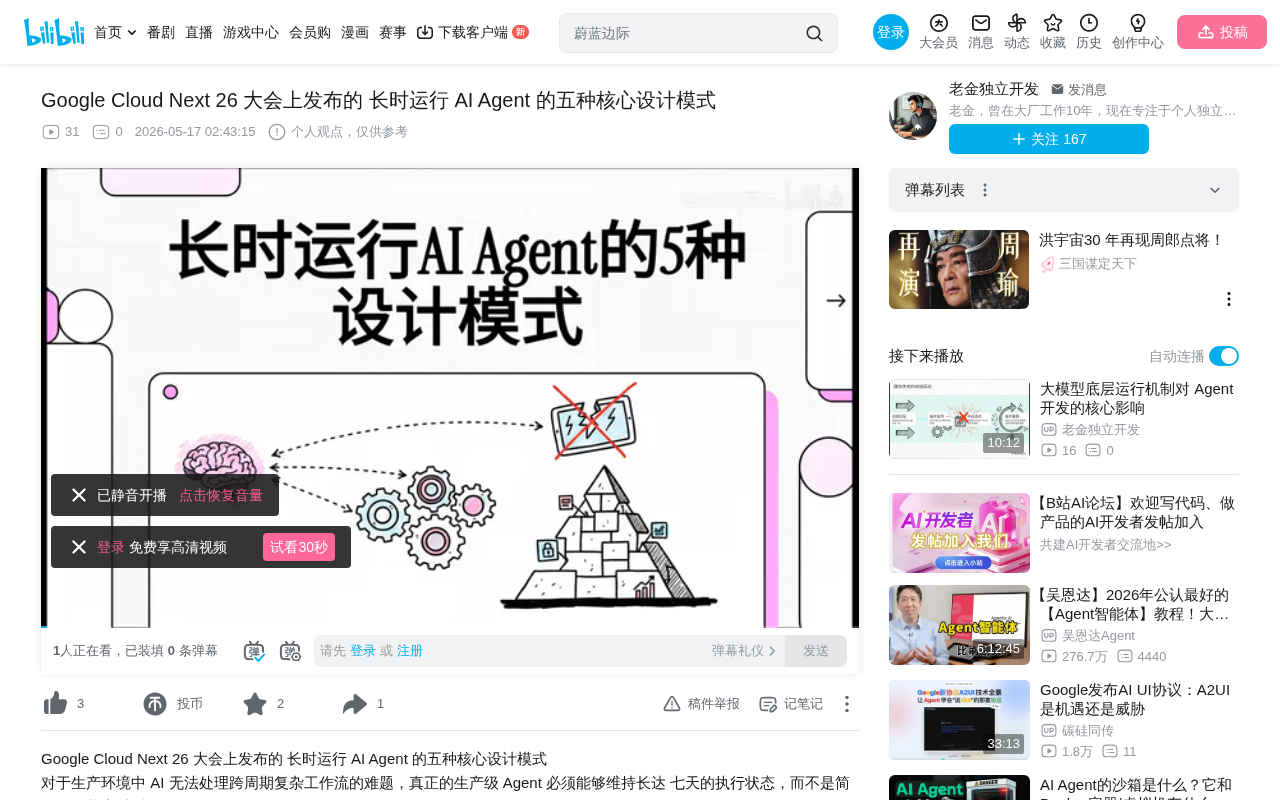
The Long-Running Dilemma: A Paradigm Shift from Stateless to Stateful
Most AI applications today remain stuck in the "stateless demo" phase—each conversation lasts only seconds, and after a single-turn interaction ends, the critically important reasoning chain is discarded. On the next interaction, the system must rebuild context from the database, which is extremely inefficient.
However, real enterprise workflows are entirely different. Processing thousands of insurance claims or running a sales pipeline spanning weeks—these scenarios absolutely require the system to persistently retain reasoning chains, soft signals, confidence scores, and other key information. If your system crashes on day five of continuous operation, all your prior prompt optimization and response tuning becomes meaningless.
The Agent Runtime update announced by Google at Cloud Next 26 directly addresses this pain point: supporting up to 7 days of state persistence—a quantum leap. AI Agents finally have the ability to work continuously across business days.
Pattern 1: Checkpointing and Recovery — The Safety Net for Multi-Day Workflows
What's the biggest fear when running multi-day workflows? Sudden errors and total context loss. The Checkpointing and Recovery pattern is designed precisely for this.
The system leverages the Runtime's secure cloud sandbox and full file system access to write intermediate state directly to disk. Developers can set policies—for example, writing a state snapshot every 50 documents processed. This way, even if the system encounters an unexpected error while processing document #201, there's no need to start over—it seamlessly resumes from the last checkpoint.
The core value of this pattern: it reduces the "cost of failure" from "redo everything" to "roll back to the nearest snapshot," dramatically improving the reliability of long-running tasks.
Pattern 2: Delegated Approval — An Elegant Human-in-the-Loop Solution
In enterprise systems, "Human-in-the-Loop" is a hard requirement. But traditional approaches are extremely fragile—send a JSON webhook and silently pray someone notices in time.
The Delegated Approval pattern fundamentally changes this through Mission Control's inbox mechanism. When an Agent hits a blocking point requiring human approval, it safely pauses in place—working memory, reasoning chains, and pending tasks are all frozen and preserved.
Here's a compelling set of numbers:
- Agent pauses at hour 8, awaiting human approval
- The approver might not process it until 24 hours later
- Zero compute resource consumption during the pause
- After approval at hour 32, the Agent resumes with millisecond-level cold start speed
True zero-latency recovery with zero resource waste—the implications for cost control are obvious to everyone.
Pattern 3: Hierarchical Memory Governance — Giving Agents an Enterprise-Grade Brain
An Agent that can run continuously for a week must have a hierarchical memory system:
- Memory Bank: Serves as long-term memory, persisting across sessions, dynamically generated and organized by topic
- Memory Profile: Serves as working memory, responsible for low-latency, high-precision extraction of specific details needed for the current task
This is like how humans have both a vast reservoir of general knowledge and short-term memory actively processing current tasks—working together seamlessly.
Three Lines of Defense for Memory Governance
However, powerful memory capabilities also introduce risks. Multiple Agents reading and writing freely in a shared memory pool can easily cause memory drift or even data leakage. As a core principle states: "You absolutely cannot let Agents dump data into vector databases unconstrained. From day one, you must govern Agent memory the same way you govern microservices."
To address this, three new infrastructure components were introduced at the conference:
-
Agent Identity: Similar to an IAM system, issuing each Agent a cryptographic identity credential that precisely restricts which memory banks and tools it can access, cutting off privilege escalation risks at the source.
-
Agent Registry: Plays the same role as service discovery in microservice architectures. When dozens of long-running Agents are operating simultaneously, the registry provides a global view—who's online, which prompt version they're running, what execution state they've reached—all at a glance.
-
Agent Gateway: An API gateway purpose-built for large language models, positioned between Agents and the memory pool. Before any request executes, it proactively intercepts and evaluates based on organizational policies. For example, if an Agent attempts to write data containing sensitive personal information into long-term memory, the gateway immediately blocks it.
Pattern 4: Ambient Processing — Tireless Event-Driven Agents
Not all Agents are built for "chatting." Agents under the Ambient Processing pattern are more like tireless "watchdogs"—they connect directly to BigQuery or Pub/Sub data streams, running continuously in the background for days, actively listening for and processing a constant flow of events.
These event-driven Agents don't need manual prompt input to trigger them; they autonomously respond to changes in data streams. Typical use cases include content moderation, anomaly detection, and real-time data pipeline processing. This pattern transforms Agents from "passive responders" into "proactive executors," dramatically expanding the application boundaries of AI Agents.
Pattern 5: Cluster Orchestration — Multi-Agent Collaborative Operations
When task complexity maxes out, a single Agent working alone is no longer realistic. The Cluster Orchestration pattern enables multiple specialized Agents to work collaboratively.
Take sales prospecting as an example. A typical cluster formation includes:
- Coordinator Agent: The "brain" that oversees the entire operation
- Lead Discovery Agent: Responsible for finding potential customers
- Research Agent: Deep-diving into customer information
- Outreach Agent: Proactively sending emails
- Scoring Agent: Rating customer intent
These specialist Agents have clear divisions of labor, jointly driving a complex sales sequence that spans multiple days.
Cluster orchestration also offers an extremely practical operational advantage: since each specialist Agent has an independent identity and is strictly governed by the gateway, they can be safely isolated in their own containers. This means you can update a single Agent's code logic completely independently—even if a deployment has minor issues, it won't affect the entire cluster. This microservice-style isolated deployment strategy is critical for production environment stability.
From Theory to Practice: Already Deployable on the Gemini Enterprise Agent Platform
The most exciting part is that all the patterns described above—7-day state persistence, sophisticated hierarchical memory management, visual governance through Mission Control—are no longer just visions in a whitepaper. They can be run in production right now on the Gemini Enterprise Agent platform.
When AI Agents truly break free from the constraints of single-turn conversations and have a full 7 days to think deeply, plan, and take sustained action, the imagination space for enterprise AI applications will be blown wide open. From end-to-end insurance claims automation, to cross-cycle sales management, to 24/7 data stream monitoring—long-running Agents are redefining AI's role in the enterprise: no longer a "Q&A tool," but a true "digital employee."
Related articles
 Industry Insights
AI Product Development in Practice: Model Selection, Building Moats, and Paths to Commercialization
Practical strategies for AI product development: why not to train models from scratch, when to use APIs vs. fine-tuning, building product moats, and the full path from evaluation systems to commercialization.
 Industry Insights
No Product Fits Your Needs? Building It Yourself Is the Best Starting Point for Indie Developers
Can't find a product that fits? Building from personal pain points is the best entry for indie developers. Niche needs + AI tools = rapid product creation.
 Industry Insights
OpenAI Codex Tutorials Mass-Copied on Bilibili, Highlighting AI Content Farm Problem
At least 9 Bilibili accounts mass-published identical OpenAI Codex tutorial videos, exposing content farm operations in the AI tools space.