Forward Deployed Engineer (FDE): Breaking Down the Hot New Role AI Giants Are Fighting Over
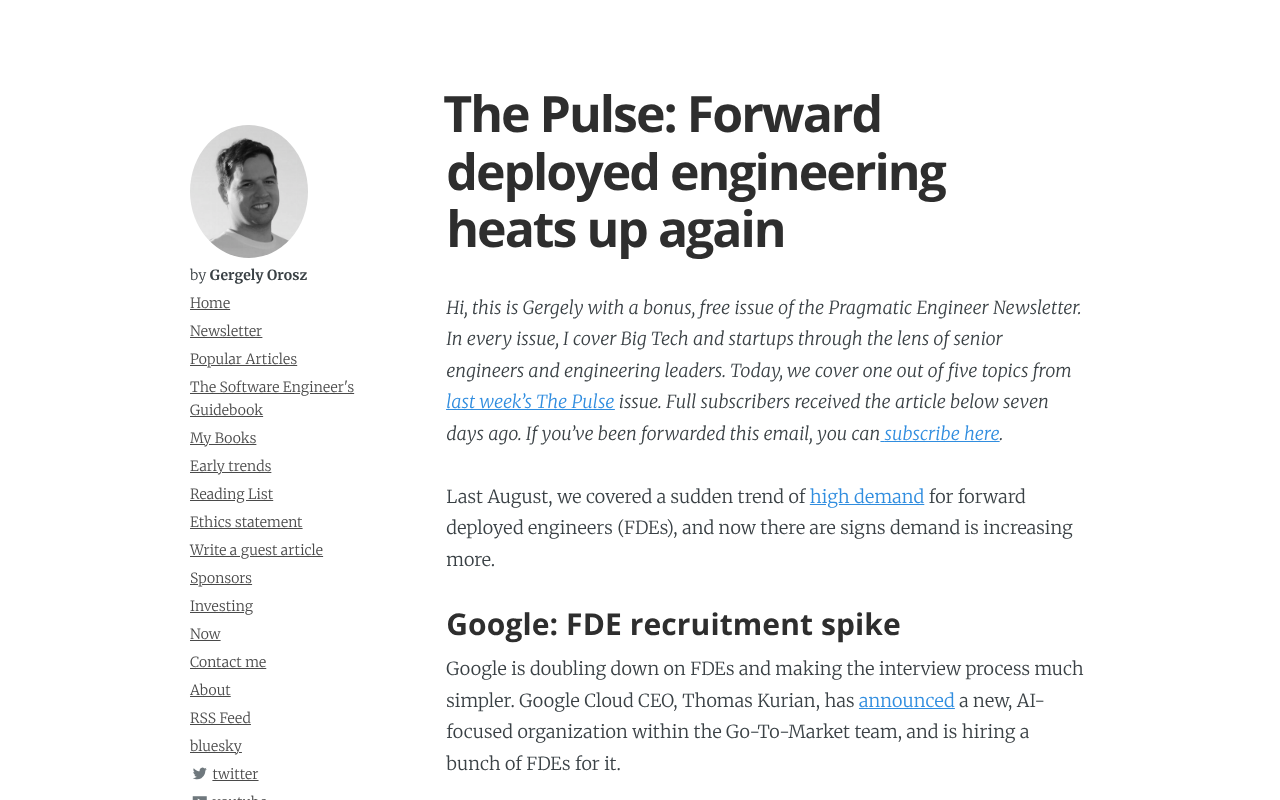
AI giants are racing to hire Forward Deployed Engineers to bridge the gap between powerful models and real-world enterprise deployment.
Forward Deployed Engineers (FDEs) — originally pioneered by Palantir — are now among the most in-demand roles at Google, OpenAI, and Anthropic. As AI shifts from a technology race to a commercialization race, FDEs serve as the critical bridge between powerful models and production-ready enterprise solutions. The role is also evolving to be more accessible to junior engineers, signaling a broader industry shift toward valuing hybrid skills over pure research expertise.
What Is a Forward Deployed Engineer (FDE)?
As the AI industry evolves at breakneck speed, a once-niche technical role is experiencing explosive growth — the Forward Deployed Engineer (FDE). According to a recent report from The Pulse, AI giants like Google, OpenAI, and Anthropic are hiring aggressively for this role, with market demand at an all-time high.
The FDE concept was originally popularized by Palantir Technologies, referring to engineers who are stationed directly at client sites to implement and deploy the company's technology products. Palantir is a U.S.-based data analytics company founded in 2003 by Peter Thiel (co-founder of PayPal) and others, initially serving U.S. intelligence agencies and defense departments. Palantir's core products, Gotham and Foundry, require deep integration with clients' complex data systems, and government and military clients typically operate in highly customized, security-sensitive environments where traditional remote technical support simply doesn't cut it. It was in this context that Palantir pioneered the FDE model — deploying engineers directly to client sites, embedding them in client workflows much like military advisors. This model proved remarkably effective; at one point, Palantir's FDE team accounted for over one-third of the company's total engineering headcount, becoming a key pillar of its commercial success.
In short, FDEs aren't backend developers writing code at headquarters. They're "technical special forces" who go deep into the business frontlines, understand client needs, and rapidly deliver solutions.
Why Are AI Companies Hiring FDEs Like Crazy?
The "Last Mile" Problem of Deploying Large Models
Whether it's the GPT series, Claude, or Gemini, large language models are already impressively powerful. But there's a massive gap between "impressive demo" and "production-ready." LLMs look stunning in demo environments, but the challenges of enterprise deployment are far more complex than most people imagine. First, there are data security and compliance issues — industries like finance and healthcare have strict regulatory requirements around data privacy (such as HIPAA and GDPR), and model deployment must satisfy these compliance frameworks. Then there's the complexity of system integration — enterprises typically run dozens or even hundreds of legacy systems (ERP, CRM, data warehouses, etc.), and AI models need to interface seamlessly with these systems to deliver value. On top of that, there are engineering challenges like hallucination control, latency optimization, cost management, and output consistency. According to McKinsey research, roughly 70% of AI proof-of-concept projects fail to make it into production — a statistic that underscores just how severe the "last mile" problem really is.
Enterprise clients need more than just an API endpoint. They need complete solutions that deeply integrate with their existing business systems and meet the demands of specific use cases. Forward Deployed Engineers are the key to bridging this gap. Their core responsibilities include:
- Understanding client business scenarios: Gaining deep insight into real pain points across vertical industries like finance, healthcare, and manufacturing
- Rapid prototyping: Building customized solutions on top of the company's AI products
- Technical evangelism and support: Helping client teams understand and adopt AI technology
- Feeding back product iterations: Relaying frontline requirements back to product and R&D teams
The Core Battleground of AI Commercialization
The competitive landscape in AI has shifted from "whose model is more powerful" to "who can better serve enterprise clients." Since 2024, the race to commercialize AI has entered a white-hot phase. OpenAI's annualized revenue has surpassed several billion dollars, with enterprise revenue growing as a share of the total — ChatGPT Enterprise and API services have become core growth engines. Anthropic has adopted a more enterprise-focused strategy, leveraging Claude's advantages in safety and controllability to win significant enterprise adoption in high-compliance industries like finance and law. Google, meanwhile, is leveraging its existing enterprise customer base on Cloud to deeply embed Gemini into cloud services like Vertex AI.
What these three companies have in common is this: the gap in model capabilities is narrowing, while customer service and deployment capabilities are becoming the core differentiators. Gartner predicts that by 2026, over 80% of enterprises will be using generative AI in production environments, signaling the formation of a massive deployment services market. Whoever can help enterprise clients get AI use cases up and running fastest will seize the advantage in the commercialization race.
The Evolution of the FDE Role: New Opportunities from Senior Experts to Junior Engineers
A Subtle Shift in Role Positioning
Notably, The Pulse points out that the latest iteration of the FDE role increasingly resembles a consultant/solutions architect position staffed by junior engineers. This shift is significant.
Early FDEs were typically seasoned senior engineers with deep technical expertise and extensive industry experience. But as AI tools themselves have become more user-friendly — with low-code/no-code integration solutions maturing and SDKs and documentation improving — the technical barrier for FDEs is lowering. Behind this shift is the rapid maturation of the AI integration tool ecosystem. Frameworks like LangChain and LlamaIndex have dramatically simplified the process of building complex architectures such as RAG (Retrieval-Augmented Generation) and Agents. Major AI companies are also continuously refining their SDKs and developer tools — OpenAI's Assistants API, Anthropic's Tool Use feature, Google's Vertex AI Extensions — all reducing the technical complexity of enterprise integration. At the same time, the rise of automation platforms like Zapier and Make, along with low-code AI workflow tools (such as Dify and Flowise), means that many scenarios that previously required deep custom development can now be quickly implemented through configuration.
The maturation of these tools means the FDE's focus is shifting from low-level technical implementation to business understanding and solution design, with the role placing greater emphasis on communication, coordination, and rapid delivery.
Career Implications for Junior Engineers
This trend offers several important takeaways for tech professionals planning their careers:
- A new career entry path: For engineers just starting out, FDE offers a unique career track — one that provides exposure to cutting-edge AI technology while building rich industry experience and client communication skills
- Compound skills matter more than pure technical ability: Raw coding ability is no longer the sole measure of value. Understanding business contexts, learning quickly, and communicating effectively — these "soft skills" are equally critical
- Traditional consulting is under pressure: Traditional IT consulting firms (such as Accenture, Deloitte, McKinsey Digital, IBM Consulting, etc.) have long relied on "army-of-consultants" models and industry knowledge moats to command premium consulting fees. But the FDE model at AI companies is disrupting this business model on two fronts: on one hand, FDEs at AI companies have direct access to the most cutting-edge technical capabilities, while traditional consulting firms often need to learn and translate these secondhand; on the other hand, AI companies are willing to offer FDEs highly competitive compensation — according to Levels.fyi data, total compensation packages for FDEs at top AI companies can reach $200,000–$400,000, far exceeding the salary levels of equivalent consultants at traditional firms. This talent siphoning effect is already visible, with several consulting firms' AI practice teams experiencing notable attrition.
Industry Trends and Future Outlook
The Deeper Signal Behind the FDE Boom
The surge in FDE hiring fundamentally reflects the AI industry's transition from a technology-driven phase to a commercialization-driven phase. As model capabilities converge, the winners will be determined by who can better serve clients and create business value faster.
The AI industry is undergoing a profound structural shift in talent demand. During the "foundation model arms race" of 2020–2023, top AI researchers and large-scale distributed training engineers were the scarcest talent. But as foundation model training has become highly concentrated among a handful of companies (OpenAI, Anthropic, Google DeepMind, Meta FAIR, etc.), and as open-source models (such as Llama, Mistral, Qwen, etc.) have rapidly advanced, the marginal demand growth for pure research talent has slowed. Meanwhile, the innovation space at the AI application layer is expanding explosively — from intelligent customer service to code generation, from drug discovery to financial risk management, every vertical domain needs hybrid talent who understand both AI technology and industry-specific business needs. Stanford's HAI 2024 Annual Report notes that growth in "application and deployment" AI roles has already outpaced "research and development" roles.
This means the talent demand structure in AI is undergoing a fundamental transformation:
- Demand growth for research-oriented talent is slowing (foundation model training is already highly centralized)
- Demand for application-oriented talent is surging (deployment scenarios are infinitely diverse)
- Bridge talent (i.e., FDEs) is becoming the scarcest resource
Relevance to the Chinese AI Market
Chinese AI companies face similar deployment challenges. Companies like Baidu Intelligent Cloud, Alibaba Tongyi, and ByteDance may not use the "FDE" title per se, but they are actively hiring for similar roles — solutions architects, technical account managers, AI application engineers, and the like. As China's large model market enters a shakeout phase following the "hundred-model war," the room for differentiation at the model layer is shrinking, and deployment service capability is becoming the decisive factor in commercial success. Understanding the essence of the Forward Deployed Engineer role can help professionals in China better navigate their career direction.
Conclusion
The FDE boom isn't a passing hiring fad — it's an inevitable product of the AI industry entering a new stage. When technology is no longer the bottleneck, the people who can translate technology into business value will become the most sought-after talent. For tech professionals, cultivating compound capabilities across "technology + business + communication" may be the best strategy for riding this wave.
Related articles

Firestore Enterprise Edition Query Engine: A Deep Dive into Full-Text Search, Subqueries, and Pipeline Operations
Deep dive into Firestore Enterprise Edition's new query engine covering full-text search, subquery Joins, and pipeline operations with practical recipe app examples.
Enterprise AI Agent Architecture in Practice: Sandbox Isolation and Skill Management Explained
Deep dive into enterprise AI agent architecture covering HARIS task decomposition, sandbox isolation, Skill persistence, MCP tool integration, and user-level memory systems.
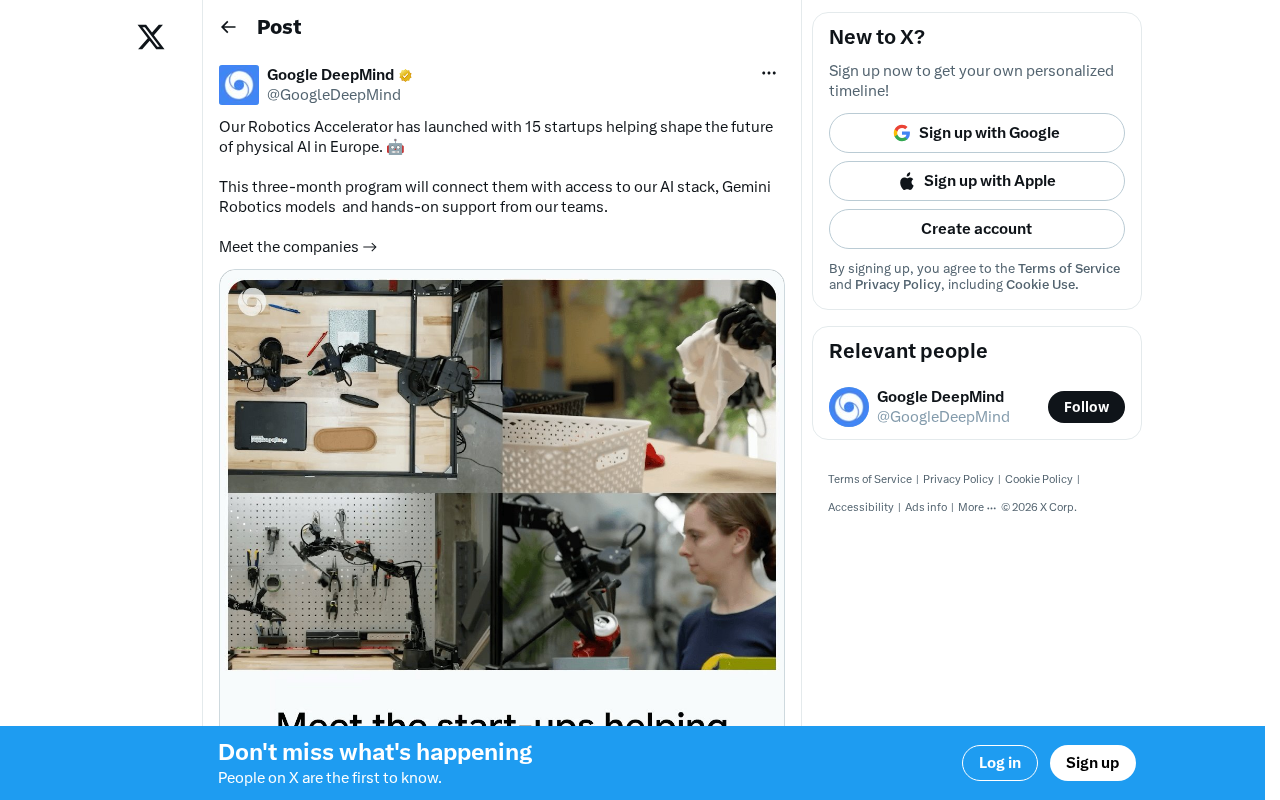
Google Launches European Robotics Accelerator: 15 Startups Selected as the Physical AI Race Begins
Google launches its European Robotics Accelerator with 15 startups selected. The program offers Gemini Robotics models, AI stack access, and team support to advance Physical AI.