Gamified Learning with NotebookLM: Activate Your Notes Using the Sherlock Holmes Deduction Method
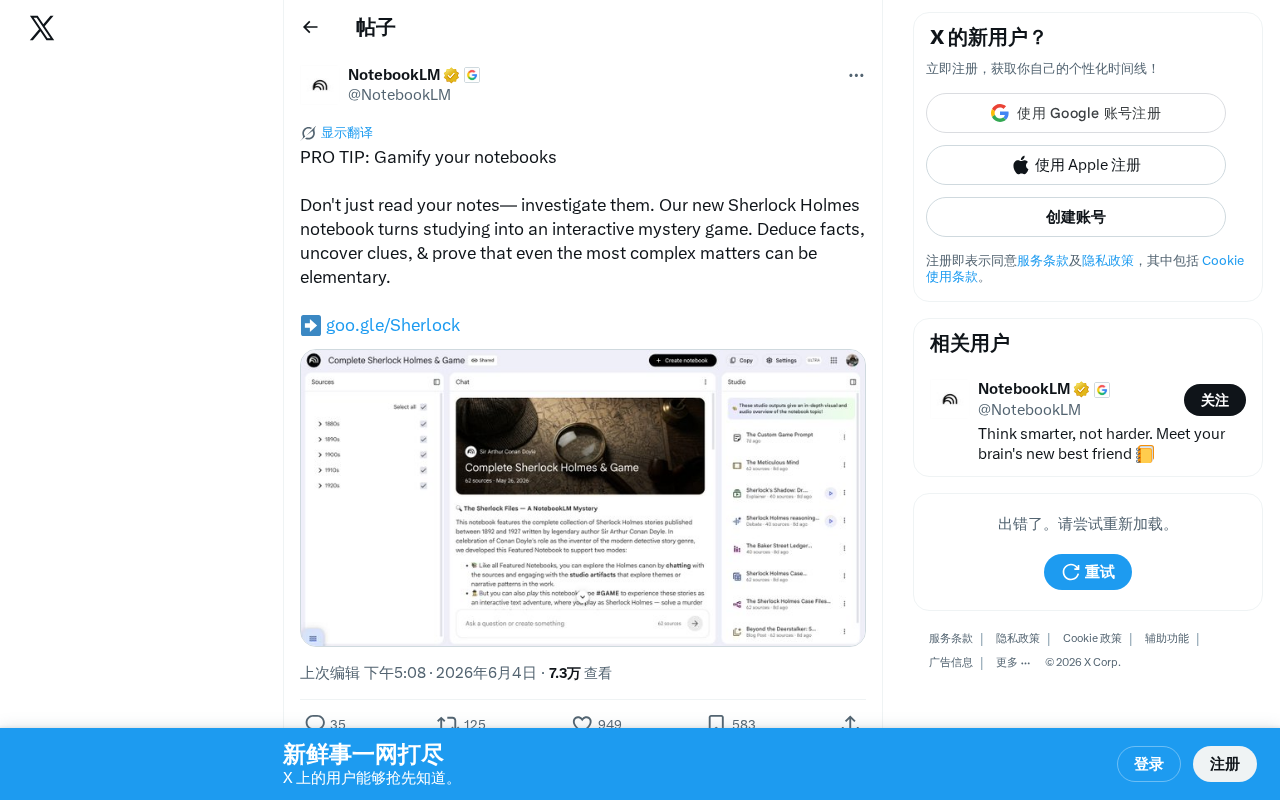
NotebookLM's Sherlock Holmes template turns note review into an interactive deduction game for better learning.
Google NotebookLM has released a Sherlock Holmes Notebook template that gamifies learning by transforming passive note review into interactive detective-style deduction. Using a three-step method — Deduce, Uncover, Prove — the approach leverages cognitive science principles like active recall and spaced repetition, wrapped in an engaging narrative framework to boost knowledge retention and learner engagement.
When Notes Become a Detective Game
The Google NotebookLM team recently shared a creative learning technique: gamifying your notebook. They've released a "Sherlock Holmes Notebook" template that transforms traditional note reading into an interactive deduction game, making the learning process as engaging as solving a case.
Google NotebookLM is an AI-powered research and note-taking assistant tool launched by Google Labs in 2023, originally named Project Tailwind. Built on Google's Gemini large language model, its core feature allows users to upload their own documents (PDFs, Google Docs, web links, etc.) as knowledge sources. The AI answers questions and performs analysis based solely on user-provided materials rather than relying on general training data, which significantly reduces AI hallucination issues. In 2024, NotebookLM went viral after launching its Audio Overview feature (automatically converting notes into two-person conversational podcasts), demonstrating AI's enormous potential in content format transformation. Now, the release of gamified learning templates marks yet another exploration in learning experience innovation for this tool.
The core idea behind this approach is simple — don't just passively read your notes, actively "investigate" them. By deducing facts and uncovering clues, even the most complex learning material becomes "elementary" — Sherlock Holmes' classic line.
The Design Philosophy of Gamified Learning
From Passive Reading to Active Exploration
Traditional note review is often linear and passive: open your notes, read from start to finish, highlight key points, then close the book. The problem with this approach is that the brain lacks sufficient engagement, resulting in low information retention.
Gamification in Education, as a pedagogical methodology, applies game design elements — such as points, levels, narrative, and challenges — to non-game contexts. Its theoretical foundation draws from multiple psychological frameworks: Csikszentmihalyi's Flow Theory suggests that when challenge difficulty matches skill level, people enter a highly focused flow state; Deci and Ryan's Self-Determination Theory identifies autonomy, competence, and relatedness as the three key drivers of intrinsic motivation. Gamified learning activates these psychological mechanisms simultaneously by setting clear goals, providing immediate feedback, and creating narrative contexts, binding dopamine release to the knowledge acquisition process, thereby enhancing engagement and memory retention.
The core transformation in gamified notes lies in:
- Deduce: Rather than giving answers directly, clues guide you to derive conclusions
- Uncover: Knowledge points are packaged as "clues" to be discovered, adding a sense of exploration
- Prove: You're required to use chains of evidence to verify whether your understanding is correct
Why Detective Mode Works for Learning
Cognitive science research shows that active recall and spaced repetition are the most effective learning strategies. The Sherlock Holmes-style notebook essentially wraps these learning science principles in an engaging framework.
Looking deeper, Active Recall refers to the process of actively retrieving information from memory without prompts, rather than simply re-reading material. Research by Karpicke and Blunt published in Science in 2011 demonstrated that active recall produces learning outcomes over 50% better than concept mapping and repeated reading. Spaced Repetition, based on Ebbinghaus's forgetting curve theory, schedules reviews just as memories are about to decay, achieving maximum long-term memory retention with minimal time investment. The combination of both — conducting active recall exercises at spaced intervals — is recognized by the cognitive science community as the most efficient learning strategy combination. Flashcard tools like Anki are built on this principle, while NotebookLM's detective mode wraps the same principles in a more narrative-driven experience.
Specifically, the Sherlock Holmes Notebook design activates these learning principles through the following mechanisms:
- Question-driven: Each "case" is a question that needs answering, triggering active recall
- Evidence collection: Forces you to return to your notes to find supporting information, strengthening information encoding
- Logical reasoning: Requires connecting fragmented information into complete knowledge chains, building deep understanding
- Immediate feedback: Clear right/wrong judgments on whether the case is solved create a learning feedback loop
How to Practice Gamified Learning in NotebookLM
Basic Steps
Users can experience this gamified learning approach directly through NotebookLM's official template. Here's how:
- Upload your learning materials to NotebookLM
- Use the Sherlock Holmes Notebook template
- The system will transform your note content into interactive deduction questions
- Complete knowledge review and consolidation by "solving cases"
Applicable Scenarios
This method is particularly suited for the following learning contexts:
- Concept-intensive subjects: Fields requiring memorization of large amounts of facts, such as law, medicine, and history
- Logic and reasoning content: Programming, mathematics, scientific principles
- Exam preparation: Turning tedious practice problems into engaging deduction games
A New Paradigm for AI-Assisted Learning
This case demonstrates an important trend for AI tools in education — not simply helping you summarize or generate content, but redesigning the learning experience itself.
From a broader perspective, AI applications in education have gone through several distinct phases: early adaptive learning platforms (like Knewton and ALEKS) primarily used algorithms to adjust question difficulty; AI writing assistants of the early 2020s (like Grammarly and Quillbot) focused on content generation assistance; while the new generation of tools represented by ChatGPT and NotebookLM have begun redefining learning interaction modes themselves. The key shift in this evolution is that AI is no longer just a content transporter or simplifier, but has become a learning experience designer — it can dynamically generate personalized learning paths, interactive formats, and assessment methods based on user materials, achieving a paradigm leap from "AI helps you learn" to "AI helps you design how to learn."
NotebookLM's journey from an initial note organization tool, to audio podcast generation, to now gamified learning, has consistently explored how AI can make knowledge acquisition more efficient and engaging. This product evolution clearly embodies one principle: the same knowledge content, presented through different interaction formats, can activate entirely different cognitive channels and emotional engagement in learners.
For individual learners, this is also a worthwhile approach to adopt: regardless of what tools you use, trying to transform passive information consumption into active knowledge exploration can significantly improve learning outcomes. Gamification doesn't make learning superficial — it leverages humanity's innate curiosity and sense of achievement to drive deeper understanding.
Key Takeaways
Related articles
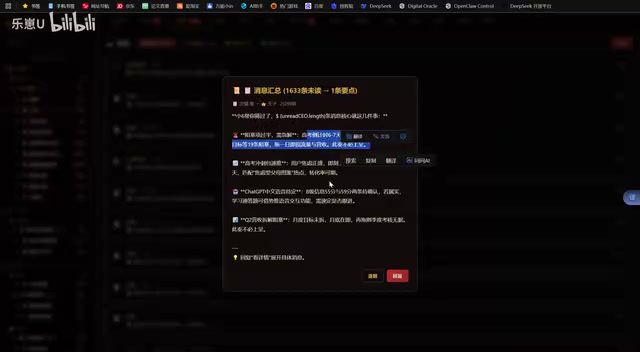
Vibe Coding in Practice: A Junior Student Uses Cursor to Build a Multi-Agent System with 51 AI Officials Based on the Three Departments and Six Ministries Framework
A junior student uses Cursor and Vibe Coding to build a multi-agent system with 51 AI officials modeled on China's Three Departments and Six Ministries, featuring task distribution, approval workflows, and Token cost visualization.
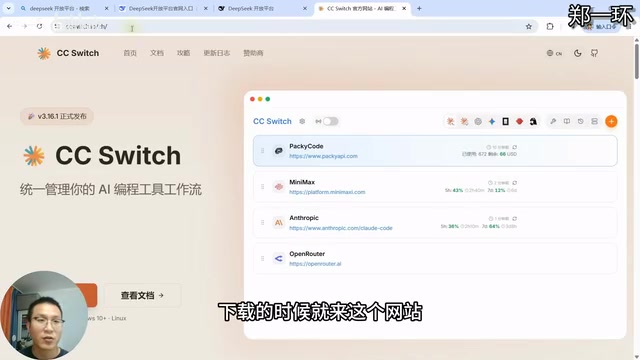
How to Connect Codex to DeepSeek Models: Free Switching via CC Switch
Learn how to connect OpenAI Codex to DeepSeek models via CC Switch, enabling free switching between DeepSeek and GPT with complete setup and routing guide.
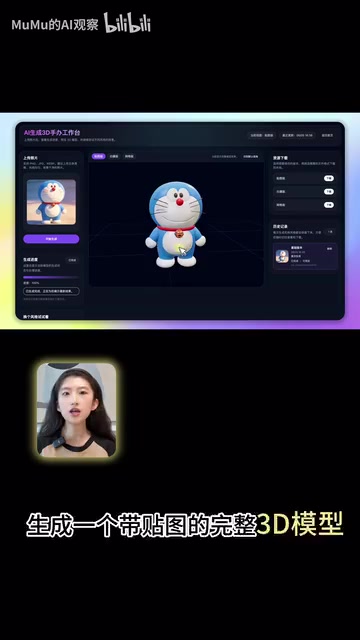
AI Coding Deployment Guide: A Complete Hands-On Workflow from Local Demo to Live Website
Most AI Coding tutorials stop at local demos. This guide walks through 8 key steps to deploy an AI-powered 3D figurine website from Codex coding to live server deployment.