Google Gemini Antigravity Weekly Quota Tripled — AI Coding Without Limits
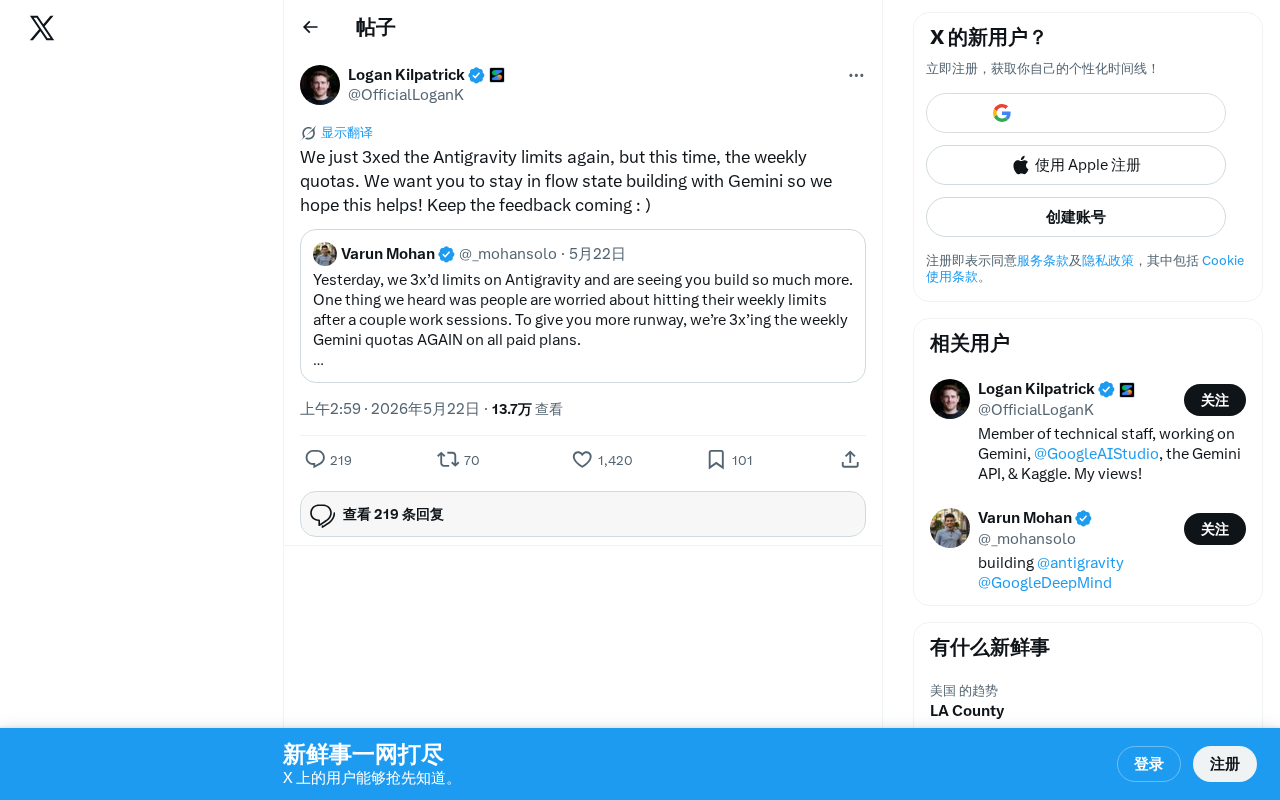
Google Gemini triples Antigravity weekly quotas to help developers stay in coding flow.
Google Gemini tripled Antigravity's weekly quotas, following a previous 3x daily quota increase. The move eliminates workflow interruptions from quota exhaustion, reflecting Google's strategy of prioritizing user experience over compute costs. Backed by custom TPU advantages, Google signals strong compute reserves in its competition against GitHub Copilot, Cursor, and Claude.
Google Gemini Antigravity Weekly Quota Tripled Again
The Google Gemini team recently announced another 3x increase to Antigravity's usage limits, this time targeting weekly quotas. Following a previous 3x boost to daily quotas, this marks yet another major adjustment, signaling Google's commitment to doubling down on AI coding tools.
What Is Antigravity?
Antigravity is a developer-facing AI coding assistant within the Google Gemini ecosystem, designed to help developers maintain a productive flow state during coding. Developers can leverage Gemini for code generation, debugging, refactoring, and more.
The name itself is a clever nod — in the Python community, import antigravity is a well-known Easter egg module that opens an xkcd comic, symbolizing the fun and lighthearted side of programming. By naming its AI coding feature after this, Google suggests the tool aims to make programming feel "weightless," removing friction from the development process. Architecturally, Antigravity is integrated into Google's developer toolchain across IDE plugins, CLI tools, and web interfaces, deeply tied to the latest models like Gemini 2.5 Pro, fully leveraging Gemini's ultra-long context window to understand large codebases.
Previously, many power users hit usage caps during intensive development sessions, forcing them to break their workflow. Google clearly noticed this pain point and moved to address it.
What the 3x Quota Increase Means
Comprehensive Upgrades to Both Daily and Weekly Quotas
Google had already tripled daily quotas, and now weekly quotas receive the same 3x treatment. The practical impact includes:
- More flexible short-term usage: Developers can make more intensive AI-assisted calls within a single day
- More stable long-term usage: Total weekly capacity is significantly increased, avoiding the frustration of burning through quotas early in the week
- Development continuity: Maintaining a consistent AI-assisted experience throughout the entire development cycle
The Compute Economics Behind Quotas
AI service quotas fundamentally stem from LLM inference costs. Each call to models like Gemini for code generation consumes GPU/TPU compute resources, involving matrix operations across billions or even trillions of parameters. At current industry rates, a single complex code generation request may cost anywhere from a few cents to tens of cents. For a platform with millions of developers, removing quotas entirely would mean potentially massive compute expenses. Google's ability to significantly relax quotas relies on cost advantages from its custom TPU (Tensor Processing Unit) chips and global data center infrastructure, as well as inference efficiency gains from Gemini's architecture optimizations (such as MoE — Mixture of Experts).
A User-Experience-First Product Strategy
The official announcement explicitly stated: "We want you to stay in flow while building with Gemini." This reveals Google's core philosophy for AI coding tools — eliminating every barrier that interrupts a developer's workflow.
Flow State is a concept introduced by psychologist Mihaly Csikszentmihalyi, describing the highly focused and productive state a person enters when fully absorbed in an activity. In software development, flow state is especially valuable — research shows programmers typically need 15–30 minutes to enter deep coding mode, and any interruption (waiting for compilation, hitting quota limits, switching tools) can break that flow, with high recovery costs. A core value proposition of AI coding tools is reducing context switches through instant responses, helping developers maintain this productive state.
Quotas are essentially resource management mechanisms, but when they frequently interrupt the user experience, they become a liability. Google's decision to significantly relax limits shows it has prioritized user experience over compute cost savings.
The AI Coding Assistant Competitive Landscape
The AI coding assistant market is intensely competitive, with GitHub Copilot, Cursor, Claude, and others all vying for developer mindshare. Quotas and usage limits have become key factors influencing user choices.
- GitHub Copilot was initially built on OpenAI Codex and now integrates the GPT-4 series, emphasizing deep integration with VS Code and the GitHub ecosystem. It uses a subscription model but also has usage caps.
- Cursor uses a proprietary code indexing and context management system, supports multi-model switching, and positions "full-codebase awareness" as its core selling point, with ongoing adjustments to usage policies and pricing.
- Claude (Anthropic) stands out with its ultra-long context window and precise code reasoning capabilities, though API calls are also subject to rate limits.
Gemini's differentiated advantages include Google's search and knowledge graph capabilities, support for million-token-level context windows, and native integration with Google Cloud developer tools. Two consecutive 3x quota increases send a clear market signal: Gemini has sufficient compute reserves to support intensive developer usage — a competitive moat built on proprietary chips and infrastructure investment.
Practical Impact for Developers
For developers currently using or considering Gemini for AI-assisted coding, this adjustment brings several tangible benefits:
- Worry-free large project development: No more fear of exhausting quotas during critical project phases, especially during sprints or pre-launch crunch periods
- Smoother team collaboration: Team members can use AI-assisted features more freely without coordinating quota allocation internally
- More room to explore: New users have more headroom to learn the tool's capabilities and experiment with different prompting strategies and workflows
- Faster iteration: In high-frequency scenarios like code review, refactoring, and test generation, developers no longer need to ration their usage
The team also encouraged users to "keep the feedback coming," hinting that further relaxations may follow based on user demand. This gradual approach also allows Google to observe actual usage patterns while progressively optimizing infrastructure load balancing.
Conclusion
Google's continued quota increases for Gemini Antigravity reflect a broader trend: AI coding tools are evolving from "novelty experiments" to "productivity infrastructure." When quotas are no longer a bottleneck, developers can truly integrate AI coding assistants into their daily workflows, relying on them as naturally as they do compilers or version control systems. This escalating competition in AI coding tools ultimately benefits the developer community — higher quotas, lower barriers to entry, and smoother development experiences are redefining productivity standards in modern software engineering.
Key Takeaways
- Google Gemini tripled Antigravity's weekly quota, following a previous 3x increase to daily quotas
- The move aims to help developers maintain flow state when using AI coding tools, reducing workflow interruptions caused by quota exhaustion
- The significant quota relaxation reflects Google's product strategy of prioritizing user experience over compute costs, backed by cost advantages from custom TPUs and global infrastructure
- Amid intensifying AI coding assistant competition, Google's repeated quota increases demonstrate its compute reserve advantages, creating differentiation against GitHub Copilot, Cursor, and Claude
Related articles
 Tech Frontiers
GitHub Agent HQ Launch: AI Coding Tools Enter the Era of Platform Competition
GitHub Universe unveils Agent HQ platform for unified coding agent management, Copilot upgrades with multi-model support. OpenAI completes restructuring, Anthropic tests new model, NVIDIA open-sources AI models.
 Tech Frontiers
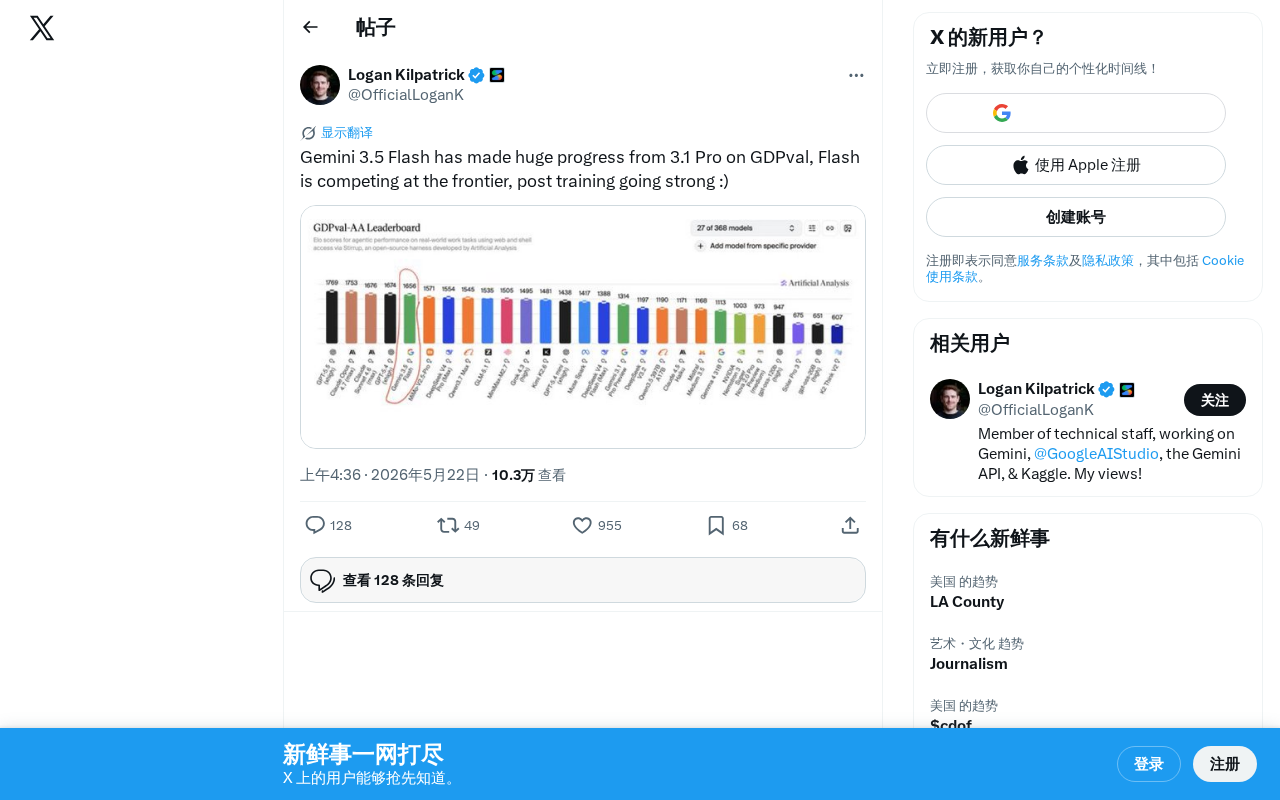
Gemini 3.5 Flash Achieves a Massive Leap on the GDPval Benchmark
Google Gemini 3.5 Flash surpasses Gemini 3.1 Pro on the GDPval benchmark. The lightweight Flash model leverages post-training techniques to approach frontier-level performance, redefining the balance between quality and cost.
 Tech Frontiers
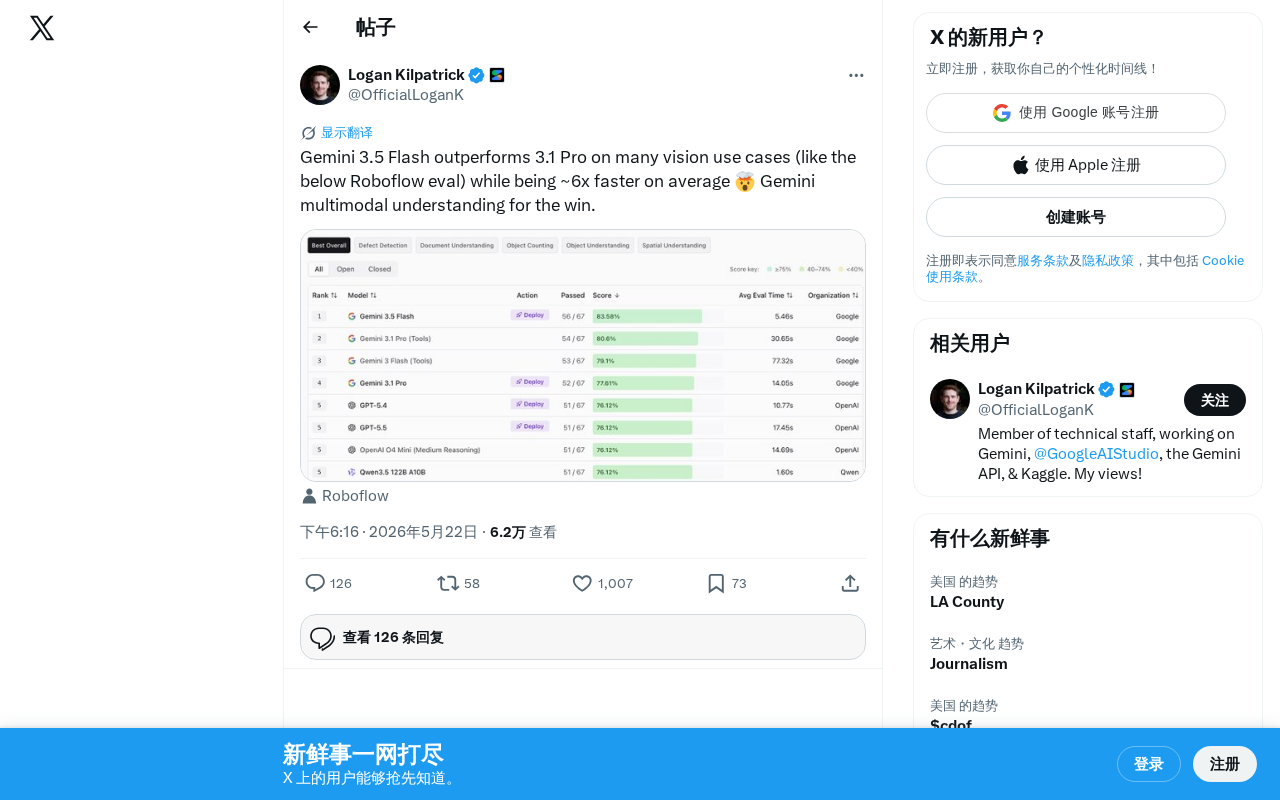
Gemini 3.5 Flash Surpasses Pro in Vision Capabilities, 6x Faster Inference
Roboflow benchmarks show Google Gemini 3.5 Flash outperforms the flagship Gemini 3.1 Pro on multiple vision tasks with ~6x faster inference, delivering a cost-effective multimodal AI solution.