Hands-On AI Programming for Beginners: Three Projects to Take You from Zero to Launch
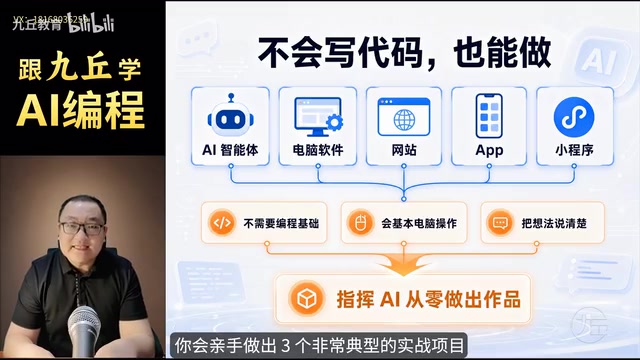
Three hands-on projects teach non-programmers to build real software using AI coding tools like Cursor and Claude Code.
This article walks through a practical AI programming course designed for absolute beginners, featuring three projects: a full-stack personal website with AI customer service, a cross-platform Pomodoro timer desktop app, and an AI digital human video generation agent. Using tools like Cursor, Claude Code, and DeepSeek, learners describe requirements in natural language and let AI generate the code — shifting the core skill from syntax memorization to precise requirement expression.
Non-Programmers Can Build Software? The AI Programming Era Is Here
Have you ever wanted to build your own website, desktop app, mini-program, or even an AI agent — only to give up because you can't code? With AI programming tools maturing rapidly, that barrier is being torn down fast. A Chinese Bilibili creator recently released an "AI Programming: From Beginner to Practitioner" course designed for people with zero coding experience, teaching them to direct AI in plain Chinese to complete three full hands-on projects.
The core philosophy of this course is crystal clear: You don't need to know how to write code — you just need to clearly describe what you want to build. This is precisely the core usage pattern of today's AI programming tools (like Cursor, Claude Code, etc.) — describe your requirements in natural language, let AI generate the code, and humans handle review and adjustments.
This paradigm of directing AI to generate code through natural language emerged from breakthroughs in large language models' (LLMs) code comprehension and generation capabilities. The launch of GitHub Copilot in 2021 is widely regarded as the watershed moment for AI programming. Since then, tools like Cursor and Claude Code have elevated this capability from "code completion" to "requirement-driven complete code generation." The underlying principle: during training, these large models ingested billions of lines of open-source code from GitHub along with massive volumes of technical documentation, enabling them to understand functional intent described in natural language and map it to concrete code implementations. The fundamental shift here is that the bottleneck of programming has moved from "memorizing syntax" to "precision of requirement expression."
Three AI Programming Projects in Detail
Project 1: Full-Stack Personal Brand Website
The first project involves building a real, deployable personal website — covering frontend page construction, cloud database integration, connecting to the DeepSeek LLM for an AI customer service feature, and finally deploying the site online.
You might not have noticed, but the course promises you won't need to purchase your own server or domain name to get a globally accessible online portfolio. This most likely means they're using free hosting platforms like Vercel or Netlify, or similar domestic Serverless deployment solutions. For absolute beginners, skipping the DevOps hurdles and seeing results immediately is a huge confidence booster.
It's worth diving deeper into Serverless architecture and modern hosting platforms here. Vercel and Netlify are currently the two most popular frontend hosting platforms, offering free static site hosting and Serverless Functions capabilities. Developers simply push code to a Git repository, and the platform automatically handles building and deployment, assigning a globally accessible subdomain. The core advantage of Serverless is on-demand computing — no traffic means no costs, and incoming requests trigger automatic scaling. This is extremely friendly for personal projects and learning scenarios. Domestic alternatives include Alibaba Cloud Function Compute and Tencent Cloud CloudBase. It's the maturity of this infrastructure that has turned "zero-experience website building" from a slogan into reality.
This project's tech stack covers the core web development pipeline: Frontend display → Backend data → AI capability integration → Deployment and launch — small but complete.
Project 2: Cross-Platform Desktop Pomodoro Timer App
The second project is a desktop Pomodoro timer application involving desktop notifications, system tray integration, and cross-platform packaging. A single codebase runs on Windows, macOS, and Linux.
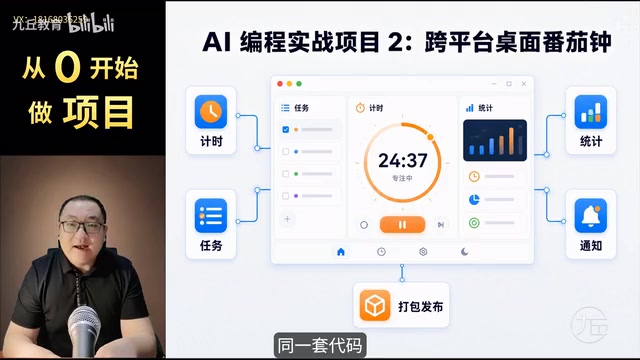
From a technical perspective, this project is most likely built on the Electron or Tauri framework. Cross-platform desktop app development has always been a pain point for individual developers — the traditional approach requires mastering multiple languages and platform-specific features. With AI programming tools, learners only need to describe the desired functionality, and AI generates the corresponding framework code and platform adaptation logic.
Specifically, Electron and Tauri are the two mainstream choices for cross-platform desktop development today. Electron, developed by GitHub, uses the Chromium browser engine and Node.js runtime, allowing developers to build desktop apps with HTML, CSS, and JavaScript — well-known apps like VS Code, Slack, and Discord are all built on Electron. Its strengths are a mature ecosystem and large community, but the downsides include large package sizes (typically over 100MB) and high memory consumption. Tauri is a rising alternative that uses the system's native WebView instead of bundling Chromium, with a Rust backend. Package sizes can be compressed to just a few MB, with better performance and security. For AI programming scenarios, Electron has richer documentation and examples, resulting in higher accuracy of AI-generated code; while Tauri is more lightweight, the quality of AI-generated Rust code isn't yet stable enough.
The practical value of this project is clear: when you're done, you'll actually have a self-developed application on your computer — a sense of accomplishment that pure theoretical learning simply can't replicate.
Project 3: AI Digital Human Short Video Agent
The third project is the most hardcore part of the entire course — input a topic, and it automatically generates a ready-to-publish talking-head short video. This involves agent construction, multi-type LLM invocation, and multi-step automated workflow orchestration.
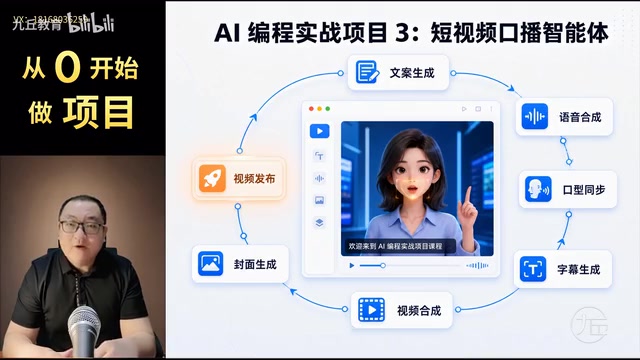
This project's technical complexity is significantly higher than the first two. It's essentially a multi-model collaborative Agent system: a text generation model writes the script, a speech synthesis model handles voiceover, a digital human model generates the video visuals, and an automation pipeline chains everything together.
AI Agents represent the cutting edge of AI application development, fundamentally different from traditional single-shot model calls. The core characteristic of an Agent system is the "plan-execute-feedback" loop: an orchestration layer breaks complex tasks into multiple sub-steps, calls the most suitable specialized model for each step, and dynamically adjusts subsequent steps based on intermediate results. In the short video generation scenario, a typical pipeline looks like: LLM generates script text → TTS (Text-to-Speech) model synthesizes audio → Digital human model drives facial movements based on audio to generate video → Video compositing tool produces the final edit. This multi-model orchestration capability is exactly the core problem that Agent development frameworks like LangChain, Dify, and Coze are trying to solve.
Once you understand this logic, you can apply it to build AI automation workflows in other domains — whether it's customer service automation, batch content production, or data analysis report generation, the underlying orchestration mindset is the same.
AI Programming Tool Selection and Technical Approach
The core tools used in the course are Claude Code and Cursor. These are currently the most mainstream choices in the AI programming space:
- Claude Code: A command-line AI programming assistant that excels at handling complex projects and multi-file collaboration
- Cursor: An AI-enhanced editor based on VS Code that's more beginner-friendly with a lower learning curve
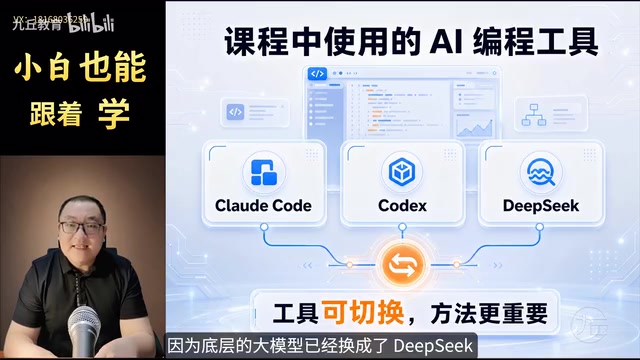
The course specifically mentions that the underlying LLM has been swapped to DeepSeek, with support for switching to other domestic Chinese models. This addresses the network access concerns many users in China have.
DeepSeek is a large model series from the Chinese AI company DeepSeek (深度求索), with DeepSeek-Coder and DeepSeek-V2/V3 performing particularly well in code generation. On mainstream programming benchmarks like HumanEval and MBPP, DeepSeek-Coder-33B's performance approaches or even surpasses GPT-3.5 Turbo, while DeepSeek-V3's comprehensive programming capabilities place it in the global top tier. DeepSeek employs a Mixture of Experts (MoE) architecture, activating only a subset of parameters during inference, which dramatically reduces computational costs while maintaining high performance — making its API pricing far lower than overseas models of comparable capability. Additionally, DeepSeek models have inherently stronger Chinese language understanding, with higher accuracy when processing Chinese requirement descriptions compared to most overseas models. This is particularly crucial for the "directing AI to code in plain Chinese" scenario.
Realistic Thoughts on Learning AI Programming from Scratch
To be objective, the concept of "AI programming with zero experience" deserves a balanced perspective:
AI programming has genuinely lowered the entry barrier dramatically. Web development fundamentals that used to take months to master can now, with AI assistance, potentially yield a working project in just days. For people without technical backgrounds, this is a real window of opportunity.
But "zero experience" doesn't mean "zero learning." You still need to understand basic project structure, file organization, debugging approaches, and how to accurately describe requirements. AI is a powerful executor, but you need to be a competent "product manager" — knowing what you want and being able to judge whether the output is correct.
In the AI programming paradigm, "requirement description ability" is essentially Prompt Engineering applied to programming scenarios. Research shows that for the same functional requirement, different ways of describing it can lead to vastly different quality in AI-generated code. Effective requirement descriptions typically include several key elements: clear functional objectives, specific input/output formats, boundary conditions and error handling requirements, and tech stack preferences. This closely mirrors the logic of writing Product Requirements Documents (PRDs) in software engineering. Therefore, the truly scarce skill in the AI programming era isn't coding itself, but the ability to think systematically — breaking down a vague idea into structured, actionable requirement descriptions. This is also why people with product, design, or operations backgrounds often pick up AI programming quickly.
The underlying methodology is indeed transferable. As the course states, once you've mastered the core skills of AI programming, whether you're building websites, apps, mini-programs, or agents, the underlying logic is the same: Requirement decomposition → Natural language description → AI code generation → Testing and validation → Iterative optimization. Once this workflow clicks, it truly can be applied across all kinds of application scenarios.
Conclusion: What Is the Core Skill of AI Programming?
AI programming tools are redefining the answer to "who can build software." From full-stack web development to desktop applications to AI agents, these three projects are designed to cover today's most mainstream application scenarios. For non-technical people looking to get started with AI programming, learning through hands-on projects is indeed the most efficient path.
What matters isn't whether you can write code right now — it's whether you can clearly express requirements, understand AI's output, and continuously iterate and optimize. That is the true programming skill of the AI era.
Related articles
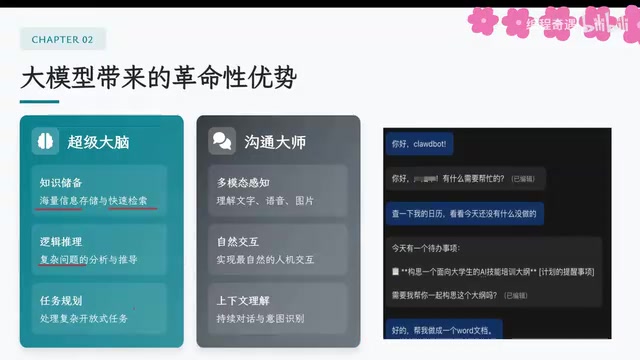
AI Agent Core Architecture Breakdown: From Concept to Enterprise-Grade Intelligent Agent Development
Deep dive into AI Agent architecture: perception, brain, and action modules. Covers RAG memory systems, tool calling mechanisms, Chain of Thought reasoning, and enterprise agent development roadmap.
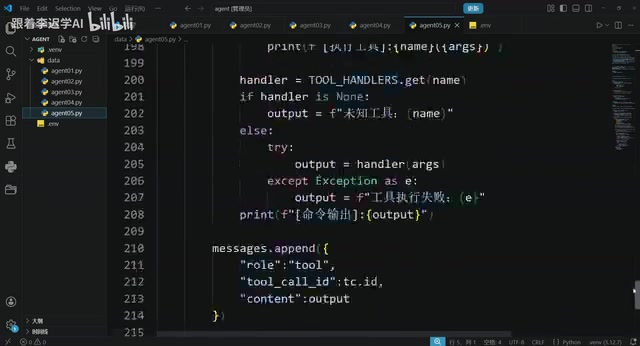
Hands-On Tutorial: Build an AI Agent from Scratch with 200 Lines of Python
Build an AI Agent from scratch with 200 lines of Python, covering prompts, memory, tool calling, RAG, and Skills — a practical guide for developers.
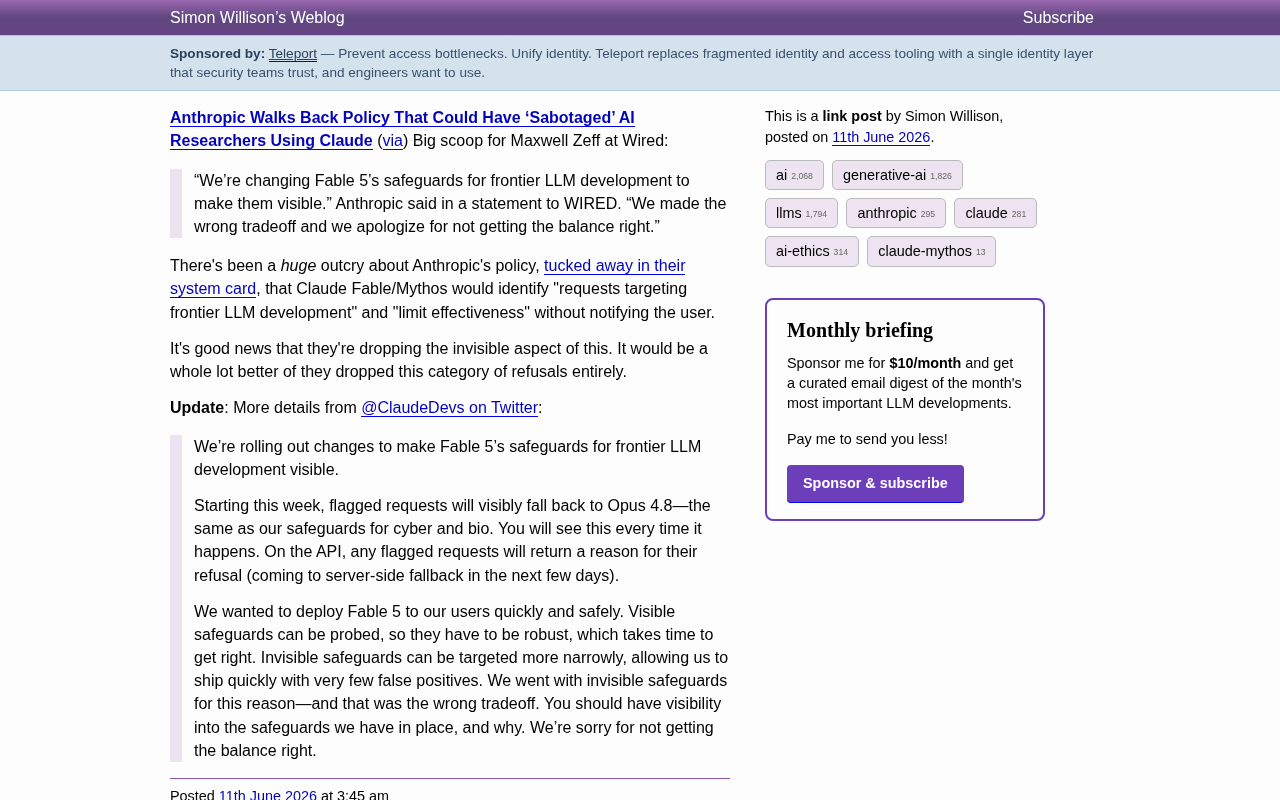
Anthropic Reverses Controversial Policy of Secretly Throttling AI Researchers Using Claude
Anthropic reverses its controversial policy of secretly throttling Claude Fable/Mythos responses to frontier LLM development requests after community backlash, raising critical questions about AI transparency.