Hotel Sustainability Assessment Algorithms: Optimization Paths and Solutions Under Data Scarcity

Hotel sustainability algorithms face data gaps, requiring web scraping and NLP to break through.
A developer openly shared that their hotel sustainability assessment algorithm has critical data gaps in AC energy consumption and degrowth metrics, proposing web scraping of hotel websites to supplement data. However, simple keyword matching generates noise, requiring layered keyword systems and NLP semantic analysis to distinguish genuine environmental action from marketing rhetoric, along with cross-validation mechanisms to prevent greenwashing contamination. The field's development remains constrained by structural issues such as low industry data standardization.
Background: An Honest and Open Algorithmic Dilemma
Recently, a developer candidly shared the current state of their hotel sustainability assessment algorithm on social media — "The algorithm isn't good enough yet, we need more data." This brief tweet reveals a widespread technical challenge in the green tourism space: how to accurately evaluate a hotel's environmental and sustainability performance through algorithms.
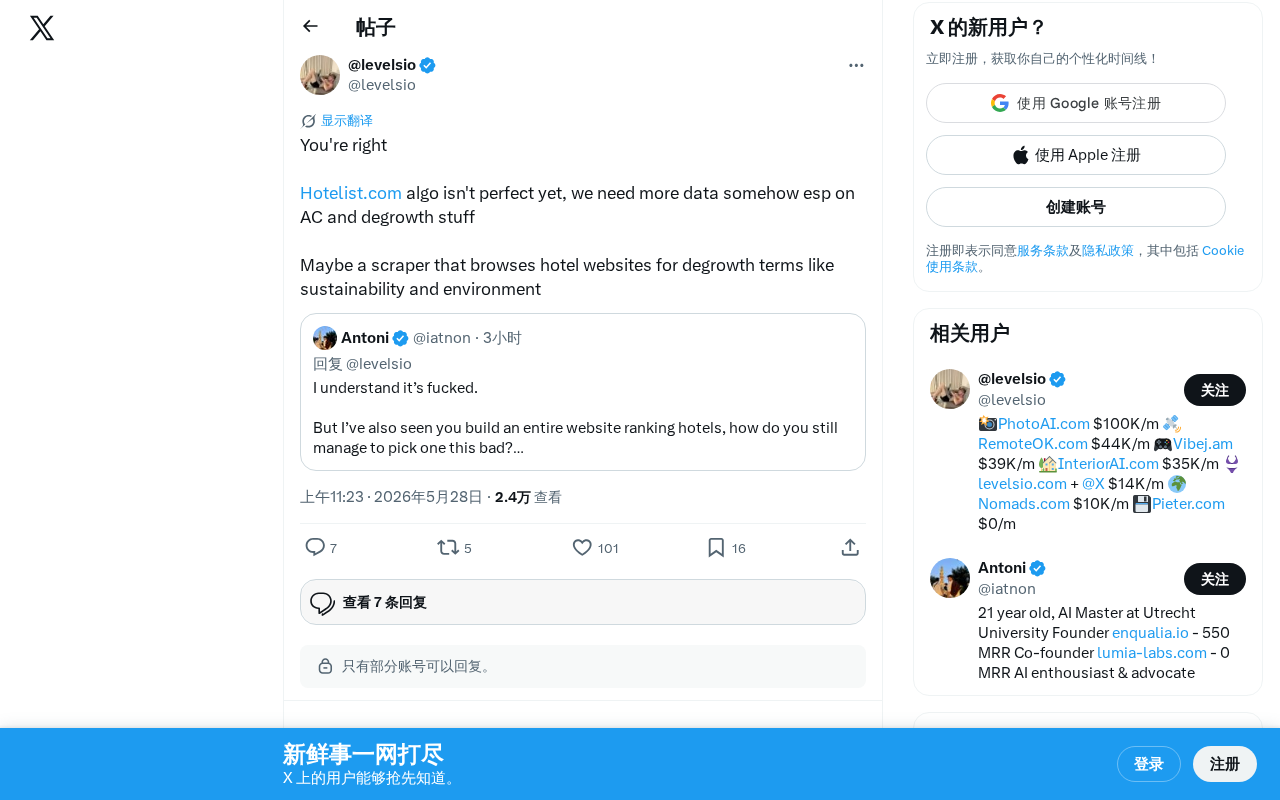
The developer specifically pointed out that the algorithm has data gaps in two critical dimensions: energy consumption data related to air conditioning (AC), and sustainability metrics related to "Degrowth." These two areas happen to be the most difficult to quantify in current green tourism assessments.
The Data Dilemma: The Core Challenge of Sustainable Tourism Assessment
Why AC Energy Consumption Data Is Hard to Obtain
In the hotel industry, air conditioning systems typically account for 40% to 60% of total energy consumption. However, the vast majority of hotels do not publicly disclose specific energy consumption data, let alone present AC system efficiency ratings and operational strategies in a structured format on their websites. This means any algorithm attempting to assess a hotel's energy performance from publicly available data faces a severe data gap.
It's worth noting that standardization efforts for hotel industry energy data disclosure have made some progress but are far from widespread. The Hotel Sustainability Intelligence Alliance (HSIA) introduced the Hotel Carbon Measurement Initiative (HCMI), providing a unified carbon emission calculation framework that major chains like Hilton and Marriott have adopted. However, independent boutique hotels and small-to-medium-sized accommodations often lack the resources and motivation to participate in such standardized systems. This structural divide makes algorithms face even larger data gaps when assessing non-chain hotels, which also explains why web scraping strategies hold particular significance for covering the long-tail market.
For algorithm developers, missing AC energy consumption data is like having the largest piece of a puzzle missing — no matter how precise the assessments are in other dimensions, the overall credibility of the results is significantly compromised.
The Quantification Challenge of "Degrowth"
"Degrowth" is a concept gaining increasing attention in the sustainability field, advocating for reducing unnecessary consumption and production to lower environmental impact. This is not a new idea — its academic roots trace back to the Club of Rome's 1972 report The Limits to Growth, and it was systematized by French economist Serge Latouche in the early 21st century. In the hotel industry context, the degrowth philosophy directly conflicts with the traditional "expansion equals success" business logic — practical implementations might include reducing single-use amenities, limiting room capacity expansion, and adopting localized supply chains. Precisely because of this, hotels willing to openly embrace this philosophy remain a minority in the industry, which fundamentally constrains the availability of related data.
This information is often scattered across different pages of hotel websites, lacking a unified standard of expression. Some hotels mention environmental philosophies on their "About Us" page, while others describe specific measures in blog posts. This information fragmentation poses enormous challenges for automated data collection.
Solutions: Web Scraping and Keyword Extraction Strategies
The developer proposed a pragmatic technical approach: building a dedicated web scraper to automatically browse hotel official websites and search for sustainability-related keywords such as "sustainability" and "environment."
While this approach is straightforward and effective, several key issues need to be addressed during implementation.
Keyword Systems Need a Layered Design
Relying solely on broad terms like "sustainability" and "environment" is likely to generate a large amount of noise. Many hotels frequently use these words in marketing copy without actually practicing sustainability.
A more effective approach is to establish a multi-layered keyword system:
- Certification layer: Specific environmental certification names, such as LEED, Green Key, EarthCheck
- Measures layer: Descriptions of specific environmental practices, such as "solar panels," "rainwater harvesting"
- Data layer: Quantitative metrics, such as carbon emission data, water-saving percentages, etc.
Through layered matching, algorithms can more precisely distinguish genuine environmental practices from superficial marketing rhetoric.
Semantic Understanding Requires Deeper NLP Techniques
Simple keyword matching cannot distinguish between hollow promises like "we are committed to sustainability" and substantive achievements like "we have reduced carbon emissions by 30%."
Introducing Natural Language Processing (NLP) technology, particularly the semantic analysis capabilities of large language models, can help algorithms assess the substantiveness of hotel sustainability claims. In the field of semantic analysis for sustainability statements, academia has developed a dedicated research direction — "NLP for Climate Disclosure." Specific technical approaches include: using BERT-class models fine-tuned on ESG report corpora for text classification; leveraging Named Entity Recognition (NER) to extract specific numbers, certification body names, and time points; and using Contrastive Learning to distinguish substantive commitments from vague statements. Institutions such as Stanford University's CRFM lab have developed benchmark datasets specifically for climate-related text, providing reference standards for model evaluation in this field. Through these technical means, models can identify statements containing specific numbers, timelines, and third-party verification, assigning them higher credibility weights.
Data Validation Mechanisms to Prevent "Greenwashing" Contamination
"Greenwashing" is one of the biggest interference factors in sustainable tourism assessment. Hotels may heavily use environmental buzzwords on their websites while their actual practices severely contradict their claims. This issue has attracted significant attention from global regulators — the EU passed the Green Claims Directive in 2023, requiring companies to provide third-party verified scientific evidence before making any environmental claims, with violators facing fines of up to 4% of annual revenue; the UK's Competition and Markets Authority (CMA) has also launched investigations into multiple travel platforms. This regulatory trend means that algorithmic tools capable of automatically identifying greenwashing will not only have commercial value but will become an industry necessity from a compliance perspective.
Scraped data needs to be cross-validated against third-party certification databases to ensure algorithm results are not misled by false environmental claims. While this step adds system complexity, it is crucial for ensuring the credibility of assessment results.
The Future of AI in Sustainable Tourism
Although this algorithm optimization discussion may seem niche, it actually reflects the enormous potential and real-world challenges of AI technology in the sustainable tourism space.
As the global tourism industry's share of carbon emissions continues to rise, consumer demand for green travel options is also growing rapidly. Intelligent tools that can accurately assess and recommend sustainable accommodation options will possess both social and commercial value.
However, development in this field is still constrained by several structural issues:
- Low data standardization: The hotel industry lacks unified sustainability data disclosure standards
- Insufficient information transparency: Key energy consumption data and environmental practice details are often not publicly available
- Inconsistent assessment frameworks: Different certification systems lack comparability
Algorithm improvement requires not only continuous technical iteration but also industry-level efforts to promote data openness and standard unification.
Conclusion
From one candid tweet, we can see that the sustainable tourism technology field is still in its early exploration stage. Multiple technical aspects — data acquisition, algorithm optimization, semantic understanding, and anti-greenwashing validation — all await breakthroughs.
For developers interested in this field, web scraping is merely the starting point of data collection. The real challenge lies in extracting meaningful sustainability insights from unstructured public information and building a verifiable assessment framework. While the road is long, every step of exploration lays the foundation for the future of green tourism.
Key Takeaways
- Hotel sustainability assessment algorithms face two major data gaps: AC energy consumption and degrowth metrics
- Developers propose using web scrapers to extract sustainability keywords from hotel websites to supplement data
- Simple keyword matching suffers from noise issues and needs to be combined with NLP techniques for semantic analysis
- Data validation mechanisms are critical for preventing "greenwashing," and regulatory trends like the EU's Green Claims Directive are making this capability an industry necessity
- The development of sustainable tourism AI tools is constrained by the structural problem of low industry data standardization
Related articles
 Industry Insights
AI Product Development in Practice: Model Selection, Building Moats, and Paths to Commercialization
Practical strategies for AI product development: why not to train models from scratch, when to use APIs vs. fine-tuning, building product moats, and the full path from evaluation systems to commercialization.
 Industry Insights
No Product Fits Your Needs? Building It Yourself Is the Best Starting Point for Indie Developers
Can't find a product that fits? Building from personal pain points is the best entry for indie developers. Niche needs + AI tools = rapid product creation.
 Industry Insights
OpenAI Codex Tutorials Mass-Copied on Bilibili, Highlighting AI Content Farm Problem
At least 9 Bilibili accounts mass-published identical OpenAI Codex tutorial videos, exposing content farm operations in the AI tools space.