How Anthropic and OpenAI Found Product-Market Fit Through Coding Agents
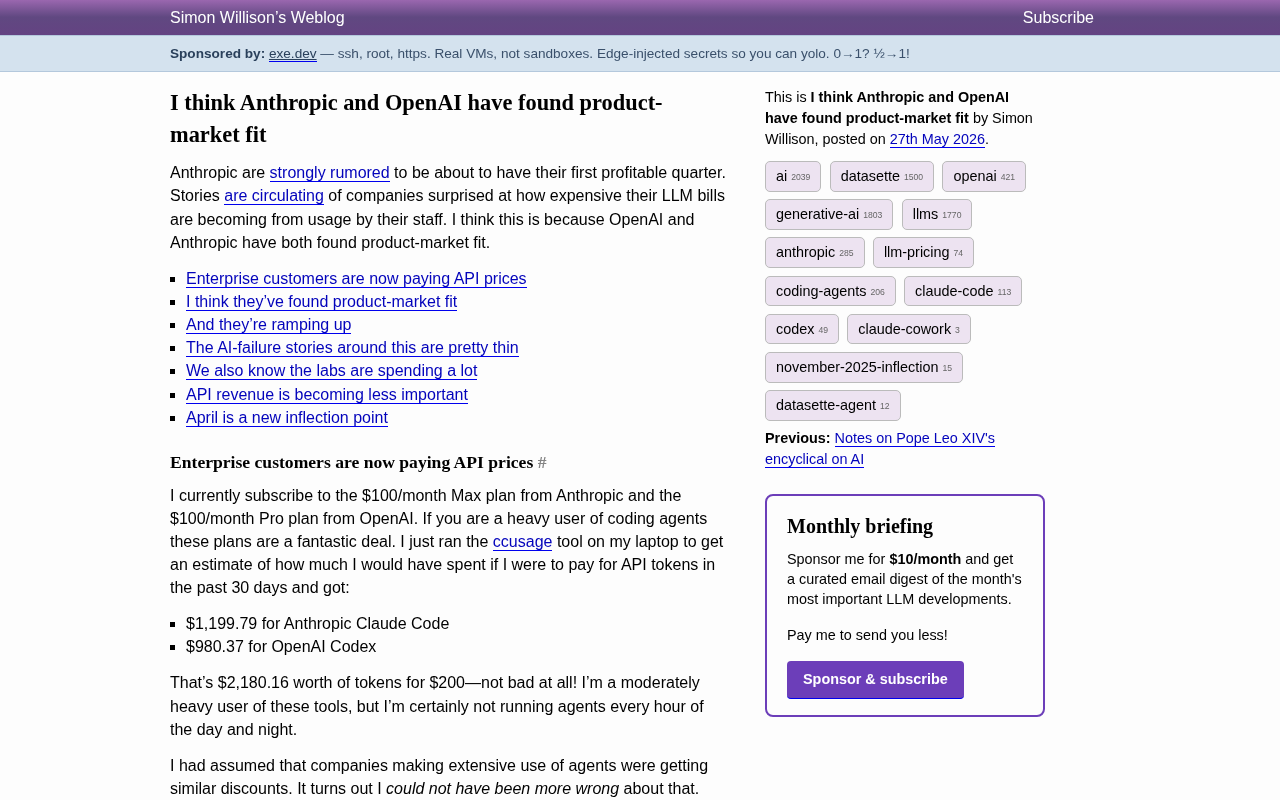
Coding agents drive Anthropic and OpenAI to product-market fit, marking AI's commercial profitability inflection point.
In 2026, coding agents (Claude Code/Codex) became AI's true PMF product, with single-user monthly consumption reaching thousands of dollars—far exceeding traditional subscriptions. Anthropic and OpenAI simultaneously shifted enterprise pricing to API usage billing, locking customers into higher prices. Anthropic's quarterly revenue is expected to hit $10.9 billion with its first profitable quarter, while signing a $1.25B/month compute contract with SpaceX for inference demand. The AI industry is transitioning from "burning cash for growth" to "product-driven profitability."
The AI industry in 2026 is experiencing a critical turning point: Anthropic is about to achieve its first profitable quarter, and OpenAI's enterprise revenue is surging. Renowned developer Simon Willison believes these two companies have finally found true Product-Market Fit (PMF)—and the core driving force behind it all is coding agents.
Product-Market Fit (PMF) is one of the most fundamental concepts in the startup world, formally introduced by venture capitalist Marc Andreessen in 2007. It describes the state where a product precisely meets a real market need—users not only want to use it but are willing to pay for it and spread the word organically. Classic criteria for determining whether PMF has been achieved include: consistently rising Net Promoter Score (NPS), stable user retention rates, and most critically—revenue that covers customer acquisition costs. The AI industry had long been stuck in the awkward state of "users without revenue" precisely because it lacked true PMF.
Enterprise Customers Start Paying API Prices
An important pricing shift is quietly taking place. Simon Willison shared his own usage data: he pays $100/month each for Anthropic and OpenAI subscriptions, but if calculated at API prices, his actual consumption over the past 30 days was $1,199.79 (Claude Code) and $980.37 (OpenAI Codex) respectively—totaling over $2,180.
He initially assumed enterprise customers would enjoy similar discounts, but the reality is exactly the opposite. Anthropic switched its enterprise plan to a "$20/seat/month + API usage billing" model at the end of 2025. OpenAI made a similar adjustment in April 2026, aligning Codex pricing with API token consumption.
Token-based billing directly ties AI usage costs to actual consumption, following the same logic as cloud computing's pay-as-you-go model. A token is the basic unit by which large language models process text, roughly corresponding to 3/4 of an English word or 1-2 Chinese characters. For AI labs, this model has two key advantages: first, heavy users (such as coding agents) consume far more than what subscription fees can cover, and usage-based billing captures this excess value; second, it shifts pricing power from "perceived user value" to "actual compute costs," providing an objective basis for price increases. The enterprise shift from fixed seat fees to API usage billing essentially transforms AI spending from a fixed cost to a variable cost, directly tied to business scale.
One more detail worth noting: both companies raised prices on new frontier models released in April—GPT-5.5's API price is 2x that of GPT-5.4, and Opus 4.7 is approximately 1.4x Opus 4.6 when accounting for the new tokenizer. Newer models are more expensive, and enterprise customers are locked into API pricing—this is a carefully designed commercial strategy.
Why Coding Agents Changed AI's Business Logic
Although ChatGPT boasts over 900 million weekly active users, only 50 million are paying subscribers—less than 5.6%. At $10-20/month subscription prices, covering OpenAI's claimed $1 trillion infrastructure investment would require billions of users paying continuously for years.
Coding Agents are the product of combining large language models with Tool Use capabilities. Unlike ordinary conversational AI, coding agents can autonomously execute multi-step tasks: reading and writing files, running terminal commands, calling external APIs, and even testing code in sandbox environments. Their core architecture is based on a "Plan-Execute-Reflect" loop—the model not only generates code but also observes execution results and self-corrects. Both Claude Code and OpenAI Codex employ this architecture, paired with long context windows (typically 200K+ tokens), enabling them to understand and modify large codebases rather than merely generating isolated code snippets.
Coding agents fundamentally changed the business equation. These tools consume far more tokens than ordinary conversations, but they're becoming daily tools for highly-paid professionals. Currently it's primarily software engineers using them, but coding agents can essentially automate any work accomplished through keyboard commands—their applicability extends far beyond programming.
Models released in November 2025 made agents truly practical, and after six months of adaptation, enterprises began investing real money in this technology. When ChatGPT became the fastest-growing consumer app in history in February 2023, it perhaps achieved PMF in some sense—but it wasn't making money then. Coding agents plus enterprise pricing is the inflection point where these companies started generating "real" revenue.
The "AI Failure" Narrative Doesn't Hold Up
"Alarm" stories about enterprise AI spending keep surfacing, but Simon believes these stories are being overblown.
The most prominent case is Uber: its CTO revealed the company burned through its entire annual AI budget in just a few months of 2026, primarily because of Claude Code. But considering that Claude Code only became truly good in November 2025, a budget set in 2025 failing to predict 2026 demand is entirely unsurprising.
Uber COO Andrew Macdonald's actual words on a podcast were quite measured—he simply said 25% of code commits come from Claude Code, but it's difficult to directly link that to consumer feature output. Yet media spun this into "Uber is finding it increasingly difficult to justify AI spending."
The story about Microsoft revoking Claude Code licenses is similar—on the surface it was about promoting their own Copilot CLI, but it was also related to fiscal year-end budget management.
Simon cited a classic pricing principle: good pricing should make customers "wince, then say yes." Uber's budget overrun and Microsoft's seat cancellation are precisely this effect in practice—the product has value, it's just that the price stings.
Astronomical Infrastructure Investment
AI labs spend tens of billions of dollars on training and inference. SpaceX's S-1 filing accidentally revealed a staggering figure: Anthropic signed a cloud services agreement with SpaceX to use COLOSSUS and COLOSSUS II compute capacity, paying $1.25 billion per month, with the contract running through May 2029.
COLOSSUS is an ultra-large-scale AI compute cluster built through a collaboration between Elon Musk's xAI and SpaceX, located in Memphis, Tennessee, completed in late 2024. Phase one deployed 100,000 NVIDIA H100 GPUs, and phase two (COLOSSUS II) expanded to approximately 200,000, making it one of the world's largest single AI training/inference clusters. Anthropic's choice to lease this cluster rather than relying entirely on AWS or Google Cloud reflects the extreme demands frontier AI inference places on compute density and network bandwidth—large-scale parallel inference requires high-speed GPU interconnects (such as NVLink and InfiniBand), where dedicated supercomputing clusters far outperform general-purpose cloud computing nodes. The $1.25 billion monthly contract translates to roughly $6,250 per GPU per month in rental costs—above market average, but in exchange for guaranteed dedicated compute capacity.
In its announcement, Anthropic stated this deal would help them "increase usage limits for Claude Code and the Claude API," implying this compute is primarily for inference rather than training. Considering Anthropic already obtains substantial compute from other providers, their willingness to spend an additional $1.25 billion monthly from a single supplier speaks volumes about the scale of inference demand.
The Strategic Pivot to API Revenue
Over the past two years, OpenAI relied more on subscription revenue while Anthropic relied more on API revenue. Anthropic's API revenue was once highly concentrated among a few large customers—reports from August 2025 showed that Cursor and GitHub Copilot alone contributed $1.2 billion of its $4 billion in revenue.
Now Anthropic's Q2 revenue is expected to reach $10.9 billion, potentially achieving profitability for the first time. Behind this shift toward enterprise direct sales lies the AI industry's profound vertical integration logic. Vertical integration refers to companies extending up and down the value chain to control more segments and capture higher profits. Anthropic launching Claude Code to compete directly with Cursor and GitHub Copilot means foundation model companies are no longer content being "compute wholesalers"—they're cutting directly into the application layer, bypassing intermediaries to capture end-user value. Historically, this parallels Apple's full-stack control strategy spanning chips, operating systems, and the App Store. For startups like Cursor that depend on the Claude API, having an upstream supplier become a direct competitor represents classic "Platform Risk"—which is why Cursor is accelerating investment in proprietary models to reduce dependence on any single vendor.
April 2026: From Technical Inflection Point to Commercial Inflection Point
If November 2025 was the technical inflection point—GPT-5.1 and Opus 4.5 making agent systems truly usable—then April 2026 is the commercial inflection point—revenue effects are materializing, frontier AI labs are benefiting enormously, and large enterprises' budgets are being materially impacted.
When Anthropic and OpenAI's IPO S-1 filings are released, we'll see audited real numbers. But from all current indicators, the AI industry is transitioning from "burning cash for growth" to a new phase of "product-driven profitability." Coding agents haven't just changed how software is developed—they've reshaped the entire AI industry's business model.
Key Takeaways
- Anthropic and OpenAI simultaneously shifted enterprise pricing to API usage billing in April 2026, locking enterprise customers into higher price points
- Coding agents (Claude Code/Codex) are the true PMF product, with single-user monthly consumption reaching thousands of dollars—far exceeding traditional subscription models
- Anthropic signed a $1.25 billion/month compute contract with SpaceX, primarily for inference rather than training, reflecting the scale of demand
- AI labs are shifting from reliance on API intermediaries to enterprise direct sales; Anthropic's quarterly revenue is expected to reach $10.9 billion with its first profitable quarter
- So-called enterprise AI spending "alarm" stories are overblown—they actually prove the product's value and pricing power
Related articles
 Industry Insights
AI Product Development in Practice: Model Selection, Building Moats, and Paths to Commercialization
Practical strategies for AI product development: why not to train models from scratch, when to use APIs vs. fine-tuning, building product moats, and the full path from evaluation systems to commercialization.
 Industry Insights
No Product Fits Your Needs? Building It Yourself Is the Best Starting Point for Indie Developers
Can't find a product that fits? Building from personal pain points is the best entry for indie developers. Niche needs + AI tools = rapid product creation.
 Industry Insights
OpenAI Codex Tutorials Mass-Copied on Bilibili, Highlighting AI Content Farm Problem
At least 9 Bilibili accounts mass-published identical OpenAI Codex tutorial videos, exposing content farm operations in the AI tools space.