MCP Isn't Dead! Anthropic's Two Power Moves Cut Costs by 85% + 12 Agentic Patterns Fully Explained
MCP Isn't Dead! Anthropic's Two Power …
MCP pivots to the cloud with 85% cost cuts and 12 Agentic patterns for production-grade AI Agents.
Facing community criticism over MCP's high cost, context bloat, and protocol overhead, Anthropic strategically repositioned MCP as a standardized remote access layer for cloud environments, complementing local CLI workflows. Through Tool Search and code sandbox techniques, token consumption dropped by over 85%, narrowing the cost gap from 32x to 7x. The article also deconstructs 12 Agentic patterns powering production-grade Agents, spanning memory management, workflow orchestration, permission control, and deterministic automation — forming a complete layered architecture.
Introduction: Is MCP Really Dying?
The hottest debate in the AI Agent community recently has been the claim that "MCP is about to become obsolete." Tests revealed that operations using MCP cost a staggering 17x more than traditional CLI, and can devour up to 72% of a large model's context window in one go. Many people declared it expensive, bloated, and completely useless.
But is that really the case? Anthropic's official response delivered a very clever reversal — MCP isn't just alive, it's found its true battlefield. This article breaks down the production-grade AI Agent architecture across four dimensions: MCP's crisis and repositioning, official cost-reduction techniques, 12 Agentic patterns, and the future multi-dimensional collaborative ecosystem.
MCP's Three Pain Points and Strategic Redirect
The Three Most-Criticized Problems
Community criticism of MCP boils down to three words: too expensive, too bloated, too dumb.
- Cost disparity: Rigorous testing showed that CLI costs only 1/17th of MCP for the same task
- Performance drag: Perplexity's CTO publicly stated they were moving away from MCP internally because it consumed 72% of the model's context window
- Protocol bloat: Take GitHub MCP as an example — it contains 43 tools, and every interaction requires packaging all tool descriptions for the model, wasting over 4,000 tokens on descriptions alone
Anthropic's Smart Reversal
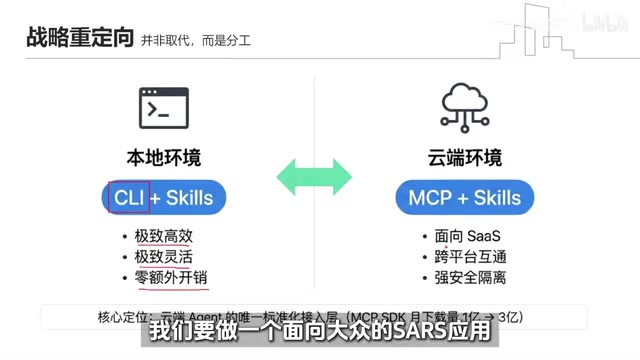
Anthropic didn't push back head-on. Instead, they executed a strategic redirect. They candidly acknowledged: for local development environments where maximum efficiency and zero overhead are the priority, CLI is indeed king.
But here's the key trend — more and more production-grade Agents run in the cloud. In cloud environments (SaaS applications, cross-platform apps), there's no local file system for you to run command lines against. What MCP provides is a strongly security-isolated, standardized remote access layer.
Think of it this way: running a small local workshop is most efficient with CLI, but if you want to open a nationwide chain serving tens of millions of users, you need a cloud-standard protocol like MCP. This isn't about one replacing the other — it's about division of labor:
- Local environment → CLI + Skills
- Cloud environment → MCP + Skills
Once the positioning was clarified, the market voted with its feet — MCP SDK monthly downloads skyrocketed from 100 million to 300 million in just a few months.
Two Official Power Moves: 85%+ Token Cost Reduction
The positioning may be clear, but MCP's token-hungry nature in the cloud still needed fixing. Anthropic unleashed two major techniques.
Move #1: Tool Search
The old approach to having models call tools was brute force — every time, the entire thick tool manual was stuffed into the model, loading 100% of tokens.
The new logic is completely different: instead of rigidly listing API functions, the system dynamically extracts based on the user's actual intent. The model first expresses what it wants to do, then the system precisely finds and delivers only the relevant pages of the manual.
This on-demand loading approach directly eliminates over 80% of tool definition tokens, with zero drop in tool selection accuracy.
Move #2: Programmatic Tool Invocation (Code Sandbox)
Tools often return too much data, and raw data flooding directly into the context will blow up the billing sheet. The core idea is simple: don't make the model a data mover — let it write code.
The system provides the model with a secure code sandbox. After a tool retrieves massive raw data, the model can write a small piece of code in the sandbox to filter by conditions, calculate totals, reformat — and only bring back the refined results.
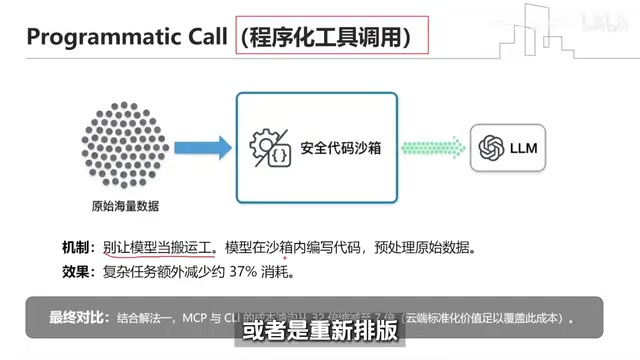
Official data shows this technique can additionally reduce token consumption by approximately 37% when handling complex tasks.
Real-World Impact: From 32x Gap Down to 7x
Combining both moves: cutting 85% of documentation + saving 37% on data transport overhead reduces the cost gap from an extreme 32x down to approximately 7x. For cloud production environments, paying this slightly higher cost in exchange for strong security isolation and cross-platform standardization is absolutely worth it.
Case Study: Cloudflare's Minimalist Philosophy
Cloudflare needed to expose approximately 2,500 API endpoints through MCP. Listing them all for the model using the old approach would be a disaster. Their solution was brilliantly simple — expose only two tools: search and execute.
The Agent first uses search to precisely locate the needed API among 2,500 endpoints, then uses execute to perform the specific operation server-side. The entire interaction consumes only about 1,000 tokens. This perfectly embodies Anthropic's philosophy: a good MCP service should be designed like a CLI, letting Agents orchestrate services through code.
12 Agentic Patterns: Full Breakdown of the Agent's Internal Brain
Solving external connectivity is only half the battle. How a truly production-grade Agent's internal brain operates is the key to success or failure. These 12 patterns, revealed from inside Claude Code, are organized across four dimensions.
Dimension 1: Memory and Context Management
We used to stuff company standards and project requirements all into the system prompt, making it bloated and unwieldy. Now it's become on-demand, hierarchical dynamic assembly.
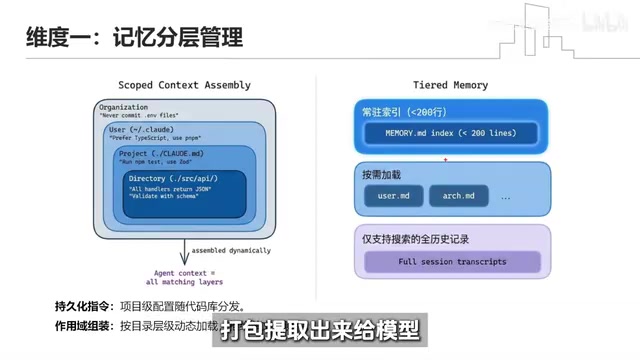
For example, when you're writing a backend API endpoint, the system only extracts the outer-layer general architecture standards + the specific rules for the current API directory, ignoring everything irrelevant. Memory storage is also layered:
- Persistent memory: Core rules under 200 lines, always accompanying the model
- Trigger-loaded: Architecture diagrams, etc., loaded only when specific scenarios are triggered
- Historical archive: Chat history from dozens of past rounds, searchable only — never occupying active memory
To combat context decay, two clever mechanisms are introduced:
- Idle-time dream consolidation: Similar to how the human brain organizes memories during sleep, a background daemon process cleans up duplicate/conflicting memories when the Agent is idle
- Progressive compression: When approaching the limit, older history gets lightly summarized and folded, ensuring the brain always stays sharp with headroom
Dimension 2: Workflow Orchestration
Many Agents jump straight into execution when they receive requirements, ending up breaking the code. The production-grade approach introduces mandatory constraints: explore first, plan second, execute last.
During the exploration and planning phases, the Agent's permissions are locked down — read-only, no writes. Like a carpenter's "measure twice, cut once" — think it through before acting.
For complex tasks with no dependencies (like modifying three unrelated modules simultaneously), the system uses a Fork-Join parallel pattern: cloning multiple sub-Agents to work simultaneously, reusing the parent node's cache, then quickly merging results when done.
Dimension 3: Fine-Grained Tool Permission Control
In the past, giving the model an all-powerful Shell environment for convenience was like handing the vault keys to an intern. Today's best practice is single-purpose minimal toolsets + risk matrix:
- 🟢 Green (running tests): Auto-approved
- 🟡 Yellow (pushing code): Confirmation prompt
- 🔴 Red (dangerous operations like dropping databases): Blocked outright
Precise type-based controls replace unchecked all-powerful permissions.
Dimension 4: Deterministic Automation
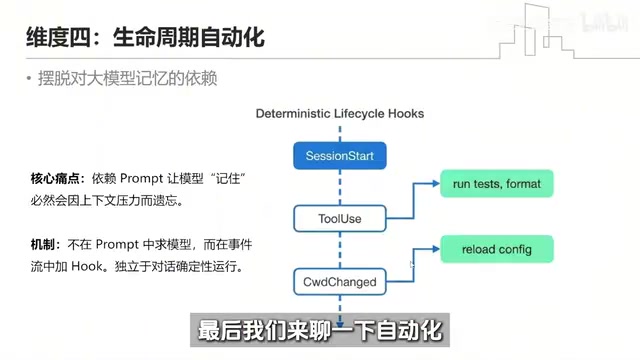
No matter how many times you remind the model in the prompt to "remember to format after writing code," it forgets once the context gets long. The solution is to extract these actions from the prompt and place them as Hooks in the event stream.
Whenever the system detects a file modification or a new task starting, tests run automatically and formatting happens automatically in the background. Instead of begging the model to remember tedious procedures, external systems handle deterministic interception.
Future Blueprint: A Multi-Dimensional Collaborative Agent Ecosystem
There's never been a one-size-fits-all solution in architecture selection. The roadmap is crystal clear:
- Simple tasks (checking weather, writing scripts) → Direct API calls, no need for heavy architecture
- Local development pursuing maximum efficiency → CLI + Skills, the champion combo
- Cloud SaaS serving mass users → MCP + Skills, where security boundaries and standardization are make-or-break
Many leading service providers (Tempo, Notion, etc.) now ship a set of Skills alongside their MCP servers. The logic is clever: MCP builds the road, Skills act as the coach telling the Agent how to drive.
But regardless of whether you choose CLI or MCP externally, as soon as tasks get complex and state starts flowing, the core engine behind it all remains those 12 Agentic patterns. Without a clear internal brain for orchestration, even the best external connections will result in chaos.
Conclusion
MCP isn't dead — it has simply, and very lucidly, found its true battlefield: the cloud. Anthropic used Tool Search and code sandboxes as two power moves to dramatically compress token consumption, and combined with the 12 internal orchestration patterns and external Skills guidance, a truly secure production-grade Agent architecture is now concretely laid out before us.
For developers, understanding the underlying logic of this layered architecture means being able to precisely choose the right weapon when requirements come in — and that is the core competitive advantage for shipping real AI applications.
Related articles
 Industry Insights
AI Product Development in Practice: Model Selection, Building Moats, and Paths to Commercialization
Practical strategies for AI product development: why not to train models from scratch, when to use APIs vs. fine-tuning, building product moats, and the full path from evaluation systems to commercialization.
 Industry Insights
No Product Fits Your Needs? Building It Yourself Is the Best Starting Point for Indie Developers
Can't find a product that fits? Building from personal pain points is the best entry for indie developers. Niche needs + AI tools = rapid product creation.
 Industry Insights
OpenAI Codex Tutorials Mass-Copied on Bilibili, Highlighting AI Content Farm Problem
At least 9 Bilibili accounts mass-published identical OpenAI Codex tutorial videos, exposing content farm operations in the AI tools space.