NVIDIA Blackwell Sets New STAC-AI Records for Financial LLM Inference

NVIDIA Blackwell GPU sets new LLM inference performance records in the STAC-AI financial benchmark.
NVIDIA's Blackwell architecture GPU has set new LLM inference performance records in STAC-AI, the authoritative financial industry benchmark. Through architectural innovations including the second-generation Transformer Engine, FP4 precision computation, and NVLink interconnect upgrades, combined with deep co-optimization of the TensorRT-LLM software stack, Blackwell achieves a generational leap in inference performance. This breakthrough will drive deeper LLM adoption in core financial scenarios such as market sentiment analysis, compliance and risk management, and high-frequency trading.
Overview
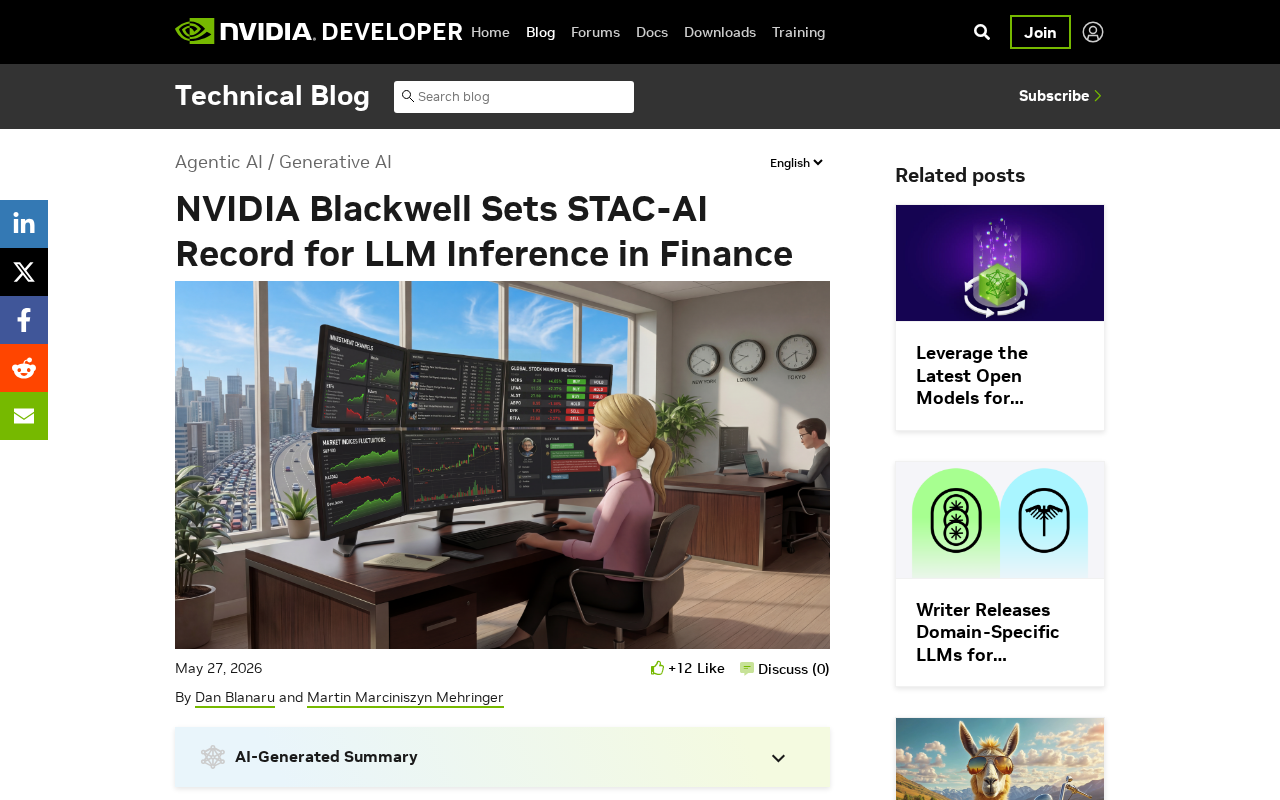
Large Language Models (LLMs) are profoundly transforming the financial trading landscape, providing unprecedented intelligent support for trading decisions through complex analysis of massive unstructured data. NVIDIA's latest Blackwell architecture GPU has set new LLM inference performance records in STAC-AI, the authoritative benchmark for the financial industry, marking a new phase for AI acceleration hardware in fintech.
What Is the STAC-AI Benchmark?
The Performance Standard for the Financial Industry
STAC (Securities Technology Analysis Center), founded in 2006 and headquartered in the United States, is an independent technology benchmarking organization dedicated to serving the financial services industry. Its membership includes the world's top investment banks, hedge funds, exchanges, and technology vendors, such as Goldman Sachs, JPMorgan Chase, and the Chicago Mercantile Exchange. STAC's core value lies in the independence and reproducibility of its testing methodology—all tests are conducted in controlled environments with third-party auditing, and results are publicly released, avoiding the credibility disputes associated with vendor self-reported data.
The STAC-AI benchmark specifically provides standardized evaluation of AI workloads in financial services scenarios, covering both model training and inference. Test scenarios are reviewed by a committee of financial practitioners to ensure high alignment with real business use cases, including market sentiment analysis, risk assessment, and compliance document processing. Unlike general-purpose AI benchmarks, STAC-AI test scenarios are derived directly from real financial business requirements, making it a critical decision-making reference for banks, hedge funds, and exchanges when selecting AI infrastructure—it measures not just raw computational performance, but throughput, latency, and efficiency under actual financial workloads.
Blackwell Architecture's Breakthrough Performance
A Generational Leap in Inference Performance
NVIDIA's Blackwell architecture GPU demonstrated exceptional LLM inference capabilities in this STAC-AI test. Blackwell (B100/B200 series), released in 2024, is manufactured using TSMC's 4NP process and integrates 208 billion transistors per GPU—approximately twice that of the previous-generation Hopper architecture H100. One of Blackwell's most revolutionary features is its dual-die interconnect design—two GPU dies are connected via a 10TB/s chip-to-chip interconnect (NV-HBI), presenting as a single logical GPU at the operating system level, completely eliminating the software compatibility barriers of traditional multi-chip solutions.
For AI inference, Blackwell incorporates extensive architecture-level optimizations, with core advantages including:
- Second-Generation Transformer Engine: Deeply optimized for LLM inference scenarios with support for FP4 precision computation. FP4 (4-bit floating point) is currently the lowest precision format supported by commercial AI chips. Compared to FP16, it can compress model size to one-quarter, dramatically increasing the model scale or batch size that can be accommodated within the same memory capacity. The second-generation Transformer Engine controls precision loss through a mixed-precision strategy—maintaining higher precision for precision-sensitive attention layers while aggressively using FP4 for compute-intensive feed-forward layers, achieving dynamic balance between performance and accuracy. This enables financial institutions to achieve near-theoretical-peak inference throughput without significantly sacrificing analytical quality.
- Larger Memory Capacity and Bandwidth: Capable of hosting larger-scale language models, reducing communication overhead from model sharding
- NVLink Interconnect Upgrade: Blackwell architecture increases NVLink bandwidth to 1.8TB/s per GPU. Combined with the fully-connected topology built using NVSwitch chips, an 8-GPU DGX B200 system achieves 14.4TB/s total inter-GPU bandwidth. When ultra-large LLMs need to be distributed across multiple GPUs for tensor parallelism or pipeline parallelism inference, this order-of-magnitude interconnect capability compresses communication overhead from model parallelism to negligible levels, supporting larger, more accurate models while maintaining low latency.
These architectural improvements translate into tangible performance advantages in financial LLM inference scenarios. Financial trading is extremely latency-sensitive—in high-frequency trading (HFT) scenarios, being hundreds of microseconds ahead of competitors can yield significant statistical arbitrage advantages. Even in algorithmic trading scenarios, news-event-driven strategies require systems to complete the entire pipeline from information ingestion, LLM semantic analysis, to trading signal generation within hundreds of milliseconds. A model that requires 500ms to complete inference simply cannot generate effective signals under certain market microstructures. The low-latency, high-throughput characteristics demonstrated by Blackwell in STAC-AI testing are a direct response to this core pain point.
Software Stack Co-optimization
Unlocking hardware performance requires software stack coordination. NVIDIA fully leveraged the TensorRT-LLM inference optimization framework in this test—an open-source framework developed by NVIDIA specifically for LLM inference optimization, built on the mature TensorRT inference engine. Its core technologies include: PagedAttention (managing KV Cache in a paged manner to significantly reduce memory fragmentation), Continuous Batching (dynamically merging requests of different lengths to maximize GPU utilization), and operator fusion optimizations targeting specific GPU architectures.
For Blackwell adaptation, TensorRT-LLM specifically introduced an FP4 quantized inference path and rewrote GEMM (General Matrix Multiplication) kernels targeting Blackwell's new Tensor Core units. This deep co-optimization strategy spanning from chip architecture to inference framework enables Blackwell's performance in actual financial inference tasks to far exceed simple linear extrapolation from theoretical peak performance.
LLM Applications in Financial Trading
From Auxiliary Analysis to Core Decision-Making
LLM applications in finance are moving from the periphery to the core. Current primary use cases include:
- Market Sentiment Analysis: Real-time parsing of news, social media, earnings calls, and other unstructured data to quantify market sentiment changes
- Automated Research Report Generation: Automatically generating investment research reports based on multi-source data, dramatically improving analyst efficiency
- Compliance and Risk Management: Automatically reviewing trade compliance and identifying potential risk signals
- Intelligent Customer Service and Advisory: Providing clients with personalized investment advice and account management services
As inference performance continues to improve, the application boundaries of LLMs in finance will expand further. Particularly in high-frequency and algorithmic trading scenarios, faster inference speeds mean processing more information within shorter time windows, thereby capturing more trading opportunities.
The Strategic Significance of Infrastructure Investment
For financial institutions, the choice of AI inference infrastructure has risen to a strategic-level decision. STAC-AI benchmark results provide objective, quantifiable reference for this decision. The new records set by Blackwell not only demonstrate NVIDIA's continued leadership in AI hardware but also point the way for financial institutions' AI infrastructure upgrades.
Industry Impact and Outlook
This STAC-AI record refresh reflects several important trends:
First, AI inference is becoming a core component of financial infrastructure. Unlike the training phase, inference is a continuously running production process whose performance directly impacts business output. Financial institutions' focus on inference performance is rapidly intensifying.
Second, the importance of industry-specific benchmarks is increasingly prominent. General-purpose benchmarks cannot fully reflect the actual needs of specific industries, and the value of vertical-domain benchmarks like STAC-AI will continue to grow.
Finally, hardware-software co-optimization is the key to unlocking AI performance. Hardware upgrades alone are no longer sufficient to meet the financial industry's extreme performance demands. Full-stack optimization from chip architecture to inference framework to application layer will become the norm.
With the large-scale deployment of Blackwell architecture and the planning of the next-generation Rubin architecture, NVIDIA's positioning in financial AI infrastructure is accelerating. For the entire financial industry, AI-driven intelligent transformation is no longer an optional question—it's a mandatory one.
Key Takeaways
- NVIDIA Blackwell architecture GPU sets new LLM inference performance records in STAC-AI, the authoritative financial industry benchmark
- Blackwell achieves a generational leap in inference performance through the second-generation Transformer Engine, FP4 precision support, and NVLink interconnect upgrades
- Hardware-software co-optimization (TensorRT-LLM + Blackwell architecture) is the critical factor behind the performance breakthrough
- LLM applications in finance are expanding from auxiliary analysis to core scenarios including market sentiment analysis, compliance and risk management, and high-frequency trading
- AI inference infrastructure has become a strategic-level investment priority for financial institutions
Related articles
 Industry Insights
AI Product Development in Practice: Model Selection, Building Moats, and Paths to Commercialization
Practical strategies for AI product development: why not to train models from scratch, when to use APIs vs. fine-tuning, building product moats, and the full path from evaluation systems to commercialization.
 Industry Insights
No Product Fits Your Needs? Building It Yourself Is the Best Starting Point for Indie Developers
Can't find a product that fits? Building from personal pain points is the best entry for indie developers. Niche needs + AI tools = rapid product creation.
 Industry Insights
OpenAI Codex Tutorials Mass-Copied on Bilibili, Highlighting AI Content Farm Problem
At least 9 Bilibili accounts mass-published identical OpenAI Codex tutorial videos, exposing content farm operations in the AI tools space.