NVIDIA Dynamo Snapshot: A Snapshot Recovery Solution for GPU Inference Cold Start Problems

NVIDIA Dynamo Snapshot solves LLM inference cold start latency through GPU state snapshot and recovery
Large model inference services face severe cold start latency during elastic scaling. NVIDIA's Dynamo Snapshot feature persists the inference service's hot state—including GPU memory layout and runtime context—as snapshots, enabling new instances to skip initialization and restore directly to a service-ready state, reducing cold start time from minutes to seconds. Deeply integrated with the Kubernetes ecosystem, it's applicable to elastic scaling, multi-model switching, and failure recovery scenarios.
The Pain of Inference Service Cold Starts
In production AI inference deployments, traffic fluctuation is the norm. Inference services need to scale elastically based on demand—scaling up during peak periods and scaling down during valleys. However, every scale-up event inevitably encounters a thorny problem: cold start latency.
The startup process for Large Language Model (LLM) inference services typically involves loading model weights, initializing GPU contexts, warming up KV Cache, and more. For models with tens of billions of parameters, this process can take several minutes or even longer. The root cause of this latency is multi-layered: taking a 70B parameter model as an example, storing it in FP16 precision requires approximately 140GB of GPU memory, and transferring it from network storage to GPU memory alone takes several minutes; CUDA context initialization involves driver loading, device memory allocation, and Stream creation; inference frameworks like TensorRT-LLM also need to perform operator fusion, precision calibration, and Kernel auto-tuning on first run, which can add several more minutes for large models; KV Cache pre-allocation is equally significant, as the system needs to pre-allocate a memory pool based on the configured maximum sequence length and batch size to avoid dynamic memory allocation overhead during inference. In Kubernetes environments, this means there's a significant gap between when a new Pod is created and when it can actually handle requests, directly impacting user experience and SLA compliance.
The Core Approach of NVIDIA Dynamo Snapshot
Snapshot and Recovery Mechanism
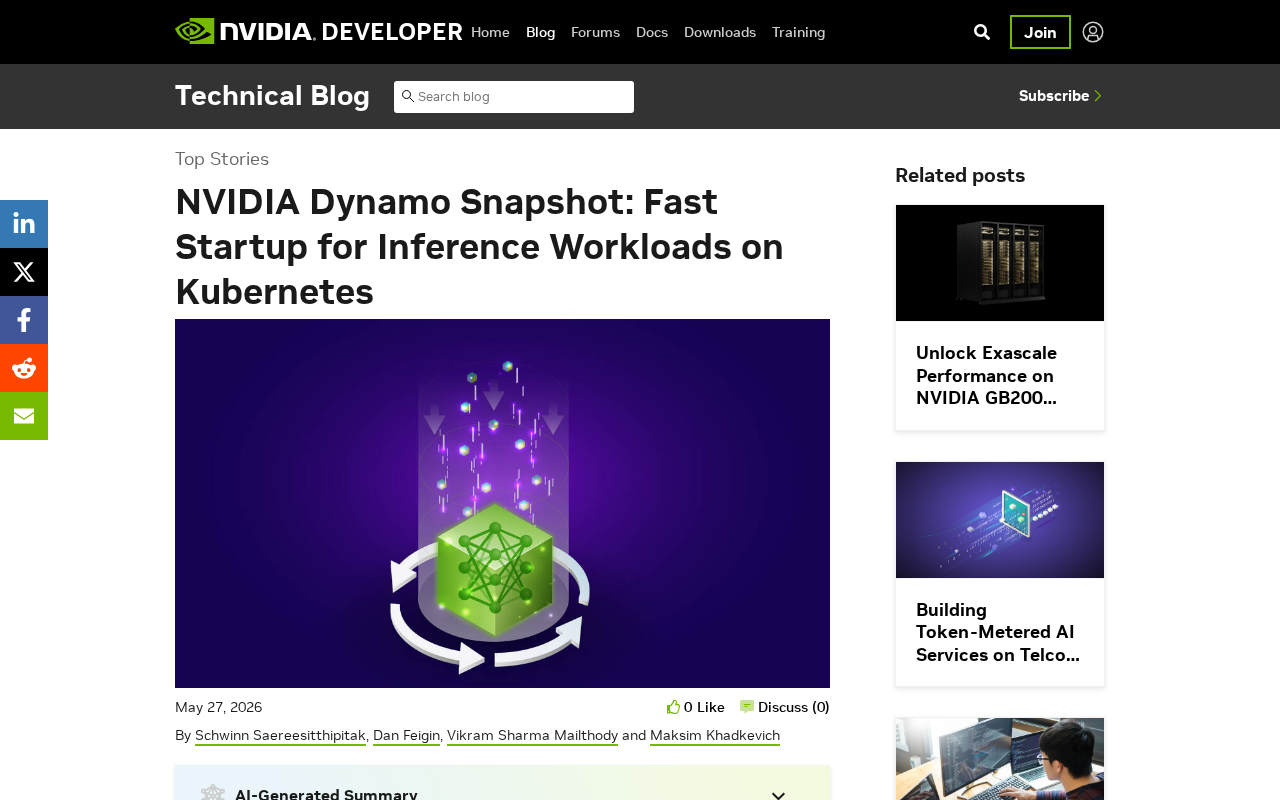
NVIDIA's Dynamo Snapshot feature essentially captures a snapshot of the inference service's "hot state," allowing new instances to skip the lengthy initialization process and restore directly to a service-ready state. This approach is similar to an operating system's hibernate and wake mechanism—the system writes memory contents entirely to disk and restores them directly upon waking, skipping the boot process—but GPU inference scenarios face much higher complexity. CPU process memory space is linear and unified, whereas GPU inference services involve two independent address spaces: Host Memory and Device Memory, along with DMA mapping relationships between them. A CUDA context is essentially a complex data structure containing device state, memory mapping tables, loaded modules, and stream queues, and its serialization requires deep cooperation with the CUDA Driver API. NVIDIA's CUDA Checkpoint/Restore (C/R) technology was built precisely for this purpose, and Dynamo Snapshot further optimizes on top of it for the specific state patterns of inference workloads—for example, identifying and skipping rebuildable temporary buffers and only persisting the core state that truly needs to be restored.
Specifically, Dynamo Snapshot persists the following key states after the inference service is fully ready:
- Model weight layout in GPU memory
- Inference engine runtime context
- Pre-allocated memory pools and buffers
- Compiled CUDA Kernels and optimization graphs
When scaling up is needed, new instances directly load this snapshot data, dramatically reducing the time from startup to readiness.
Deep Integration with Kubernetes
Dynamo Snapshot is not a standalone tool but is deeply integrated into the Kubernetes ecosystem. It leverages Kubernetes storage abstractions (such as PersistentVolume) to manage snapshot data and coordinates snapshot creation, storage, and recovery workflows through custom controllers.
Kubernetes' PersistentVolume (PV) system decouples underlying storage (NFS, Ceph, cloud provider block storage, etc.) from Pods, binding on demand through PersistentVolumeClaims (PVC). The VolumeSnapshot API (part of the CSI specification) allows point-in-time snapshots of PVs, similar to the concept of database backups. Dynamo Snapshot's custom controller is built on the Kubernetes Operator pattern, watching inference service readiness state events and automatically triggering the snapshot creation workflow after the service completes warm-up. When HPA (Horizontal Pod Autoscaler) triggers scale-up, it can be combined with tools like KEDA (Kubernetes Event-driven Autoscaling) to implement more granular triggering strategies based on custom metrics such as request queue depth, while custom schedulers or Init Container mechanisms handle mounting the corresponding snapshot volumes when new Pods start up.
In actual deployments, operations teams can:
- Pre-create snapshots: Automatically generate snapshots after a model is first deployed and warm-up is complete
- Restore on demand: When HPA triggers scale-up, new Pods preferentially start from snapshots
- Version management: Different model versions correspond to different snapshots, supporting canary releases and fast rollbacks
Key Technical Implementation Challenges
The GPU State Serialization Problem
Unlike CPU process snapshots, state recovery for GPU inference services faces unique challenges. Data structures in GPU memory, CUDA contexts, and the states of various hardware accelerators all need to be correctly captured and restored. Dynamo Snapshot needs to work deeply with the CUDA runtime to ensure snapshot completeness and consistency.
Balancing Storage Efficiency and Recovery Speed
Snapshot data for large models can reach tens or even hundreds of gigabytes. Striking a balance between storage cost and recovery speed is a critical design consideration. Common optimization strategies include:
- Incremental snapshots: Based on the Copy-on-Write (CoW) principle, only differences from the base image are saved. Similar to container image layering, model weights form the immutable base layer, while inference engine compilation artifacts (such as TensorRT Engine files) and runtime context form the difference layer, significantly reducing storage footprint.
- Tiered storage: Frequently accessed hot snapshots are placed on NVMe SSDs (latency ~100μs), recent versions on network-attached storage (latency ~1ms), and historical versions archived to object storage (e.g., S3, latency ~10ms). Combined with prefetch mechanisms, the system can proactively load snapshots from cold to hot storage when scale-up events are predicted.
- Parallel loading: Leveraging technologies like GPU Direct Storage (GDS) to accelerate data transfer from storage to GPU memory. GDS establishes direct DMA channels between NVMe SSDs and GPU memory, bypassing CPU memory as an intermediary. In actual testing, this can improve large file loading bandwidth by 2-5x, which is particularly effective for snapshot recovery scenarios involving tens of gigabytes.
Practical Application Scenarios
Elastic Inference Services: Handling Traffic Spikes
The most direct application scenario is handling traffic spikes. When an online inference service detects growing request queues, it can rapidly launch new instances via snapshots, reducing scale-up response time from minutes to seconds.
Multi-Model Scheduling: Efficient Model Switching
In environments with limited GPU resources, it may be necessary to rotate different models on the same set of GPUs. Dynamo Snapshot makes model switching efficient—save the current model's snapshot, load the target model's snapshot—avoiding the need to reload weights from scratch each time.
Failure Recovery: Minimizing Service Interruption
When inference Pods are rescheduled due to node failures, the snapshot mechanism can significantly accelerate service recovery, minimizing the impact of failures on users.
Significance for the AI Infrastructure Industry
As large model inference becomes a core workload in AI infrastructure, the importance of the cold start problem is increasingly prominent. Through Dynamo Snapshot, NVIDIA combines hardware-level optimization with cloud-native orchestration, providing a practical engineering solution for large-scale inference deployments.
This also reflects an important trend in the AI infrastructure space: optimization is no longer limited to the model itself but extends to the entire service lifecycle management. From model training to inference deployment, from resource scheduling to elastic scaling, every stage is becoming a battleground for performance optimization. For teams operating large-scale inference services, Dynamo Snapshot is a technical solution worth thorough evaluation.
Key Takeaways
- NVIDIA Dynamo Snapshot reduces inference service cold start time from minutes to seconds through a snapshot and recovery mechanism
- The solution deeply integrates with the Kubernetes ecosystem, supporting automatic snapshot creation, version management, and on-demand recovery
- GPU state serialization and storage efficiency are core technical challenges requiring deep cooperation with the CUDA runtime
- Applicable to critical scenarios including elastic inference scaling, multi-model scheduling, and rapid failure recovery
- Reflects the industry trend of AI infrastructure optimization extending from the model layer to full service lifecycle management
Related articles
 Industry Insights
AI Product Development in Practice: Model Selection, Building Moats, and Paths to Commercialization
Practical strategies for AI product development: why not to train models from scratch, when to use APIs vs. fine-tuning, building product moats, and the full path from evaluation systems to commercialization.
 Industry Insights
No Product Fits Your Needs? Building It Yourself Is the Best Starting Point for Indie Developers
Can't find a product that fits? Building from personal pain points is the best entry for indie developers. Niche needs + AI tools = rapid product creation.
 Industry Insights
OpenAI Codex Tutorials Mass-Copied on Bilibili, Highlighting AI Content Farm Problem
At least 9 Bilibili accounts mass-published identical OpenAI Codex tutorial videos, exposing content farm operations in the AI tools space.