OpenAI Foundation Commits $250 Million Across Three Key Directions to Promote Shared AI Prosperity
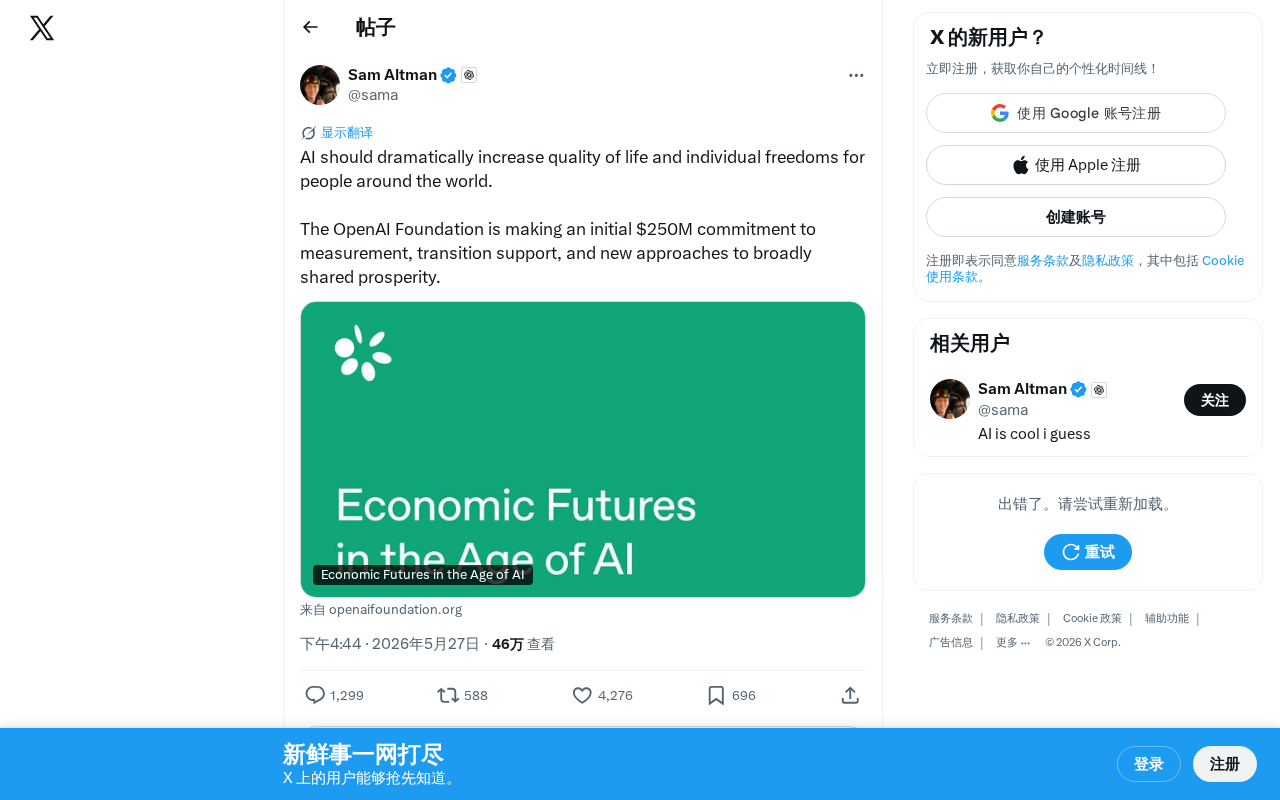
OpenAI Foundation invests $250M to ensure AI prosperity is shared globally across three key directions.
The OpenAI Foundation announced an initial $250 million investment focused on three directions: measurement, transition support, and shared prosperity, aiming to ensure AI benefits reach a broader global population. The initiative encompasses building quantitative frameworks for AI's social impact, helping those displaced by AI navigate transitions smoothly, and exploring new wealth-sharing models beyond traditional redistribution—while also serving as OpenAI's strategic response to criticism following its shift from nonprofit to for-profit status.
OpenAI Foundation's Major Commitment: Where Will $250 Million Go?
OpenAI recently announced a notable initiative: the OpenAI Foundation will deploy an initial $250 million to ensure that the prosperity generated by AI technology can be shared by a broader global population. The funding will focus on three key directions—Measurement, Transition Support, and exploring new pathways to shared prosperity.
OpenAI's CEO stated on social media: "AI should significantly improve the quality of life and personal freedom of people worldwide." This statement sets the tone for this massive investment—it's not just about technological progress, but about how to ensure that progress benefits everyone.
Deep Dive into the Three Core Directions
Measurement: Tracking AI's Real Social Impact with Data
How exactly do we quantify AI's impact on society? This is a long-overlooked yet critically important question. Currently, there is a lack of systematic data and evaluation frameworks regarding AI's effects on employment, income distribution, educational equity, and other areas. By investing in building measurement systems, the OpenAI Foundation signals its intent to track AI's actual social outcomes through data-driven approaches, rather than relying on intuition or guesswork to shape policy.
Quantifying AI's social impact is an emerging interdisciplinary field that blends econometrics, sociology, and data science. Common methodologies currently used in academia include: natural experiments (leveraging regional differences in AI technology penetration as quasi-experimental settings), panel data tracking (longitudinal monitoring of the same groups' employment and income changes before and after AI adoption), and hybrid methods combining large-scale surveys with machine learning. Research by MIT economist Daron Acemoglu and others has established partial baseline frameworks, but a global, systematic evaluation system remains absent. If the OpenAI Foundation can build open data infrastructure in this direction, it would have profound implications for the entire policy research community.
The importance of this direction lies in the fact that only by accurately measuring AI's social impact can we implement targeted interventions and adjustments. This also provides a scientific basis for subsequent policymaking and resource allocation.
Transition Support: Helping Those Affected by AI Navigate Change Smoothly
The rapid development of AI technology will inevitably bring structural changes to the labor market. Some jobs may be replaced by automation, while new positions and skill requirements continue to emerge. The core of transition support is helping those most affected by AI—whether individuals or communities—navigate this transitional period successfully.
Every major technological revolution in history has been accompanied by profound labor market restructuring. The First Industrial Revolution caused mass unemployment among British textile workers, giving rise to the Luddite movement; the automation wave of the 1980s hit manufacturing blue-collar workers, and the decline of America's "Rust Belt" remains an important social policy issue to this day. Unlike previous waves, this round of AI-driven technological disruption has a distinctive characteristic: it affects not only physical labor but also deeply penetrates knowledge-based and creative work, and the pace of change far exceeds any previous technological revolution in history. McKinsey Global Institute estimates that by 2030, as many as 375 million workers globally may need to switch occupational categories, making the scale and urgency of "transition support" far beyond any historical precedent.
Specific measures may include:
- Career retraining programs: Providing affected workers with opportunities to learn new skills
- Educational resource reallocation: Adjusting education systems to meet talent demands of the AI era
- Industry buffer mechanisms: Providing transitional support for impacted industries
Compared to the "develop first, deal with consequences later" attitude of many tech companies, OpenAI's proactive inclusion of transition support in its strategic planning reflects a more forward-looking sense of social responsibility.
New Pathways to Shared Prosperity: Exploring New Models for AI Wealth Distribution
This is the most imaginative of the three directions. How to distribute the enormous economic value created by AI is one of the central issues in current tech ethics discussions. The OpenAI Foundation clearly hopes to explore new mechanisms beyond traditional redistribution models, ensuring that wealth growth from AI doesn't concentrate solely in the hands of a few tech elites.
Universal Basic Income (UBI) refers to the policy concept of governments unconditionally distributing a fixed cash amount to all citizens on a regular basis, with theoretical roots traceable to Thomas Paine's 18th-century writings. In the AI era, the core logic behind UBI's revival is: when AI automation replaces human labor at scale, the traditional social contract of "work in exchange for income" will face fundamental challenges, requiring an income distribution mechanism decoupled from labor to maintain social stability and consumer spending power. Sam Altman himself funded the "Stockton Economic Empowerment Demonstration" (SEED) project in 2019, distributing $500 per month to 125 residents of Stockton, California for two years. Results showed significant improvements in recipients' full-time employment rates and mental health levels. The "new pathways to shared prosperity" explored by the OpenAI Foundation will likely expand experimental scale on this foundation and explore institutional designs that directly convert economic surplus generated by AI into citizen dividends.
Previously, Sam Altman had publicly discussed concepts like Universal Basic Income (UBI) on multiple occasions, and OpenAI had also funded related social experiments. The establishment of this foundation and its funding commitment can be seen as further institutionalization and scaling of this approach.
The Deeper Industry Significance Behind $250 Million
The $250 million commitment isn't an astronomical figure within the context of overall AI industry investment, but its symbolic significance far exceeds the number itself. Currently, global attention to AI safety and social impact is intensifying, and governments worldwide are accelerating the development of AI regulatory frameworks. OpenAI's move can be interpreted from multiple dimensions:
Proactively shaping industry norms. As a leading company in the AI field, voluntarily assuming social responsibility helps set industry standards and provides a more favorable position for dialogue with regulators.
Establishing an independent public interest mechanism. Operating through a foundation format allows building an independent public interest platform beyond commercial interests, strengthening public trust in AI development.
Responding to external skepticism about OpenAI. OpenAI was founded in 2015, initially operating as a nonprofit organization with the mission of "ensuring artificial general intelligence benefits all of humanity." In 2019, to attract large-scale commercial investment (particularly Microsoft's $13 billion injection), OpenAI created a "Capped Profit" subsidiary structure, stipulating that investor returns are capped at 100 times their investment, with excess profits going to the nonprofit parent entity. However, as ChatGPT exploded in popularity and the company's valuation soared to hundreds of billions of dollars, the actual constraining power of this structure came under widespread questioning. In 2024, OpenAI further advanced its complete transformation into a traditional for-profit company, triggering lawsuits and public criticism from multiple parties including co-founder Elon Musk. Against this backdrop, the establishment of the OpenAI Foundation and its $250 million commitment serves both as a substantive response to external skepticism and as a strategic arrangement to preserve an institutional anchor for its public interest mission along its commercialization path.
Challenges and Outlook: How Far from Commitment to Implementation?
There is often a significant gap between commitments and implementation. The following questions deserve ongoing attention:
- How will the $250 million be specifically allocated across different directions and projects?
- How will project effectiveness be evaluated, and can results be presented openly and transparently?
- AI's social impact is global—can the foundation's resources and influence truly reach developing countries and marginalized groups?
Regardless, at a time when AI technology is reshaping the world at an unprecedented pace, having a leading company willing to transform "shared prosperity" from a slogan into concrete action is itself a positive signal. Going forward, the industry and the public need to continuously monitor the fulfillment of these commitments and push more tech companies to join the movement toward AI inclusivity.
Key Takeaways
- The OpenAI Foundation announced an initial investment of $250 million, focusing on three directions: measurement, transition support, and shared prosperity
- The initiative aims to ensure that the benefits of AI development reach a broader global population rather than concentrating among a select few
- The transition support direction addresses AI's impact on the labor market, with urgency far exceeding any previous technological revolution—McKinsey estimates up to 375 million workers may need to switch careers by 2030
- The shared prosperity exploration builds on empirical foundations from social experiments like UBI, with Sam Altman having previously conducted a related pilot in Stockton, California
- This move also directly responds to questions about OpenAI's "original mission" following its transition from nonprofit to for-profit, preserving an institutional public interest anchor along its commercialization path
- Implementation of commitments, funding transparency, and actual coverage in developing countries remain key areas to watch going forward
Related articles
 Industry Insights
AI Product Development in Practice: Model Selection, Building Moats, and Paths to Commercialization
Practical strategies for AI product development: why not to train models from scratch, when to use APIs vs. fine-tuning, building product moats, and the full path from evaluation systems to commercialization.
 Industry Insights
No Product Fits Your Needs? Building It Yourself Is the Best Starting Point for Indie Developers
Can't find a product that fits? Building from personal pain points is the best entry for indie developers. Niche needs + AI tools = rapid product creation.
 Industry Insights
OpenAI Codex Tutorials Mass-Copied on Bilibili, Highlighting AI Content Farm Problem
At least 9 Bilibili accounts mass-published identical OpenAI Codex tutorial videos, exposing content farm operations in the AI tools space.