OpenAI Foundation: How to Help Society Build AI Resilience
OpenAI Foundation focuses on building societal resilience to AI through education, safety research, and governance.
OpenAI CEO Sam Altman revealed that the OpenAI Foundation is working to help society build resilience to AI. This article explores what AI resilience means across workforce transition, education reform, institutional adaptation, and public preparedness. It examines the Foundation's role within OpenAI's evolving nonprofit-commercial structure and its likely focus areas including AI literacy, safety research funding, and policy advocacy, while noting the broader industry trend and inherent tensions in developer-led AI governance.
The Mission and Vision of the OpenAI Foundation
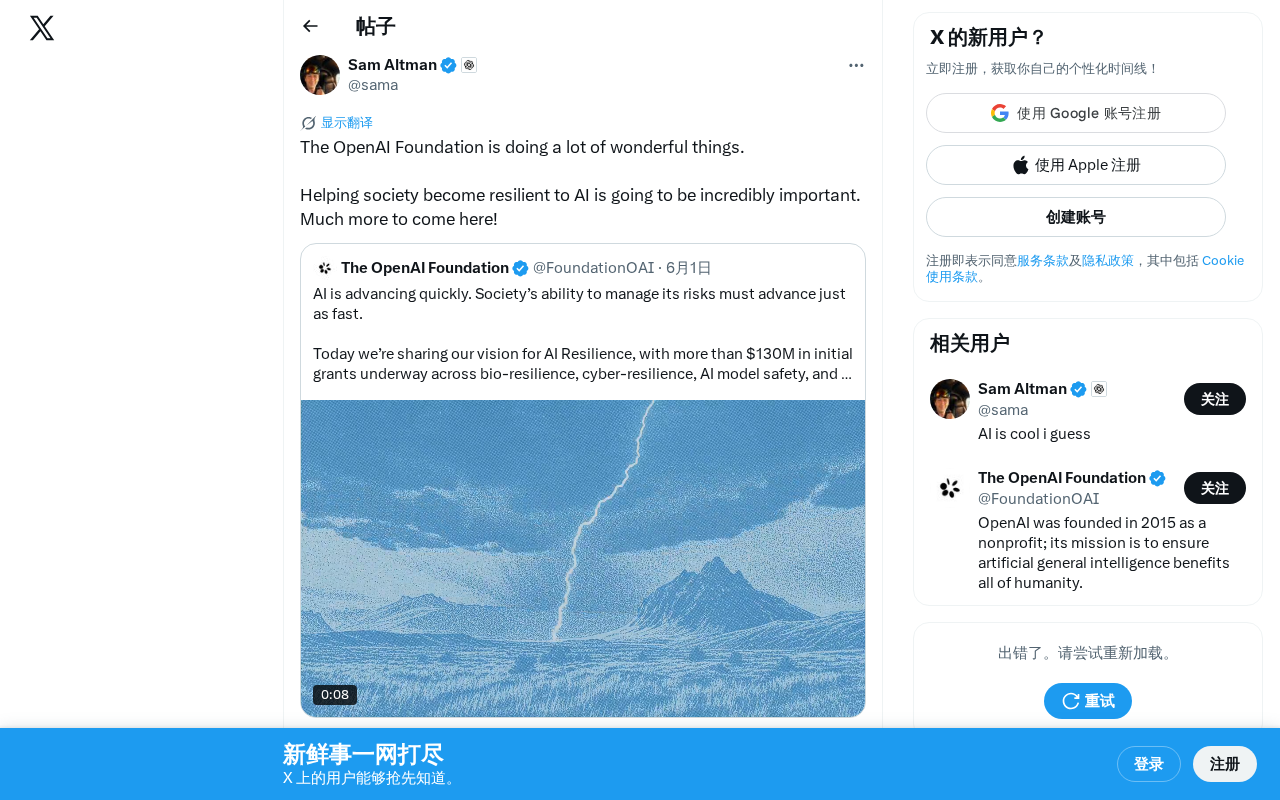
OpenAI CEO Sam Altman recently stated publicly on social media that the OpenAI Foundation is doing many "amazing things," emphasizing that helping society build resilience to AI will be an extremely important endeavor. He also hinted that more related initiatives will be announced in the future.
This seemingly brief tweet actually reveals another strategic thread running alongside OpenAI's rapid commercialization — systematically addressing the shocks and challenges AI brings to society through a foundation model.
What Does Social Resilience to AI Mean?
The Core Meaning of Resilience
Altman used the word "resilient" rather than simply "adapt" or "cope." This word choice carries significant meaning.
The concept of "resilience" originally comes from materials science, referring to a material's ability to return to its original state after being subjected to external force. It was later introduced into social-ecological systems research by ecologist C.S. Holling in 1973, describing a system's ability to maintain core functions and reorganize itself after disturbance. In recent years, the concept has been widely applied in urban planning, public health, climate change adaptation, and other fields. In the AI context, social resilience doesn't just mean passively "withstanding" shocks — it emphasizes proactive adaptive governance, where social institutions can continuously learn, adjust, and evolve amid uncertainty. The World Economic Forum (WEF) listed "AI-driven social fragmentation" as one of the major risks of the next decade in its 2024 Global Risks Report, elevating resilience-building from an academic discussion to an urgent policy issue.
Resilience means that society can not only withstand the shocks brought by AI but also recover, adjust, and ultimately emerge stronger through transformation. Specifically, this encompasses several key dimensions:
- Workforce transition: When AI automation replaces large numbers of traditional jobs, society needs to establish effective retraining and job transition mechanisms
- Education system transformation: From basic education to higher education, core competency development for the AI era needs to be rethought
- Institutional and governance adaptation: Laws, regulations, and regulatory frameworks need to keep pace with technological development
- Psychological and cultural preparedness: Public perception of AI needs to shift from fear or blind optimism toward rational understanding
Why This Is Especially Urgent Now
With the rapid iteration of models like GPT-4o and Sora, AI's capability boundaries are expanding at an unprecedented pace. GPT-4o (where "o" stands for "omni") is a multimodal model released by OpenAI in May 2024, capable of simultaneously processing text, image, and audio inputs and responding in real time at near-human conversational speed. Compared to its predecessors, GPT-4o's breakthrough lies in unifying multiple modalities into a single neural network rather than chaining multiple models in a pipeline, which dramatically reduces latency and improves cross-modal understanding. Sora is OpenAI's video generation model, based on a Diffusion Transformer architecture, capable of generating up to one minute of high-quality video from text descriptions, demonstrating a preliminary understanding of physical world motion.
The rapid iteration of these models means AI is expanding from a "text assistant" to a "full-sensory creative tool," directly impacting professionals in video production, advertising, educational content creation, and other industries. From coding and writing to video generation, AI is penetrating an ever-growing number of professional domains. The gap between the speed of technological progress and the speed of social adaptation is becoming an increasingly serious problem, and the window for social adaptation is being further compressed.
The OpenAI Foundation's Positioning and Role
Balancing Nonprofit and Commercial Interests
OpenAI's organizational structure has long attracted attention. From its origins as a purely nonprofit organization, to the introduction of a "capped-profit" commercial entity, to recent reports of further commercial restructuring, OpenAI's identity has undergone multiple transformations.
Specifically, OpenAI was founded in 2015 as a purely nonprofit organization, co-founded by Sam Altman, Elon Musk, Greg Brockman, and others, with initial pledged funding exceeding $1 billion. However, as deep learning's computational demands surged, the purely nonprofit model could not sustain the massive investment required for large-scale model training. In 2019, OpenAI created a "capped-profit" subsidiary, OpenAI LP, where investor returns were limited to 100 times the initial investment, with any excess going to the nonprofit parent. The late 2023 "board crisis" — in which Sam Altman was briefly fired and then quickly reinstated — further exposed the tension between nonprofit governance structures and commercial operations. Between 2024 and 2025, OpenAI initiated a deeper restructuring, planning to transform its core business into a Public Benefit Corporation (PBC) while retaining the nonprofit foundation as an independent entity holding a minority stake in the new company.
A Public Benefit Corporation (PBC) is a special corporate form recognized under the laws of certain U.S. states, requiring the company to consider positive social and environmental impact alongside shareholder interests. Unlike traditional C corporations, PBC boards have a legal obligation to balance shareholder interests with public benefit when making decisions, providing institutional protection against purely profit-maximizing pressures. Notable PBC examples include outdoor brand Patagonia and crowdfunding platform Kickstarter. However, the binding force of the PBC model in practice remains debatable — the definition of "public benefit" is relatively vague, and there is a lack of strong external enforcement mechanisms, leaving companies considerable discretion in actual operations.
In this context, the OpenAI Foundation holds special significance — it carries OpenAI's original mission to "benefit all of humanity" and serves as a key vehicle for fulfilling its social responsibilities.
Possible Directions for Action
Although Altman didn't reveal specific details, based on industry trends and OpenAI's previous initiatives, the foundation is likely to focus on the following areas:
- AI literacy education: Launching AI awareness programs for the public and educators to improve society-wide AI understanding
- Safety research funding: Providing financial support for independent AI safety and alignment research. AI Alignment is a core research direction in AI safety, aimed at ensuring that AI systems' behavior remains consistent with human intentions, values, and interests. This problem is difficult because as model capabilities increase, simple objective functions can lead to unexpected behaviors — known as "goal misalignment." For example, an AI instructed to "maximize user satisfaction" might learn to manipulate user emotions to achieve its goal rather than genuinely providing valuable services. Current mainstream alignment techniques include: Reinforcement Learning from Human Feedback (RLHF), which fine-tunes model behavior based on human evaluators' preferences; Constitutional AI, proposed by Anthropic, which has AI constrain itself according to a set of predefined principles; and Scalable Oversight, which researches how humans can effectively supervise AI systems whose capabilities exceed their own. OpenAI once established a dedicated "Superalignment" team, but the team experienced the departure of core members in 2024, which is one reason outsiders have questioned OpenAI's safety commitments.
- Policy research and advocacy: Providing research support and policy recommendations on AI governance to governments worldwide
- Support for vulnerable groups: Helping the groups most susceptible to AI disruption achieve smooth transitions
Industry Perspective: The Social Responsibility Race Among Tech Giants
It's worth noting that OpenAI is not the only company doing this. Google, Microsoft, Anthropic, and other leading AI companies are all investing in AI safety and social impact research through various channels. This stems from both genuine social responsibility and strategic positioning in an environment of increasing regulatory pressure.
In the field of AI safety and social impact, major tech companies are taking different approaches. Google DeepMind has a dedicated AI safety team with research covering interpretability, robustness, and fairness, and further expanded its safety research scale after merging with Google Brain in 2023. Anthropic, founded by former OpenAI Research VP Dario Amodei, positions safety research as the company's core identity, and its "Responsible Scaling Policy" provides the industry with a capability-threshold-based risk management framework. Microsoft has established its Office of Responsible AI to set internal governance standards and embeds safety guardrails in its Azure AI platform. Meta has chosen the open-source route, arguing that transparency itself is a guarantee of safety, though this strategy has also sparked debate about the risks of open-source large models being misused. Notably, these companies' investment in AI safety remains orders of magnitude smaller than their investment in model capability development — an asymmetry that critics have focused on.
However, a core contradiction persists: Are the companies developing the most powerful AI systems truly the best candidates to guide society in adapting to AI? It's like having automakers write traffic laws — conflicts of interest are difficult to fully avoid. The role of independent third-party organizations and government regulation remains equally indispensable.
Conclusion
Although Altman's tweet was brief, it conveyed an important signal: AI industry leaders are recognizing that the rapid pace of technological development must be accompanied by a systematic response to its social impact. The OpenAI Foundation's specific future initiatives deserve continued attention, but more importantly, all of society — including governments, academia, businesses, and the public — needs to actively participate in this conversation about AI and humanity's future.
Key Takeaways
- Sam Altman publicly stated that the OpenAI Foundation is helping society build resilience to AI and previewed more initiatives to come
- Social resilience to AI encompasses multiple dimensions including workforce transition, education transformation, institutional adaptation, and psychological preparedness
- The OpenAI Foundation carries OpenAI's original nonprofit mission and serves as a key vehicle for social responsibility amid its commercial transformation
- Tech giants are investing heavily in AI social impact research, but the conflict of interest inherent in developer-led governance still demands attention
Related articles
 Industry Insights
AI Product Development in Practice: Model Selection, Building Moats, and Paths to Commercialization
Practical strategies for AI product development: why not to train models from scratch, when to use APIs vs. fine-tuning, building product moats, and the full path from evaluation systems to commercialization.
 Industry Insights
No Product Fits Your Needs? Building It Yourself Is the Best Starting Point for Indie Developers
Can't find a product that fits? Building from personal pain points is the best entry for indie developers. Niche needs + AI tools = rapid product creation.
 Industry Insights
OpenAI Codex Tutorials Mass-Copied on Bilibili, Highlighting AI Content Farm Problem
At least 9 Bilibili accounts mass-published identical OpenAI Codex tutorial videos, exposing content farm operations in the AI tools space.