OpenAI Officially Rebuilds Its Robotics Team: Hiring Hardware and ML Engineers at Scale
OpenAI rebuilds its robotics team, hiring at scale to develop general-purpose robots powered by its foundation models.
OpenAI has officially announced its return to robotics, launching large-scale hiring for hardware and ML engineers. Led by DALL·E creator Aditya Ramesh, the robotics division evolved from OpenAI's world simulation research program. The team is pursuing a co-design approach integrating AI and hardware, with short-term plans to support infrastructure workers and a long-term vision of personal robots for everyone.
OpenAI Returns to the Robotics Arena
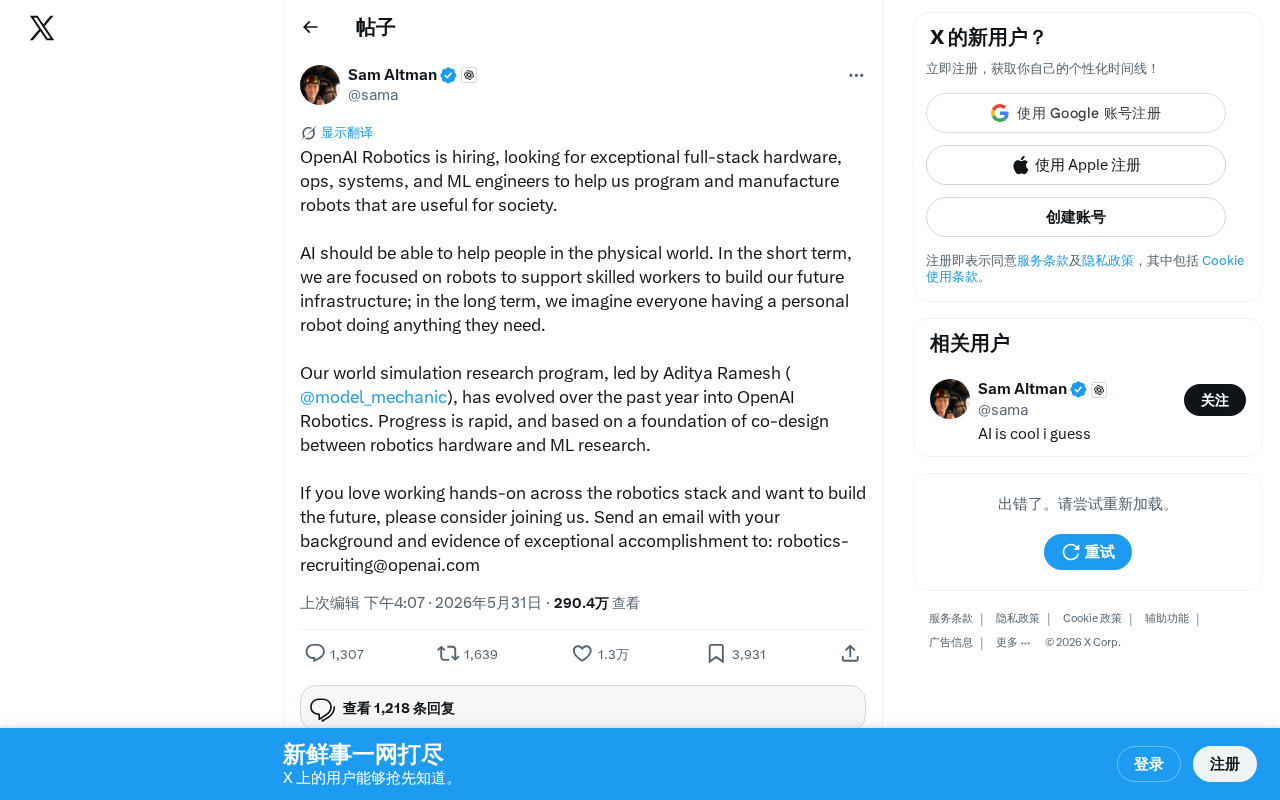
OpenAI recently announced on social media that its robotics division (OpenAI Robotics) is hiring at scale, seeking full-stack hardware engineers, operations engineers, systems engineers, and machine learning engineers. The goal: to program and manufacture "robots that are useful for society."
This marks OpenAI's official return to the physical-world AI arena after disbanding its robotics team in 2021. It's worth looking back: OpenAI's original robotics team was formed around 2017 and achieved remarkable results — most famously training the Dactyl robotic hand to solve a Rubik's Cube using reinforcement learning (2019), demonstrating the enormous potential of Sim-to-Real transfer. However, the team was dissolved in 2021, primarily due to technical bottlenecks at the time: reinforcement learning worked well on simple tasks but was difficult to scale to complex, general-purpose manipulation, and there was insufficient real-world data to train models with strong generalization capabilities. Team members subsequently scattered to robotics startups like Covariant. Today, breakthroughs in large language models and multimodal models have completely changed the landscape — foundation models provide powerful commonsense reasoning and generalization capabilities, meaning robots no longer need to learn each task from scratch. Unlike last time, OpenAI now has powerful foundation models like GPT-4 and Sora as its technological bedrock, making the timing and conditions for re-entering robotics fundamentally different.
From World Simulation to Robotics: The Technical Path Revealed
Led by Aditya Ramesh, Evolved from World Simulation Research
OpenAI revealed a key piece of information: the current robotics project originated from its "World Simulation Research Program," led by Aditya Ramesh. Ramesh is the core creator of the DALL·E series of image generation models — he led the development of DALL·E (2021) and DALL·E 2 (2022). The former used a GPT-architecture autoregressive approach to unify text tokens and image tokens in a single model, while the latter introduced diffusion models and CLIP embedding spaces, dramatically improving generation quality. Ramesh's core expertise lies in multimodal representation learning — enabling AI to simultaneously understand language and visual information and establish precise mappings between the two. This capability is critical for robotics: robots need to understand natural language instructions from humans (e.g., "put the red cup on the table"), map them to an understanding of the visual scene, and then translate that into specific motion control sequences. Having Ramesh lead the robotics project strongly suggests that OpenAI's technical approach will rely heavily on vision-language-action multimodal fusion.
This means OpenAI's robotics technology roadmap likely deeply integrates visual generation and world model capabilities. A "World Model" is a core frontier direction in recent AI research. The central idea is to have AI systems build an internal representation of how the physical world operates. World models need to not only understand what objects are in an image, but also predict how objects will move and interact under physical rules like force, gravity, and friction. This concept was first systematically articulated by Turing Award laureate Yann LeCun, who argued that world models are the key missing module for achieving human-level AI. OpenAI's Sora video generation model is widely regarded as an important step toward world simulation — it can generate physically plausible video sequences, suggesting the model has internally learned some degree of physical intuition. Transferring this capability to robotics means robots could "imagine" the consequences of their actions internally before executing them, enabling safer and more efficient planning and decision-making.
Over the past year, this world simulation research project has gradually evolved into a full-fledged robotics division. OpenAI emphasizes that "progress has been rapid," with the technical foundation being "co-design of robotics hardware and ML research." Co-design is an important engineering philosophy: during product development, software algorithms and hardware form factors influence each other and are jointly optimized from the very beginning, rather than designing hardware first and then adapting software to it. In robotics, the traditional approach is often for mechanical engineers to first determine joint degrees of freedom, sensor layouts, and actuator specifications, and then for software teams to develop control algorithms within the given hardware constraints. Co-design requires bidirectional adaptation: if an AI algorithm performs better with a certain sensor configuration, the hardware design should accommodate that need; conversely, if a certain mechanical structure simplifies the control problem, the algorithm should adjust accordingly. Apple's chip-software integration and Tesla's joint optimization of FSD chips and neural networks are both successful examples of the co-design philosophy. OpenAI's adoption of this approach means its robots' physical form will be deeply shaped by AI capabilities. This is similar to the paths taken by Tesla Optimus, Figure, and other companies, but OpenAI's deep expertise in large models could provide a differentiated advantage.
Short-Term Goals and Long-Term Vision
OpenAI has laid out a clear timeline for its robotics business:
- Short-term goal: Develop robots to support skilled workers in building future infrastructure. This suggests initial products may target industrial scenarios such as construction, manufacturing, and logistics with collaborative robots.
- Long-term vision: Give everyone a personal robot capable of completing any task needed. This is the ultimate goal of general-purpose humanoid robotics.
"AI should be able to help people in the physical world" — this statement may sound simple, but it represents a major strategic expansion for OpenAI: extending from digital-world intelligence (ChatGPT, API services) to physical-world intelligence.
Industry Landscape and Competitive Analysis
Fierce Competition in the Robotics Arena
The general-purpose robotics space is already extremely crowded:
- Tesla Optimus: Leveraging its own manufacturing capabilities and visual AI experience accumulated from FSD
- Figure AI: Backed by investments from Microsoft, NVIDIA, and other tech giants, with BMW partnership for deployment
- 1X Technologies: Received early investment from OpenAI (ironically, OpenAI is now entering the field itself)
- Boston Dynamics: Transitioning the Atlas humanoid robot toward electric-drive commercialization
OpenAI's biggest differentiator entering the arena now is its deep expertise in large language models, multimodal understanding, and world models. If it can combine GPT-level reasoning capabilities with physical manipulation, it could achieve a breakthrough in robot generalization in unstructured environments. A key concept to understand here: in robotics, "structured environments" refer to highly predictable settings like factory assembly lines where object positions are fixed and task workflows are standardized — traditional industrial robots are already very mature in such environments. "Unstructured environments," on the other hand, refer to homes, construction sites, outdoor settings, and other scenarios full of uncertainty: diverse objects in random positions, uneven surfaces, varying lighting conditions, and unpredictable behavior from humans and animals. Making robots work in unstructured environments requires "generalization" — the ability to perceive, reason, and act reasonably when facing objects, scenes, and tasks never seen before. The few-shot learning and commonsense reasoning capabilities demonstrated by large language models are considered key to breaking through this bottleneck. For example, even if a robot has never seen a particular tool, it can use the language model's knowledge to infer its purpose and how to grasp it.
Key Signals from Hiring
Looking at the hiring requirements, OpenAI is seeking "full-stack" talent — spanning hardware, operations, systems, and ML. This indicates that OpenAI isn't just building a software-level robot brain but is deeply involved in hardware design and manufacturing. The phrase "manufacture robots" makes it clear that OpenAI plans to develop its own hardware, rather than serving solely as an AI supplier for third-party robots.
Far-Reaching Industry Impact
When the world's most powerful AI lab decides to build its own robots, the competitive landscape of the entire industry will be reshaped. For existing robotics companies, OpenAI is both a potential competitor and possibly a standard-setter in the early stages.
More notably, OpenAI's choice to enter through "supporting infrastructure construction" is a pragmatic one — industrial scenarios have clear demand and willingness to pay, while also providing valuable real-world data for general-purpose robotics. From world simulation to real-world deployment, OpenAI is building a complete technology pipeline from virtual to physical. The core technical paradigm of this pipeline is Sim-to-Real (simulation-to-reality transfer): training robot policies at scale in high-fidelity physics simulators (such as NVIDIA Isaac Sim, MuJoCo, etc.), then deploying the trained models onto real robots. The advantage of this approach is that training data can be generated infinitely in simulation with no risk of hardware damage. But the biggest challenge is the "Reality Gap" — no matter how realistic a simulation environment is, it cannot perfectly reproduce the physical details of the real world. To bridge this gap, researchers typically employ "Domain Randomization" techniques, randomizing various physical parameters in simulation to force models to learn policies that are robust to environmental variations. OpenAI's evolution from world simulation research to a robotics division likely means it is building higher-fidelity world simulators, combining the capabilities of generative models like Sora to further narrow the reality gap.
The curtain on the robotics era is being raised by AI giants together.
Related articles
Vibe Coding in Practice: A Junior Student Uses Cursor to Build a Multi-Agent System with 51 AI Officials Based on the Three Departments and Six Ministries Framework
A junior student uses Cursor and Vibe Coding to build a multi-agent system with 51 AI officials modeled on China's Three Departments and Six Ministries, featuring task distribution, approval workflows, and Token cost visualization.

How to Connect Codex to DeepSeek Models: Free Switching via CC Switch
Learn how to connect OpenAI Codex to DeepSeek models via CC Switch, enabling free switching between DeepSeek and GPT with complete setup and routing guide.

AI Coding Deployment Guide: A Complete Hands-On Workflow from Local Demo to Live Website
Most AI Coding tutorials stop at local demos. This guide walks through 8 key steps to deploy an AI-powered 3D figurine website from Codex coding to live server deployment.