OpenAI Symphony: The Future of Coding Agents Is Task Queues, Not Chat Windows

The bottleneck of multi-Agent parallel development is human attention, requiring a shift from conversation-driven to task-driven workflow orchestration.
When developers run multiple Coding Agents simultaneously, the real bottleneck isn't AI capability but human attention and context switching. OpenAI's open-source Symphony provides a task orchestration specification: shifting the subject from "sessions" to "tasks," controlling transitions through state machines, requiring Agents to submit Proof of Work, and maintaining human review gates. Its core insight is that the primary interface of an AI-native workbench should be tasks, states, evidence, and acceptance — not chat windows.
When You Have Three Agent Windows Open, the Bottleneck Isn't AI — It's You
If you're already using Codex, Claude Code, or Copilot Agent simultaneously for development, you've probably encountered a subtle problem — it's not that the Agent isn't fast enough, but that you're starting to lose track. One window is modifying the frontend, another is running tests, and a third is investigating a historical bug. It feels great at first, but after three or four windows, you start forgetting: which one finished, which one is stuck, which one needs confirmation, which one you said you'd retry.
In their engineering blog introducing Symphony, OpenAI directly called out this real-world bottleneck: Interaction is the ceiling for Coding Agents — not model capability, but human attention. The blog mentions that after managing three to five sessions simultaneously, context switching becomes painful for most people. You're jumping between terminals, reminding Agents to stay on track, checking if they're stuck. Eventually you realize the Agent is fast, but you've become the bottleneck.
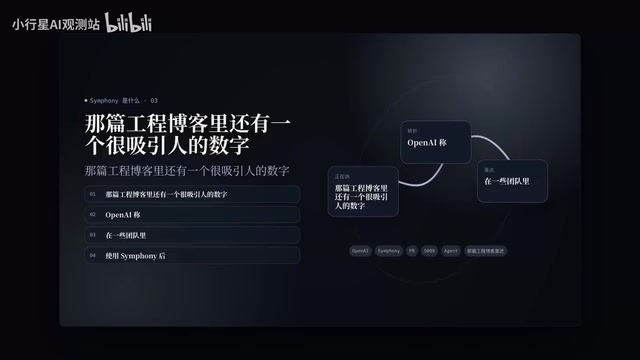
This is the context behind OpenAI open-sourcing Symphony. According to their engineering blog, some internal teams saw approximately a 500% increase in merged PRs during the first three weeks of using Symphony. Of course, this is OpenAI sharing their own team's practice, not a third-party evaluation. But the structural change behind that number is what's truly worth paying attention to: when Agents can genuinely keep working continuously, teams must redesign how tasks are dispatched, how state is tracked, and how results are verified.
What Symphony Is: From Chat Windows to Task Queues
More precisely, Symphony is not a model, nor an IDE plugin — it's an orchestration specification and reference implementation for Coding Agents. You could call it a "task orchestrator" or "Agent work dispatch console."
What it does is: continuously read issues from the task system, dispatch qualifying tasks to Agents, and manage the execution process through Workspaces, state machines, and logs. Human attention is no longer spent watching each session, but rather on task definition, state transitions, evidence review, and acceptance decisions.
The Subject Shifts from "Session" to "Task"
When we normally use Agents, the default subject is a "session" — you open a window, give it a task, then watch its output. When tasks pile up, you open more windows. The problem is that sessions aren't a good unit of work management. A real task might require multiple PRs, span several repositories, or might just be an investigation report that doesn't change any code at all.
Symphony's approach is to change the subject to tasks. The spec.md in the GitHub repository provides an engineering description: create an independent Workspace for each task, and run a Coding Agent Session within that Workspace. In other words, it's not "I opened an Agent so it needs to do something," but rather "there's a clearly defined task here, so the system needs to ensure the Agent drives it forward."
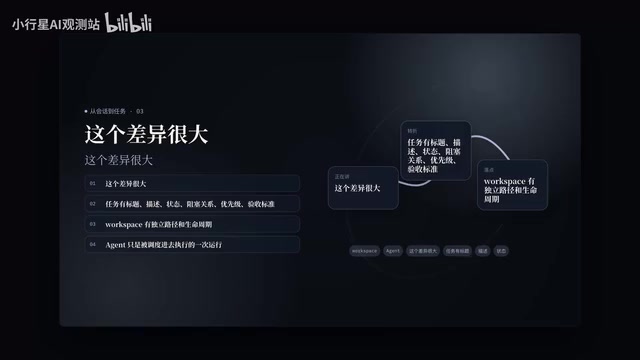
This difference is significant. Tasks have titles, descriptions, states, dependencies, priorities, and acceptance criteria. Workspaces have independent paths and lifecycles. The Agent is just a single run that gets scheduled into the Workspace. Work is no longer scattered across a bunch of chat windows — it returns to the task system that teams already know how to manage.
State Machine as Control Logic
The Linear reference implementation in the GitHub repository contains a workflow.md, which serves as a workflow contract written for both the Agent and the scheduler. It defines task states as a set of transitions:
Todo → In Progress → Human Review → Rework → Merging → Done
On the surface this looks like kanban column names, but in Symphony, state IS control logic:
- Todo: The system can pull it to In Progress and start an Agent
- In Progress: Agent is executing
- Human Review: PR has been attached and verified, awaiting human review
- Rework: Reviewer requested changes
- Merging: Merge process begins
- Done/Closed/Canceled: Stop running and clean up Workspace
Symphony doesn't remove humans entirely — it moves them off the "check every few minutes" hot path. What humans should actually do is define tasks, confirm acceptance criteria, handle reviews, and approve merges — shifting from managing agents to managing work.
Proof of Work: Not "It's Done," but "I Can Prove It's Done"
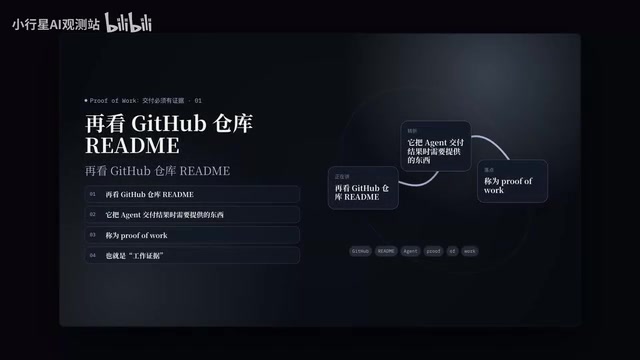
The GitHub repository README calls what Agents need to provide when delivering results Proof of Work. Listed examples include: CI status, PR Review Feedback, complexity analysis, and Walkthrough Videos.
This design is particularly important. What teams actually need isn't a statement of "I'm done," but "I can prove I'm done." Simplified, it's a delivery evidence package:
- What was changed? Why was it changed this way?
- Which tests were run? What were the results?
- Where are the screenshots or recordings?
- What known risks remain?
- How do we roll back if something goes wrong?
Without solidifying this step, running multiple Agents in parallel easily becomes "several black boxes simultaneously producing a bunch of stuff you don't dare merge." This is also why the Human Review state can't be skipped — Agents can push work to a reviewable state, but whether to merge, deploy, or expand permissions still requires explicit human gatekeeping.
Prerequisites: Without Engineering Foundations, More Agents Only Amplify Chaos
Symphony's README explicitly states that it's an Engineering Preview for Trusted Environments — more like an architecture example, not a commercial product you can download and mindlessly put into production.
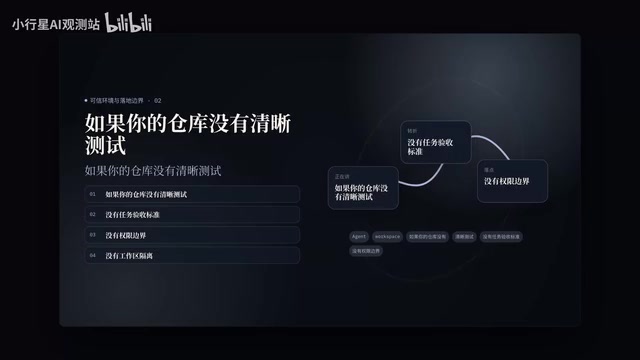
If your repository lacks clear tests, task acceptance criteria, permission boundaries, workspace isolation, or rollback habits, then running more Agents simultaneously will only amplify the chaos. Before, it was one person in one window creating mess; now it becomes ten Workspaces creating mess together.
Symphony's prerequisite is actually Hardened Engineering: repositories must be suitable for Agent work, tasks must be decomposable, verification must be automated, state must be trackable, and failures must be recoverable. Without these foundations, so-called full automation is just generating uncertainty faster.
Five-Step Implementation Path for Regular Teams
What regular teams should learn isn't to immediately copy OpenAI's architecture, but to first build a "mini Symphony":
Step One: Turn your task board into a real control plane. Each task should have at minimum: state, owner, acceptance criteria, and dependencies.
Step Two: Give the Agent a workflow contract within the repository. It doesn't have to be called workflow.md, but it should clearly state: what to look at first after receiving a task, when code changes are allowed, when tests must be run, when to enter human review, and when to stop.
Step Three: Use an independent workspace for each task. Especially when running multiple Agents in parallel, physical isolation is crucial. Otherwise it's hard to see who introduced a particular change, and hard to safely roll back.
Step Four: Mandate a delivery evidence package. Test results, screenshots, recordings, change summaries, risk descriptions, rollback methods — at least several of these categories. You don't have to auto-merge, but you can't accept an evidence-free "it's done."
Step Five: Gradually expand task granularity. Start by having Agents do small fixes, small investigations, small refactors. Once state transitions, evidence submission, and review acceptance are running smoothly, then let them handle complex tasks spanning files, modules, and repositories.
Conclusion: The Next Phase Is About Workflows, Not Window Count
What Symphony truly signals is: The primary interface of an AI-native workbench might not be a chat box, but tasks, states, evidence, and acceptance.
When Agents aren't very capable, chat boxes work well because humans need to course-correct constantly. But when Agents truly start working continuously, chat boxes become the bottleneck. The next phase isn't about who can open more windows, but who can place Agents into a trackable, verifiable, recoverable workflow.
From "conversation-driven" to "task-driven" — this isn't just a change in interaction paradigm, but a fundamental restructuring of how software engineering is organized.
Related articles
 Industry Insights
AI Product Development in Practice: Model Selection, Building Moats, and Paths to Commercialization
Practical strategies for AI product development: why not to train models from scratch, when to use APIs vs. fine-tuning, building product moats, and the full path from evaluation systems to commercialization.
 Industry Insights
No Product Fits Your Needs? Building It Yourself Is the Best Starting Point for Indie Developers
Can't find a product that fits? Building from personal pain points is the best entry for indie developers. Niche needs + AI tools = rapid product creation.
 Industry Insights
OpenAI Codex Tutorials Mass-Copied on Bilibili, Highlighting AI Content Farm Problem
At least 9 Bilibili accounts mass-published identical OpenAI Codex tutorial videos, exposing content farm operations in the AI tools space.