OpenAI Models Officially Land on AWS Bedrock, Ushering in a New Multi-Cloud Era for Enterprise AI Deployment
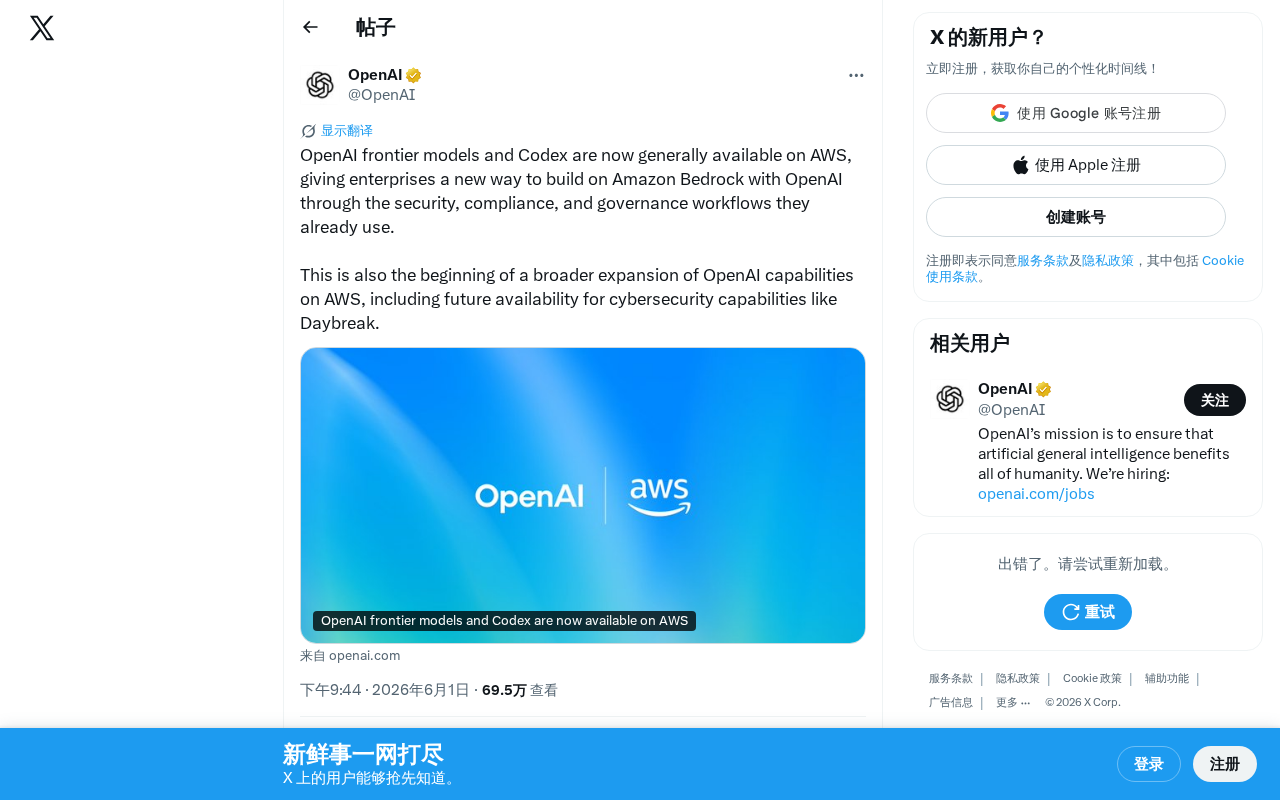
OpenAI models and Codex launch on AWS Bedrock, breaking Azure exclusivity and ushering in multi-cloud AI.
OpenAI has announced that its frontier models and Codex programming tool are now generally available on Amazon Bedrock, enabling enterprises to invoke OpenAI capabilities through their existing AWS security and compliance frameworks. This move breaks the exclusive binding between OpenAI and Microsoft Azure, accelerating the multi-cloud AI deployment era. OpenAI also plans to launch cybersecurity products including Daybreak on AWS, evolving toward an enterprise AI platform. Bedrock now becomes one of the most comprehensive enterprise AI platforms, integrating mainstream models from OpenAI, Anthropic, Meta, and more.
OpenAI's Full Integration with Amazon Bedrock: Partnership Details
OpenAI has announced that its frontier models and Codex programming tool are now generally available (GA) on the AWS platform. Enterprise users can now invoke OpenAI's capabilities directly through Amazon Bedrock. This means businesses can use OpenAI's most powerful AI models without leaving their existing AWS security, compliance, and governance workflows.
Amazon Bedrock is a fully managed AI model service platform officially launched by AWS in 2023. Its core design philosophy is to let enterprises access foundation models from multiple AI vendors through a unified API interface, without having to manage underlying GPU clusters and model inference infrastructure themselves. Bedrock uses a serverless architecture where enterprises pay based on actual usage, while supporting enterprise-grade features such as fine-tuning and Retrieval-Augmented Generation (RAG). Unlike calling model vendors' APIs directly, Bedrock integrates model invocations into AWS's overall security and governance framework — data never leaves the customer's designated AWS region, which is critical for enterprises with strict data sovereignty requirements.
This partnership marks yet another significant shift in the AI industry landscape — OpenAI models, once seen as an exclusive advantage of Microsoft Azure, are now fully open to the AWS ecosystem.
Key Breakthroughs for Enterprise AI Deployment
Seamless Security and Compliance Integration
For large enterprises, the biggest barrier to adopting new AI capabilities is often not the technology itself, but security and compliance concerns. Many enterprises have already built mature security architectures, data governance processes, and compliance frameworks on AWS. With OpenAI models served through Amazon Bedrock, enterprises can:
- Reuse existing IAM permission management and access control policies
- Keep data flowing within existing VPCs and security boundaries
- Leverage AWS-native audit logs and monitoring tools to track AI invocations
- Meet industry-specific compliance requirements (such as HIPAA, SOC 2, etc.)
It's worth understanding in depth that IAM (Identity and Access Management) is AWS's core identity and access management service, allowing enterprises to control with extreme granularity who can access which resources and perform which operations. Enterprises typically spend months or even years building comprehensive IAM policy frameworks covering complex scenarios such as role permissions, cross-account access, and temporary credentials. VPC (Virtual Private Cloud) is AWS's network isolation mechanism, enabling enterprises to run workloads in logically isolated virtual networks, using security groups, network ACLs, and private subnets to ensure data is not exposed to the public internet. OpenAI models being served through Bedrock means that AI inference requests can be completed within private networks via VPC endpoints (PrivateLink), with data never traversing public networks — this is critical for processing sensitive information such as financial transaction data and patient health records.
This dramatically lowers the barrier for enterprises to adopt OpenAI models, especially for clients in highly regulated industries such as finance, healthcare, and government.
Enterprise Deployment of the Codex Programming Assistant
Codex, as OpenAI's AI programming assistant, holds special significance with its general availability on AWS. Codex was originally released in 2021 as OpenAI's code generation model and served as the core engine behind GitHub Copilot. After multiple iterations, Codex has evolved from a simple code completion tool into an AI programming agent capable of understanding complex codebase context and executing multi-step programming tasks. The 2025 version of Codex can autonomously run code in sandbox environments, write tests, fix bugs, and submit code changes via pull requests.
Enterprise development teams can integrate Codex into their software development lifecycle without changing their existing development toolchains or deployment processes. In enterprise scenarios, Codex's value lies not only in boosting individual developer coding speed, but also in standardizing code quality, accelerating code review processes, and helping teams quickly understand and maintain legacy codebases. For teams already deeply using AWS CodePipeline, CodeBuild, and other DevOps tools, this is a highly attractive option — AWS CodePipeline and CodeBuild are AWS-native CI/CD (Continuous Integration/Continuous Deployment) toolchains, and Codex's integration with these tools means AI-generated code can automatically enter the enterprise's existing build, test, and deployment pipelines, rapidly boosting development efficiency in a familiar environment.
Strategic Expansion: Cybersecurity Capabilities Coming Soon
OpenAI explicitly stated in its announcement that this is just the beginning of a broader capability expansion on AWS. Cybersecurity-related capabilities will be offered on AWS in the future, including a security product called Daybreak.
The launch of Daybreak reflects the industry trend of deep convergence between AI and cybersecurity. Traditional cybersecurity relies on rule engines and signature matching to detect threats, but these methods have proven insufficient against increasingly sophisticated attack vectors such as AI-generated phishing emails, polymorphic malware, and zero-day exploit attacks. The application prospects for large language models in the security domain include: automated analysis of security logs and alerts, converting natural language threat intelligence into actionable defense rules, and assisting security analysts with incident response and forensic investigations. According to Gartner's forecast, global cybersecurity spending will exceed $260 billion by 2027. OpenAI's entry into this space not only provides high-value vertical application scenarios for its models but also enables rapid access to target customers through AWS's deep presence in the enterprise security market (via services like AWS Security Hub, GuardDuty, etc.).
This signal is worth watching. OpenAI is evolving from a pure large language model provider toward an enterprise AI platform. Cybersecurity is one of the fastest-growing areas of enterprise IT spending, and OpenAI's choice to make security capabilities the next focus of its AWS expansion demonstrates its deep understanding of the enterprise market and strategic ambition.
Industry Impact: The Multi-Cloud AI Era Accelerates
Breaking Cloud Vendors' Model Exclusivity Barriers
Over the past two years, exclusive binding relationships between cloud vendors and AI model companies have been a hot topic in the industry. Since 2019, Microsoft has invested over $13 billion cumulatively in OpenAI, establishing a deeply intertwined commercial relationship: Microsoft Azure became OpenAI's exclusive cloud infrastructure provider while gaining commercial distribution rights for OpenAI models through Azure OpenAI Service. This exclusive arrangement gave Azure a significant competitive advantage in the enterprise AI market, with many enterprises choosing to migrate to Azure solely because they needed access to models like GPT-4.
However, since 2024, the relationship has undergone subtle changes. OpenAI has begun seeking greater commercial independence, including transitioning from a nonprofit structure to a for-profit company and establishing partnerships with other cloud vendors like Oracle. This full-scale landing on AWS Bedrock represents a major step in OpenAI's multi-cloud strategy and formally ends Microsoft's exclusive advantage in OpenAI model distribution. That said, Microsoft remains OpenAI's largest investor and infrastructure partner, and their core partnership has not been dissolved.
For enterprise users, this is a positive signal — they no longer need to be forced to migrate cloud platforms for a specific AI model, and AI deployment under multi-cloud strategies becomes much more flexible.
Amazon Bedrock's Model Ecosystem Competitiveness Grows
Amazon Bedrock, as AWS's managed AI model service platform, had already integrated mainstream models such as Anthropic Claude, Meta Llama, and Mistral. The addition of OpenAI models makes Bedrock one of the most comprehensive enterprise AI platforms on the market in terms of model selection.
Multi-cloud strategy refers to the practice of enterprises using two or more cloud service providers simultaneously, with the goals of avoiding vendor lock-in, optimizing costs, improving availability, and meeting compliance requirements across different regions. According to Flexera's 2024 State of the Cloud Report, over 87% of enterprises have adopted multi-cloud strategies. However, implementing multi-cloud strategies in AI model deployment previously faced unique challenges: cloud vendors tended to exclusively bind specific models (e.g., Azure binding OpenAI, AWS deeply partnering with Anthropic, Google Cloud promoting Gemini), forcing enterprises to deploy different models on different cloud platforms, which significantly increased management complexity and costs.
With OpenAI models landing on Bedrock, enterprises can now access OpenAI's GPT series, Anthropic Claude, Meta Llama, and other mainstream models on a single AWS platform, managed through a unified API and governance framework. Enterprises can compare and switch between different vendors' models on the same platform, choosing the best solution for specific business scenarios. This significantly reduces the complexity of multi-cloud AI deployment and provides convenience for A/B testing and dynamic switching between different models.
Conclusion
The general availability of OpenAI models on AWS Bedrock is not just a commercial partnership coming to fruition — it reflects the broader trend of the AI industry shifting from a "model race" to an "enterprise deployment race." Whoever can enable enterprises to use AI most conveniently and securely will win the next phase of the market. OpenAI's embrace of the multi-cloud ecosystem, AWS's acquisition of top-tier model support, and enterprise users gaining more choices — this is a win-win-win scenario.
Key Takeaways
- OpenAI's frontier models and Codex are now generally available (GA) on AWS Amazon Bedrock, allowing enterprises to reuse existing security and compliance workflows
- This is the beginning of OpenAI's broader capability expansion on AWS, with cybersecurity capabilities including Daybreak coming in the future
- This move breaks the exclusive binding between OpenAI models and Microsoft Azure, accelerating the arrival of the multi-cloud AI deployment era
- Amazon Bedrock becomes one of the most comprehensive enterprise AI platforms, integrating mainstream models from OpenAI, Anthropic, Meta, and more
Related articles
 Industry Insights
AI Product Development in Practice: Model Selection, Building Moats, and Paths to Commercialization
Practical strategies for AI product development: why not to train models from scratch, when to use APIs vs. fine-tuning, building product moats, and the full path from evaluation systems to commercialization.
 Industry Insights
No Product Fits Your Needs? Building It Yourself Is the Best Starting Point for Indie Developers
Can't find a product that fits? Building from personal pain points is the best entry for indie developers. Niche needs + AI tools = rapid product creation.
 Industry Insights
OpenAI Codex Tutorials Mass-Copied on Bilibili, Highlighting AI Content Farm Problem
At least 9 Bilibili accounts mass-published identical OpenAI Codex tutorial videos, exposing content farm operations in the AI tools space.