Karpathy's Epic Interview: In the Software 3.0 Era, Understanding Is Humanity's Only Moat
Karpathy's Epic Interview: In the Soft…
Karpathy proposes Software 3.0: programming shifts from writing code to prompt engineering, with understanding as humanity's core value.
At AI Ascent 2025, OpenAI co-founder Karpathy argued that software is evolving from traditional programming (1.0) and neural network training (2.0) to a 3.0 era where LLMs serve as universal computational interpreters and programming becomes prompt engineering, causing many intermediate applications to "evaporate." Future computing architecture will see neural networks become the host process, though model capabilities remain uneven due to verifiability differences. He distinguished Vibe Coding from Agentic Engineering, emphasized that humanity's irreplaceable core value lies in deep understanding, and advised entrepreneurs to build their own reinforcement learning environments in vertical domains.
Introduction: An AI Pioneer's Anxiety
At Sequoia Capital's AI Ascent 2025 summit, OpenAI co-founder and former head of Tesla Autopilot, Andrej Karpathy, uttered a statement that shook the global developer community: "As a programmer, I have never felt so behind."
This industry pioneer, who personally helped build the modern AI ecosystem, coined the concept of Vibe Coding a year ago, fundamentally changing how countless developers work. Just one year later, he delivered an even more disruptive verdict — we are standing at the critical threshold of the leap from Software 2.0 to Software 3.0, and the very essence of programming is undergoing a fundamental shift.
The Cognitive Turning Point: Why Karpathy Says He's "Never Felt So Behind"
Karpathy described a very specific inflection point — December 2024. Before that, like most developers, he viewed AI coding tools as efficient assistants: capable of generating code snippets, occasionally making errors that required manual correction, and generally improving productivity.
But with the release of next-generation large models, everything changed. While on vacation, Karpathy discovered that the new models were generating code at a near-perfect level. He kept raising increasingly complex requirements, and the model output consistently maintained extremely high quality. He couldn't even remember the last time he manually corrected code.
The continuous accumulation of trust led him to fully enter the Vibe Coding state — no longer writing and checking code line by line, but describing requirements in natural language and completely trusting the system to handle the entire development workflow. Karpathy specifically emphasized: many people's understanding of AI is still stuck at the ChatGPT-style Q&A level, but if you've truly experienced an agentic continuous workflow, you'll realize the underlying logic has fundamentally changed.
Software 3.0: Programming Shifts from Writing Code to Prompt Engineering
In Karpathy's framework, software development has gone through three stages:
- Software 1.0: The traditional programming paradigm — humans write explicit code rules, and computers execute according to predetermined logic
- Software 2.0: The core of programming shifts from writing code to organizing datasets, designing objective functions, and training neural networks
- Software 3.0: The essence of programming shifts to prompt engineering, with large language models becoming a new universal computational interpreter
Karpathy illustrated this transformation with two powerfully impactful examples:
Example 1: The Paradigm Shift in Cross-Platform Installation
In the Software 1.0 paradigm, building a cross-platform installer requires writing complex scripts to handle different operating systems, hardware environments, and dependencies. In the Software 3.0 paradigm, you simply copy the text describing the installation process to an agent, which autonomously observes the environment, determines the steps, iteratively debugs, until the program runs successfully.
Example 2: The "Evaporation" of the MenuGen App
Karpathy developed a MenuGen application — take a photo of a menu, and it automatically generates accompanying images for each dish. Under the traditional paradigm, this requires an entire pipeline: OCR recognition, API calls, UI rendering, service deployment, and more. But the Software 3.0 version needs only two steps: take a photo, send it to the large model with a single instruction. The model directly returns a complete menu with images.
At that moment, Karpathy realized: the entire application he had previously developed shouldn't even exist in the Software 3.0 paradigm. All the intermediate layers — OCR, API calls, UI rendering, app deployment — had all been "evaporated."
The Neural Computer: A Role Reversal in Future Architecture
Following this logic, Karpathy painted an even more disruptive picture: future computer architecture will undergo a complete inversion of host and guest.
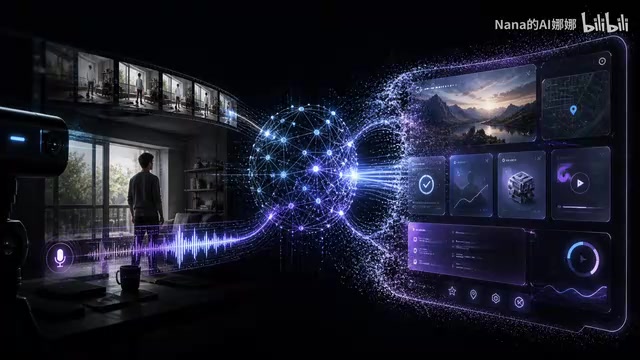
In today's architecture, the CPU and operating system are the core, and neural networks are merely processes running on top of them. But in the future, neural networks will become the host process of the system, dominating the absolute majority of computational consumption, while traditional CPUs degrade to co-processors responsible only for specific deterministic tasks.
Imagine this scenario: a device feeds raw video and audio directly into a neural network, which understands the scene and requirements, then uses diffusion models to render in real-time a unique user interface tailored exclusively to that moment — not assembled from fixed components, but instantaneously generated for the current task.
The Verifiability Framework: Understanding Why LLM Capabilities Are So Uneven
Why can top large models refactor 100,000-line codebases and discover zero-day vulnerabilities, yet stumble on common-sense questions like "should I drive or walk to a car wash 50 meters away"?
Karpathy calls this "jagged intelligence," and its root cause lies in verifiability. When frontier labs train models, they fundamentally rely on reinforcement learning environments — models receive positive rewards as long as their outputs pass verification. This determines:
- In domains like math and code with clear right/wrong criteria, models are trained repeatedly and achieve extraordinary capabilities
- In common-sense and logic domains where standardized verification mechanisms are hard to establish, training intensity is insufficient and performance is rough
A typical case: the qualitative leap in chess ability from GPT-3.5 to GPT-4 wasn't intelligence emergence — it was because massive chess game data was deliberately added to the pre-training set. Labs decide what data to feed, and models develop superhuman capabilities in the corresponding domains.
Agentic Engineering: From Vibe Coding to Production-Grade AI Development
Karpathy clearly distinguished two concepts:
Vibe Coding raises the capability floor for everyone — even those who don't know code can build applications through natural language. But it cannot solve the threshold problems of quality, security, and accountability.
Agentic Engineering is the engineering discipline of orchestrating and supervising multiple autonomous agents to achieve massive productivity gains while maintaining professional software quality and security standards. The engineer's core work shifts from writing code line by line to coordinating agents like a conductor, designing verification mechanisms, and holding the quality baseline.
Karpathy stated bluntly that future technical hiring should be completely restructured: no more algorithm puzzles for candidates to solve on the spot. Instead, give candidates a grand real-world project and see how they leverage agents to complete system construction, security offense/defense, and stress testing.
Humanity's Ultimate Moat: Understanding Cannot Be Outsourced
As agents become increasingly powerful, what is humanity's true value? Karpathy offered the answer that deeply struck him:
"You can perhaps outsource your thinking, but you cannot outsource your understanding."
You can forget the trivial differences between various PyTorch APIs, but you must understand the underlying principles of tensors and memory views; you must know what operations cause unnecessary memory copies and what designs introduce security vulnerabilities.
Agents can write payment logic for you, but they might associate cross-platform payment funds using email addresses, ignoring the fact that users can easily register and pay with different emails. Such code runs fine, tests pass, but the underlying design is wrong. Only humans with deep understanding of business logic and system architecture can catch these errors and guard system boundaries.
An Agent-Native Future World
Karpathy also used a striking metaphor to describe large models: "We're not creating animals — we're summoning spirits." These models lack the intrinsic motivation, curiosity, and emotions that evolution provides; they are statistical entities shaped by data and reward functions.
Looking ahead, Karpathy predicts we're moving toward an agent-native world:
- Developer documentation will no longer teach humans where to click, but provide instruction text that can be directly copied to agents
- Infrastructure will be built primarily around data structures that are easy for large language models to understand
- Every person and organization will have agents representing them, collaborating directly with each other
Conclusion: Don't Chase the Escape Velocity of Large Models — Build Your Own RL Environment
This paradigm revolution from Software 1.0 to Software 3.0 isn't about replacing humans with AI. It's about completely liberating humans from tedious execution layers, returning them to their most essential role — understanding the world, defining value, making judgments, and creating new things.
As intelligence becomes increasingly cheap and execution becomes increasingly automated, what remains truly precious and irreplaceable is always human understanding, judgment, and unique taste. For entrepreneurs, opportunity lies in vertical domains: as long as you can build a verifiable reinforcement learning environment in your own scenario, you can create vertical systems that far surpass general-purpose models.
Don't chase the escape velocity of large models — build your own RL environment.
Related articles
 Expert Opinions
Windsurf CEO Deep Dive Interview: Speed Is the Only Moat
Windsurf CEO Varun Mohan shares insights on AI coding IDE pivots, product methodology, async Agent challenges, and differentiation strategy vs Cursor. Speed is the only moat.
 Expert Opinions
Being Underestimated Is Freedom: A Contrarian Competition Philosophy for the AI Era
Exploring the contrarian strategy of 'being underestimated is freedom' in AI. From OpenAI to DeepSeek to Cursor, why staying under the radar beats standing in the spotlight.
How the Protestant Work Ethic Was Hija…
How the Protestant Work Ethic Was Hijacked: From Protecting Workers to Oppressing Them
Philosopher Elizabeth Anderson reveals how the Protestant work ethic was twisted from a worker-protecting ideal into a tool of oppression—and what it means for the AI era.