Replit's Domain-Specific Agents: One-Click Batch Fixes for SEO and Security Vulnerabilities
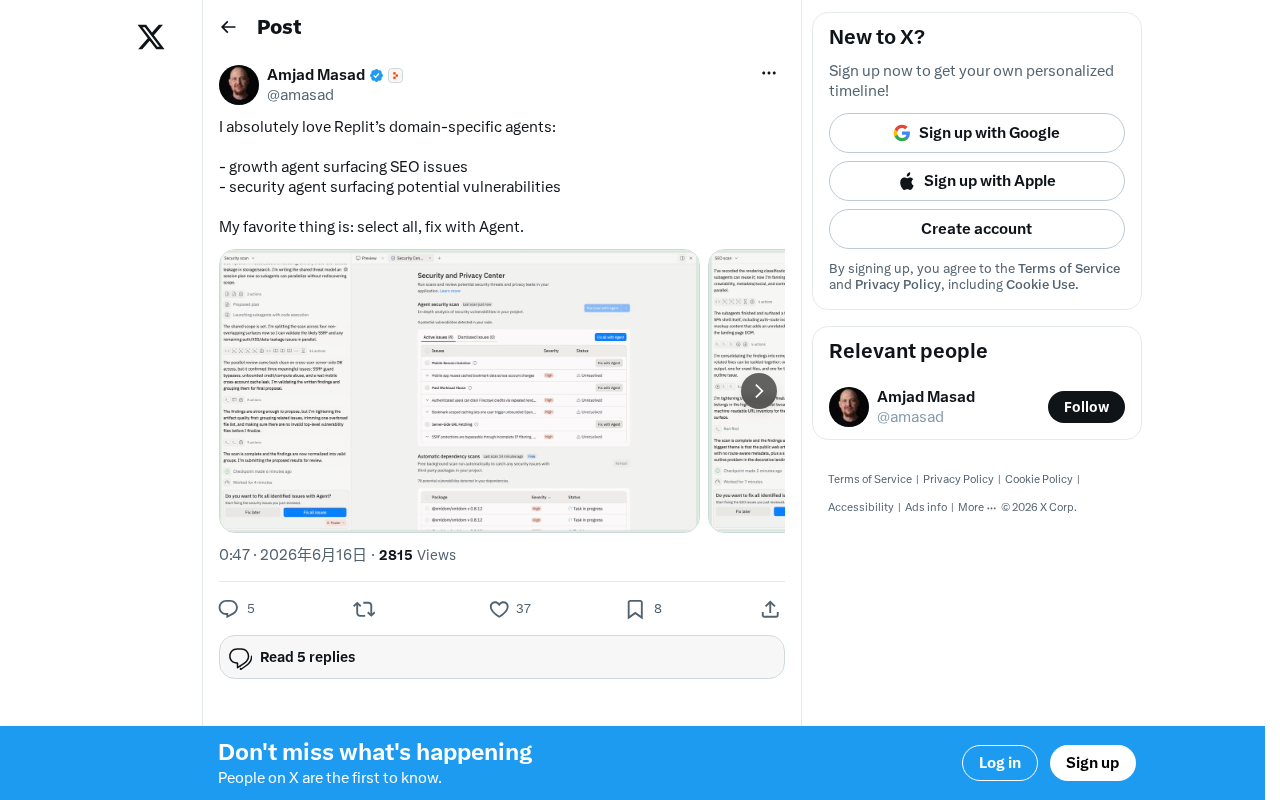
Replit launches domain-specific AI Agents for one-click batch SEO and security fixes.
Replit introduces domain-specific AI Agents — Growth Agent for automatic SEO issue detection and Security Agent for proactive vulnerability scanning. The standout feature is a "Select All, Fix with Agent" workflow that enables one-click batch remediation, shifting developers from executors to reviewers. This marks a broader industry trend from general-purpose AI assistants to specialized, proactive domain Agents.
Replit's Domain-Specific Agents Capture Developer Attention
Recently, a developer shared their experience with Replit's domain-specific agents on social media, sparking widespread discussion in the tech community. These specialized AI Agents can automatically detect and fix issues across different domains, signaling that AI-assisted development is evolving from general-purpose code generation toward more refined vertical use cases.
Domain-specific Agents represent an architectural design philosophy distinct from general-purpose AI assistants. In the AI Agent technology stack, an Agent refers to an intelligent entity capable of perceiving its environment, making autonomous decisions, and executing actions. While general-purpose Agents attempt to solve all problems with a single model, domain-specific Agents achieve higher professional precision by constraining task boundaries, injecting domain knowledge, and customizing evaluation criteria. This design borrows from the microservices architecture philosophy — decomposing complex systems into multiple single-responsibility, highly specialized service units, each excelling within its own domain.
Two Core Agents: Growth and Security
Growth Agent: Automatically Scanning and Discovering SEO Issues
Replit's Growth Agent focuses on technical optimizations related to website growth. It can automatically scan projects and proactively discover potential SEO issues, such as missing meta tags, non-standard URL structures, and page load performance bottlenecks.
SEO (Search Engine Optimization) refers to the practice of improving a website's ranking in search engine results pages through technical methods and content strategies. Technical SEO encompasses a wide range of elements, including proper configuration of meta tags (such as title and description), structured data markup (Schema.org), canonical URL deduplication, sitemap generation, robots.txt configuration, and Google's Core Web Vitals performance metrics that have become key ranking factors in recent years — LCP (Largest Contentful Paint) measures how quickly the main content loads, FID (First Input Delay) measures page interaction responsiveness, and CLS (Cumulative Layout Shift) measures visual stability.
For indie developers and small teams, SEO optimization is often an overlooked yet critical aspect. The traditional approach requires using multiple tools like Google Search Console (a free site management tool provided by Google for monitoring a website's performance in search results) and Lighthouse (an open-source automated auditing tool built into Chrome that evaluates pages across multiple dimensions including performance, accessibility, and SEO) to investigate issues one by one. The Growth Agent integrates this entire workflow directly into the development environment, significantly lowering the optimization barrier.
Security Agent: Proactively Detecting Code Vulnerabilities
The Security Agent focuses on code security, automatically scanning and flagging potential security vulnerabilities. Its detection scope covers common issues such as XSS attack risks, SQL injection vulnerabilities, sensitive information leaks, and insecure dependencies.
The security threats involved here are worth explaining in detail: XSS (Cross-Site Scripting) refers to attacks where malicious scripts are injected into web pages and executed when other users browse them, potentially stealing cookies or session information. SQL injection involves inserting malicious SQL statements into input fields to manipulate database queries, potentially leading to data leaks or tampering. Both vulnerability types have consistently ranked on the OWASP (Open Web Application Security Project) Top 10 security risks list.
Security audits typically require professional security engineers or expensive third-party tools. Snyk is a commercial platform focused on open-source dependency security scanning that automatically detects known vulnerabilities in project dependencies and provides remediation suggestions. SonarQube is a code quality and security analysis platform that supports Static Application Security Testing (SAST) and can detect security hotspots, code smells, and technical debt. While these tools are powerful, they have high configuration and usage barriers and usually require additional costs. By embedding security detection capabilities as an Agent within the development workflow, Replit enables even developers without a security background to discover and fix potential risks during the coding phase, truly realizing the concept of "Shift Left Security."
Shift Left Security is a core principle in the DevSecOps field, advocating for moving security testing from the traditional post-deployment stage to the coding and build stages. Research shows that fixing a security vulnerability during the coding phase can cost only a fraction of what it would cost in production — the earlier a problem is discovered, the lower the cost and risk of remediation.
Killer Feature: Select All + One-Click Batch Fix with Agent
The developer particularly highlighted an exciting interaction pattern: "Select All, Fix with Agent."
After an Agent scans and identifies a series of issues, users don't need to manually address them one by one. Instead, they can select all issues at once and hand them off to the AI Agent for batch automated fixing. This workflow completely frees developers from tedious, repetitive repair work.
Here's a practical example: the Security Agent identifies 15 security vulnerabilities — you simply click "Select All," then click "Fix with Agent," and within seconds all issues are automatically resolved. For projects with rapid iteration cycles, this kind of experience delivers a remarkable efficiency boost.
The value of batch fix mode goes beyond just saving time — it fundamentally changes the human-AI collaboration paradigm. The traditional code fix workflow is sequential: discover issue → understand issue → write fix → verify fix → move to next one. Agent batch fixing parallelizes and automates this process, transforming the developer's role from "executor" to "reviewer" — they only need to perform a Code Review after fixes are complete. This model aligns with the "batch run, unified report" philosophy in automated testing, essentially achieving a sensible division of labor between AI's scalable processing power and human judgment.
Industry Trend: From General-Purpose AI Assistants to Domain-Specific Agents
Replit's design approach reflects an important trend in AI development tools — the evolution from general-purpose AI assistants to domain-specific Agents.
AI-assisted programming tools have gone through several distinct phases. The earliest stage featured rule-based code completion (such as IDE-built-in IntelliSense), followed by statistical model-based intelligent completion (like early versions of TabNine). The launch of GitHub Copilot in 2021 marked the formal entry of Large Language Models (LLMs) into the programming assistance space — built on OpenAI's Codex model, it could generate entire code blocks based on context, representing a general-purpose capability. Subsequently, tools like Cursor and Windsurf further expanded AI capabilities from simple code completion to conversational programming and project-level understanding.
Replit's Agent-based strategy represents yet another paradigm leap — AI no longer waits for developers to ask questions but proactively patrols, discovers issues, and provides fix proposals, evolving from a "reactive assistant" to a "proactive expert." Their approach splits AI capabilities into multiple domain-specific Agents, each deeply focused on a particular area with stronger professional judgment.
The advantages of this architecture include:
- Greater expertise: Each Agent focuses on a single domain, delivering higher detection accuracy
- Strong composability: Different Agents can work in parallel, covering the entire development lifecycle
- More intuitive user experience: Issues are categorized by domain, allowing developers to address them in a targeted manner
In the future, we may see more types of domain Agents emerge — for example, a Performance Optimization Agent (automatically analyzing runtime bottlenecks and memory leaks), an Accessibility Agent (checking WCAG compliance to ensure users with disabilities can use the product), an Internationalization Agent (checking for hardcoded text, date formats, and character encoding issues), and more — gradually building a complete AI development assistant ecosystem.
Practical Takeaways for Developers
Replit's domain-specific Agent model points to a direction worth watching: the value of AI tools lies not only in "helping you write code" but also in helping you discover problems you haven't yet realized exist, and automatically solving them. This shift from passive assistance to proactive discovery is likely to become the core competitive advantage of next-generation AI development tools.
For teams evaluating development platforms, the depth and breadth of AI Agents is becoming an increasingly important assessment dimension. Whether a platform can provide specialized Agents covering security, performance, growth, compliance, and other dimensions — and whether these Agents can work together to form a closed loop — will directly impact team development efficiency and product quality. In an era where AI capabilities are becoming increasingly commoditized, whoever can go deeper, more accurate, and more user-friendly in vertical scenarios is more likely to earn developers' long-term trust.
Related articles
Microsoft Build 2026: In-Depth Analysis of the In-House Reasoning Model MAI Thinking-E and the Full AI Product Suite
Microsoft Build 2026 unveils MAI Thinking-E, its first in-house reasoning model with 1T MoE architecture, plus 6 vertical AI models. Deep dive into performance, strategy, and industry trends.
Deep Dive into Claude Sonnet 4: Replicating Lovable with Just Two Prompts
Deep dive into Claude Sonnet 4: replicate Lovable with two prompts, generate McKinsey-grade reports, build 2D games, and explore the AI Agent building block economy.
APImart Review: One-Stop Low-Cost Access to GPT, Claude, and Other Leading AI Models
Hands-on review of APImart, an API aggregation platform supporting GPT-4o, Claude, Veo and more. GPT image generation from $0.006/image. Full walkthrough, results, pricing, and risk analysis.