APImart Review: One-Stop Low-Cost Access to GPT, Claude, and Other Leading AI Models
APImart offers unified low-cost access to GPT, Claude, Veo, and other top AI models via one API.
APImart is an API aggregation platform that consolidates major AI models — including GPT-4o, Claude Sonnet 4.5, and Veo 3.1 — into a single, unified interface. This hands-on review covers the registration process, GPT image generation quality and speed, detailed pricing comparisons (as low as $0.006 per image), and important risk considerations around data privacy and service stability.
What Is an API Aggregation Platform?
Developers and enthusiasts who frequently call AI large language models know all too well the real-world hurdles of dealing with official APIs directly — high registration barriers, inconvenient overseas payment methods, and steep pricing. API aggregation platforms (also known as API relay or proxy services) exist precisely to solve these pain points. They consolidate model endpoints from multiple AI providers like OpenAI, Anthropic, and Google into a single platform, allowing users to access all of them with just one account and a unified interface.
From a technical standpoint, the core of an API aggregation platform is a combination of reverse proxy and API gateway. The platform maintains backend connections to each AI provider's API, routing user requests to the corresponding official endpoint based on the target model, then returning the response to the user. This architecture is similar to how a CDN works — users don't communicate directly with the origin server but interact through an intermediary layer. These platforms typically adopt the OpenAI-compatible API format as a unified standard, meaning developers only need to write code following OpenAI's SDK conventions. When switching between models from different providers, they simply change the model name parameter without rewriting any integration logic.
APImart, the platform we're reviewing today, is exactly this kind of aggregation service. It integrates a wide range of popular models covering text conversation, image generation, video generation, and more — all at prices noticeably lower than official rates.
Models and Features Supported by APImart
APImart currently supports an impressive range of models, including but not limited to:
- Text conversation models: OpenAI GPT-4o, Anthropic Claude Sonnet 4.5, and other leading large language models
- Image generation models: GPT Image Generation (GPT-Image) and other popular image generation models
- Video generation models: Veo 3.1 fast, Jimeng 2.0, and other video generation tools
Veo is a video generation model developed by Google DeepMind. Veo 3.1 fast is its latest fast-inference version, capable of generating high-quality short video clips with relatively accurate physics. Jimeng is ByteDance's AI video generation product, built on their proprietary video generation model. It has unique strengths in understanding Chinese-language contexts and Eastern aesthetic styles, with version 2.0 showing significant improvements in motion consistency and visual quality. It's worth noting that the computational cost of video generation models is far higher than image generation, since temporal consistency between frames must be maintained — which is why video generation API calls are typically priced much higher.
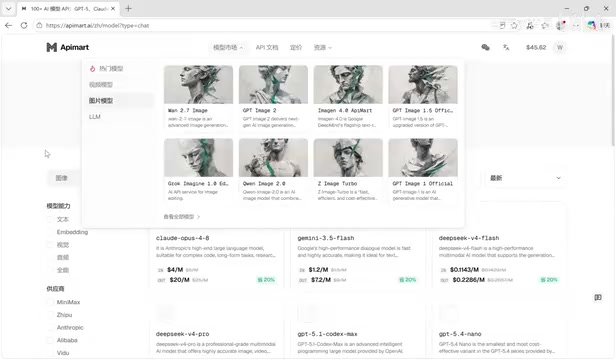
In terms of feature coverage, the platform essentially covers all major current AI application scenarios. Whether it's everyday text Q&A, code assistance, or the recently trending AI image generation and video creation, everything can be accessed from a single platform.
Hands-On Test: GPT Image Generation Quality and Speed
Technical Background of GPT Image Generation
GPT Image Generation (GPT-Image, also known as GPT-4o's native image generation capability) is fundamentally different from the earlier DALL·E series. DALL·E is a standalone diffusion model, whereas GPT-4o's image generation capability is directly embedded within the multimodal large language model — the model can understand text semantics while simultaneously outputting pixel-level images. This architecture gives GPT Image Generation far superior performance in text rendering, instruction following, and detail consistency compared to traditional text-to-image models. It can accurately embed text within images and precisely control compositional elements, which is the core reason it went viral in early 2025.
Workflow
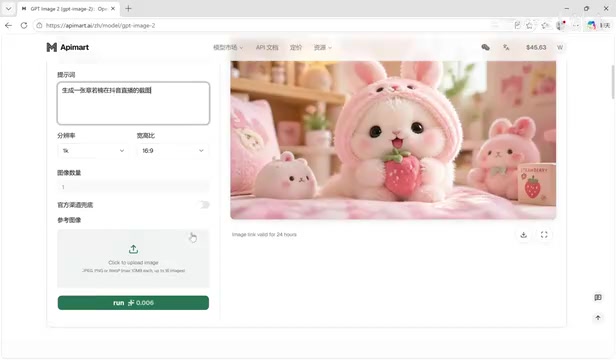
The platform provides a visual interface. The complete GPT image generation workflow is as follows:
- Enter a text prompt describing the desired image content
- Add a reference image — upload a reference photo, and the generated result will match its style
- Click generate and wait for the model to return results
Generation Quality
Based on hands-on testing, GPT image generation delivers impressive results — the generated images are remarkably realistic and natural, which is one of the key reasons this feature has gained such widespread popularity recently.
Speed and Queue Times
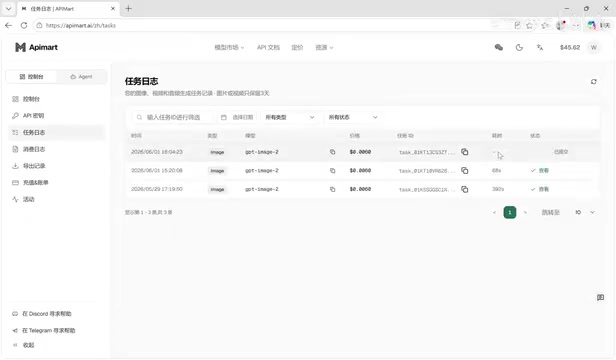
Be prepared for some wait times. The first generation took approximately 68 seconds, and the second took 94 seconds due to a longer queue. Popular models experience queuing during peak hours, and wait times can fluctuate.
Tips for Checking Task Status
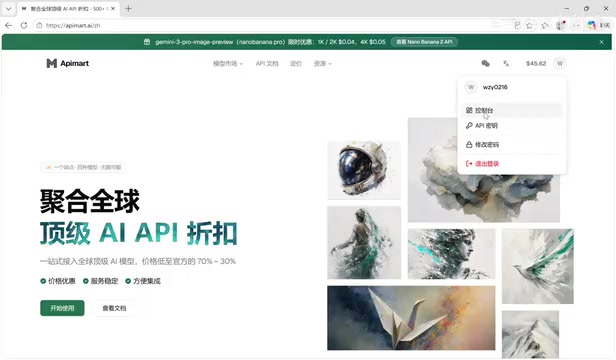
If the page seems stuck during generation with no progress, don't panic. Go back to the homepage, click on your account to enter the console, and check the current task status in the task log. If it shows "Submitted," the task is queued for processing — just wait patiently.
Detailed Price Comparison
Pricing is the core competitive advantage of API aggregation platforms. Before diving into specific prices, it helps to understand the pricing logic behind AI model APIs: text models are typically billed based on token consumption, where tokens are the basic units that large language models use to process text — roughly 1-2 tokens per English word and 1-2 tokens per Chinese character. Image and video models, on the other hand, are billed per generation task. API aggregation platforms can offer prices lower than official rates primarily through bulk purchasing discounts, arbitrage from regional pricing differences, and the platform's own operational subsidies.
Based on our testing, APImart's specific pricing is as follows:
| Model | APImart Price | Notes |
|---|---|---|
| GPT Image Generation | ~$0.006/image | Roughly 4 Chinese cents per image |
| Jimeng Model | ~80% of official price | About 20% cheaper than official rates |
| Other models | Generally below official pricing | Check the platform for real-time quotes |
For heavy AI users, these price differences add up significantly over time. Especially for image generation — a use case with low per-unit cost but high frequency — 4 cents per image is genuinely attractive.
Usage Recommendations and Risk Considerations
Who Is This For?
- Developers: Need to integrate multiple AI model APIs into projects; the unified interface dramatically reduces integration costs
- AI enthusiasts: Want to try various cutting-edge models without registering separate accounts on each platform
- Content creators: Frequently use image or video generation features and are cost-sensitive
Risks to Be Aware Of
When using third-party API aggregation platforms, keep the following points in mind:
- Data privacy: When using an API relay service, all request data — including prompts, uploaded images, and generated results — passes through the relay platform's servers. This means the platform technically has the ability to log, store, and even analyze all user interactions. By contrast, when calling official APIs directly, data only travels between the user and the official servers, and major providers typically commit to not using API call data for model training. For scenarios involving trade secrets, personal privacy, or regulated data, it's advisable to use official APIs. When choosing a relay platform, look for a clear privacy policy, data retention period disclosures, and HTTPS encryption support.
- Service stability: Relay platforms depend on upstream official APIs. Changes to official interfaces — such as API version upgrades, rate limit adjustments, or regional blocking policy changes — can directly impact the relay platform's service availability. Additionally, the platform's own server capacity and operational capabilities are key factors in stability.
- Compliance: Some relay platforms may operate in a gray area. For example, unauthorized API resale may violate providers' Terms of Service. Make sure you fully understand the implications before committing to long-term use.
- Peak-hour queuing: Popular models may require longer wait times during peak usage periods. This happens because the relay platform's upstream API quota is limited, and when concurrent requests exceed the quota, they must queue.
Conclusion
As an AI API aggregation platform, APImart performs well in both model coverage and pricing. It brings together popular models like GPT-4o, Claude Sonnet 4.5, and Veo 3.1 under a unified access point with a visual interface. For users looking to experience multiple AI models at low cost, it's a platform worth considering.
That said, be mindful of potential risks around data security and service stability, and make rational choices based on your specific needs.
Related articles

Mistral Le Chat Image Generation Review: Can It Replace Fable?
Mistral AI launches image generation in Le Chat, dubbed Le Chaton Fat. We analyze its capabilities, compare it with Fable, and explore the trend of AI chat platforms integrating image generation.
Testing DeepSeek's Safety Mechanisms: Multiple Jailbreak Attempts Successfully Blocked
An overseas security blogger systematically tested DeepSeek's jailbreak resistance using direct requests, rephrased prompts, and varied strategies. Results show robust intent recognition, consistent blocking, and context-aware safety mechanisms.
A Middle Schooler with Zero Coding Skills Built a Story-Driven Game with AI: Creativity Unshackled from Technical Barriers
A middle schooler with no coding experience used AI to build an interactive story game with branching choices and surreal alien adventures. We explore what this means for creative democratization.