Replit Partners with Visa: How AI Agentic Payments Are Reshaping the Future of Transactions

Replit and Visa partner to explore autonomous AI agent payments, ushering in the agent economy era.
Replit has entered a deep partnership with global payments giant Visa to jointly develop AI Agentic Payments solutions, enabling AI agents to autonomously initiate and complete payment operations. The collaboration must address four core challenges: security, identity verification, programmability, and compliance. This trend signals AI agents evolving from information assistants to economic participants, with traditional financial giants embracing the AI agent era and AI business models expanding from subscriptions to transaction commissions.
Replit and Visa Forge Strategic Partnership: The Era of AI Agentic Payments Begins
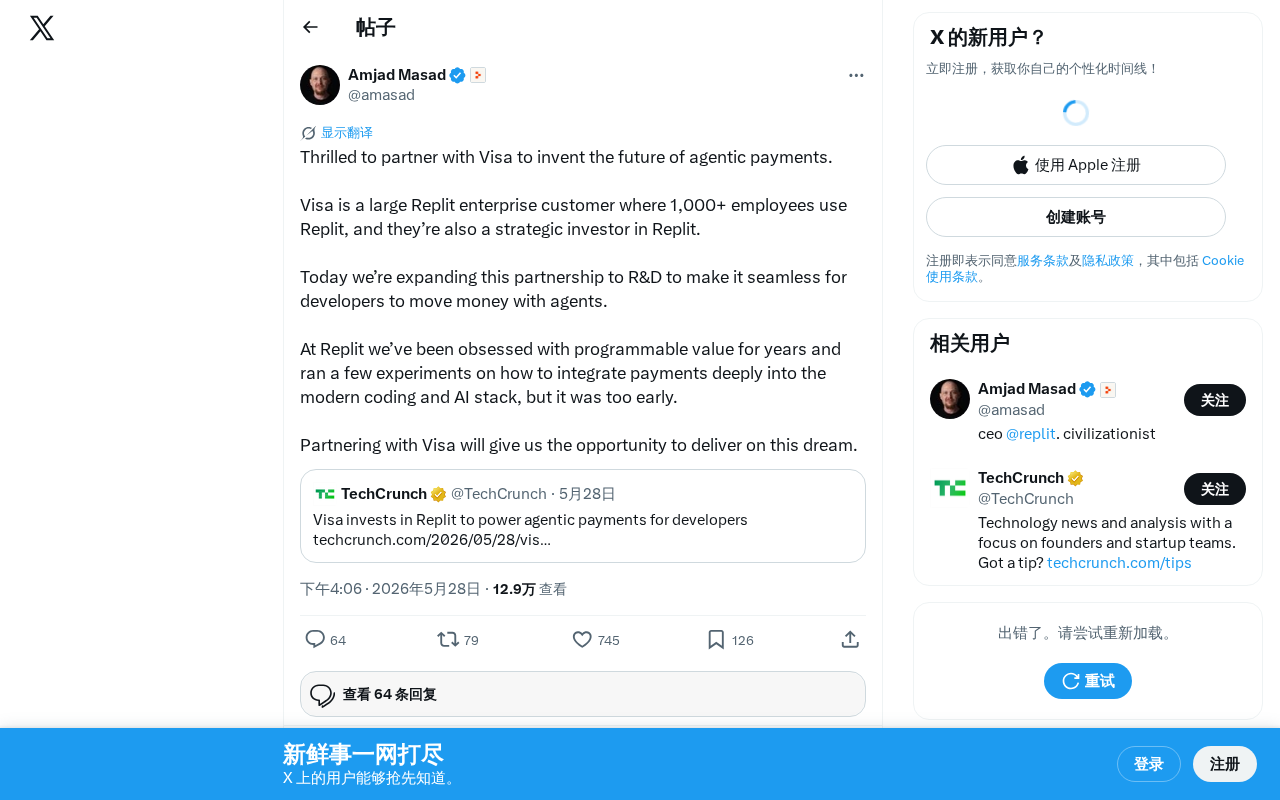
Replit's CEO recently announced on social media that Replit has officially entered into a deep partnership with global payments giant Visa to jointly explore the future of "Agentic Payments." This collaboration marks a critical step for AI agents moving from information processing into actual financial transactions.
Replit is a San Francisco-based cloud integrated development environment (IDE) company founded in 2016. Its platform allows users to write, run, and deploy code directly in the browser without any local environment setup. In recent years, Replit has made a major bet on AI, launching Replit Agent—an AI coding agent capable of automatically generating complete applications from natural language descriptions. This has transformed Replit from a traditional developer tools platform into an AI-native software creation platform, now serving over 30 million users ranging from beginners to enterprise developers.
According to the disclosure, Visa is not only a major enterprise customer of Replit—with over 1,000 Visa employees already using the Replit platform—but also a strategic investor in the company. This partnership will elevate the relationship from a customer engagement to deep R&D collaboration, with the goal of enabling developers to seamlessly facilitate fund transfers through AI agents.
What Are AI Agentic Payments? Concept Explained
"Agentic Payments" is a rapidly emerging concept—it refers to AI agents autonomously initiating, verifying, and completing payment operations while executing tasks. Imagine your AI assistant not only comparing prices and placing orders for you, but also directly completing the payment, all without requiring step-by-step human confirmation.
To understand the revolutionary nature of this concept, it's important to first understand the current technical evolution of AI Agents. Since 2022, as large language model (LLM) capabilities have broken through, AI Agents have evolved from simple Q&A conversational assistants into autonomous systems capable of using tools (Tool Use), performing multi-step reasoning (such as the "reasoning-action" loop defined by the ReAct framework), and even coordinating multiple sub-agents to complete complex workflows. Companies like OpenAI, Anthropic, and Google have all released model interfaces supporting Function Calling, enabling AI agents to interact with external APIs and services in a structured manner. It is precisely this leap from "conversation to action" that makes AI agent involvement in payment processes technically feasible.
Realizing this concept requires solving several core challenges:
- Security: How AI agents can safely operate funds within authorized boundaries. This involves fine-grained permission control mechanisms, such as setting per-transaction limits, restricting merchant categories, defining time windows, etc., ensuring that agents don't exceed user-defined safety boundaries even when running autonomously.
- Identity Verification: How to ensure agent behavior represents the user's true intent. Traditional payments rely on active user confirmation (such as entering passwords or fingerprint verification), while AI agentic payments require a new "delegated authorization" mechanism—users define intent and constraints in advance, and agents act autonomously within those conditions. This is similar in concept to OAuth authorization protocols but requires a more dynamic and context-aware implementation.
- Programmability: How to make payment logic as flexible and controllable as writing code. Developers need to be able to define complex payment rules through APIs, such as "automatically purchase when the price falls below a certain threshold" or "automatically compare supplier quotes monthly and pay the best option" conditional logic.
- Compliance: How to meet financial regulatory requirements across different jurisdictions globally. In the EU, PSD2 (Payment Services Directive 2) requires Strong Customer Authentication (SCA), meaning most electronic payments need at least two identity verification factors; in the US, state-level Money Transmitter Laws impose strict licensing requirements on fund transfers. AI agents as "non-human" payment initiators have no clear legal status within existing regulatory frameworks—this is an issue the entire industry needs to collectively address.
Visa, as one of the world's largest payment networks, has core infrastructure (VisaNet) capable of processing over 65,000 transactions per second, covering more than 200 countries and territories. More importantly, Visa has been aggressively modernizing its payment technology in recent years, including tokenization services (replacing sensitive card numbers with one-time tokens to enhance security), Visa Developer Platform (providing payment API interfaces for third-party developers), and Visa Direct (real-time push payment network). These technological foundations provide ready-made security layers and programmable interfaces for AI agentic payments. Replit, on the other hand, possesses a powerful AI programming platform and developer ecosystem. The combination of the two is poised to find the optimal balance between technical feasibility and commercial deployment.
Replit's Long-Term Strategy: From Programmable Value to AI Payment Integration
Replit's CEO revealed in the announcement that the team has maintained a strong focus on "Programmable Value" for years, conducting multiple experiments attempting to deeply integrate payment functionality into modern programming and AI technology stacks. However, the timing wasn't right until now.
The concept of "Programmable Value" aligns closely with the "Embedded Finance" trend in the fintech sector in recent years. The core idea of embedded finance is to embed financial services (payments, lending, insurance, etc.) as APIs into non-financial software and platforms, allowing users to naturally complete financial operations while using products without needing to switch to banking or payment apps. Stripe pioneered this trend—by enabling any website to integrate payment capabilities with just a few lines of code, it dramatically lowered the barrier for merchants to access financial services. Platforms like Shopify and Square have also deeply integrated payments, lending, and other financial functions within their respective ecosystems. Replit had previously experimented with cryptocurrency tipping and developer payment collection features on its platform, but these attempts failed to scale due to regulatory constraints and technological maturity limitations.
Now, with AI Agent capabilities advancing rapidly—evolving from simple conversational assistants to autonomous systems capable of executing complex multi-step tasks—the need for payment integration has become more urgent than ever. When AI agents can book hotels, procure supplies, and manage subscription services for users, payment capability becomes the indispensable "last mile." Notably, this "last mile" isn't merely a technical integration issue—it represents a fundamental transformation in user experience: in traditional workflows, users need to repeatedly switch between AI recommendations and payment confirmations, while AI agentic payments compress this process into a seamless automated workflow, fundamentally eliminating the friction between "intent and action."
Industry Impact: Three Major Transformations Brought by AI Agentic Payments
This partnership signals several important developments:
Traditional Financial Giants Actively Embrace the AI Agent Era
Visa's choice to partner with an AI-native platform rather than building in isolation demonstrates that the industry recognizes AI agentic payments are not a question of "whether they will come" but "how to make them come better." In fact, Visa is not the only financial giant positioning in this direction. Mastercard launched its Agent Pay proof-of-concept project in late 2024, exploring AI agents' autonomous payment capabilities in e-commerce scenarios; PayPal also showcased AI-driven intelligent checkout flows at its developer conference. Investment banks like JPMorgan Chase and Goldman Sachs have similarly assembled dedicated teams to study AI agents' impact on financial services. This collective strategic pivot indicates that the financial industry is viewing AI agents as the next paradigm-level transformation after mobile payments.
Developer Experience Will Become a Key Competitive Differentiator
Replit's core advantage lies in its extremely low development barrier. If any developer can integrate payment capabilities for AI agents with just a few lines of code, this will dramatically accelerate the entire ecosystem's development. This logic closely mirrors Stripe's path to success—Stripe defeated numerous traditional competitors in the payments space primarily because it simplified complex payment integration into a developer experience of just a few lines of code. Replit's unique advantage is that it provides not just API interfaces but a complete AI-assisted development environment, meaning developers can even describe payment requirements in natural language and have Replit Agent automatically generate the corresponding integration code. This nested model of "AI writing AI payment code" could lower the barrier to payment integration to unprecedented levels.
The Commercialization Path for AI Agents Is Becoming Clear
When agents can directly participate in economic activity, AI product business models will expand from "subscription-based" to "transaction commission-based," potentially reshaping the entire profitability logic of AI applications. Currently, the vast majority of AI applications use a SaaS subscription model (such as ChatGPT Plus at $20/month), where users pay for "access rights." But when AI agents can complete actual transactions on behalf of users, platforms have the opportunity to extract commissions from each transaction—similar to payment networks (Visa charges approximately 0.1-0.15% in network fees), e-commerce platforms (Amazon charges 8-15% in sales commissions), or app stores (Apple takes a 15-30% cut). This means AI platform revenue will be directly tied to the actual economic value created by their agents, rather than merely correlated with user counts, potentially giving rise to a wave of "transaction-driven" AI unicorns.
Conclusion: AI Agents Evolving from Information Assistants to Economic Participants
While the Replit-Visa partnership is still in the R&D phase, it represents an important direction for the AI industry: AI agents are evolving from "information assistants" to "economic participants." The profound significance of this transformation is that it could give rise to an entirely new "Agent Economy"—an economic system in which millions of AI agents, representing their respective users or enterprises, autonomously conduct transactions for goods and services in digital marketplaces. This requires not only upgrades to payment infrastructure but also entirely new trust mechanisms, dispute resolution frameworks, and regulatory systems. As more similar partnerships emerge, we may soon see AI agents playing an increasingly central role in everyday commercial activities.
Key Takeaways
- Replit and Visa have entered a deep R&D partnership to jointly develop AI Agentic Payments solutions
- Over 1,000 Visa employees already use the Replit platform, and Visa is also a strategic investor in Replit
- Replit has been exploring the concept of programmable value for years, but conditions weren't ripe for implementation until now
- AI agentic payments must address four core challenges: security, identity verification, programmability, and compliance
- Traditional financial giants are actively embracing the AI agent era, and AI commercialization is expanding from subscription models to transaction commission models
Related articles
 Industry Insights
AI Product Development in Practice: Model Selection, Building Moats, and Paths to Commercialization
Practical strategies for AI product development: why not to train models from scratch, when to use APIs vs. fine-tuning, building product moats, and the full path from evaluation systems to commercialization.
 Industry Insights
No Product Fits Your Needs? Building It Yourself Is the Best Starting Point for Indie Developers
Can't find a product that fits? Building from personal pain points is the best entry for indie developers. Niche needs + AI tools = rapid product creation.
 Industry Insights
OpenAI Codex Tutorials Mass-Copied on Bilibili, Highlighting AI Content Farm Problem
At least 9 Bilibili accounts mass-published identical OpenAI Codex tutorial videos, exposing content farm operations in the AI tools space.