SQLite Releases AGENTS.md: Explicitly Rejecting AI-Generated Code and Opening a Dedicated Bug Forum
SQLite explicitly rejects AI-generated code and opens a new forum to triage AI bug reports
The SQLite project added an AGENTS.md file explicitly rejecting AI Agent-generated code, hardening its stance from "does not currently accept" to "does not accept" to signal a long-term policy. Facing a flood of AI-generated bug reports, SQLite opened a dedicated Bug forum, adopting a "diversion rather than blockade" strategy — acknowledging AI's value in finding bugs while insisting code must be written by humans. This nuanced AI governance approach may become a new paradigm for open-source projects.
Article
The SQLite project recently added an AGENTS.md file to its code repository, making its stance clear: AI Agent-generated code is not accepted. Meanwhile, due to a flood of AI-generated bug reports, the SQLite forum has been forced to open a dedicated new Bug forum to cope. This event reflects the entirely new challenges that open-source projects face in the AI era.
What SQLite's AGENTS.md Says
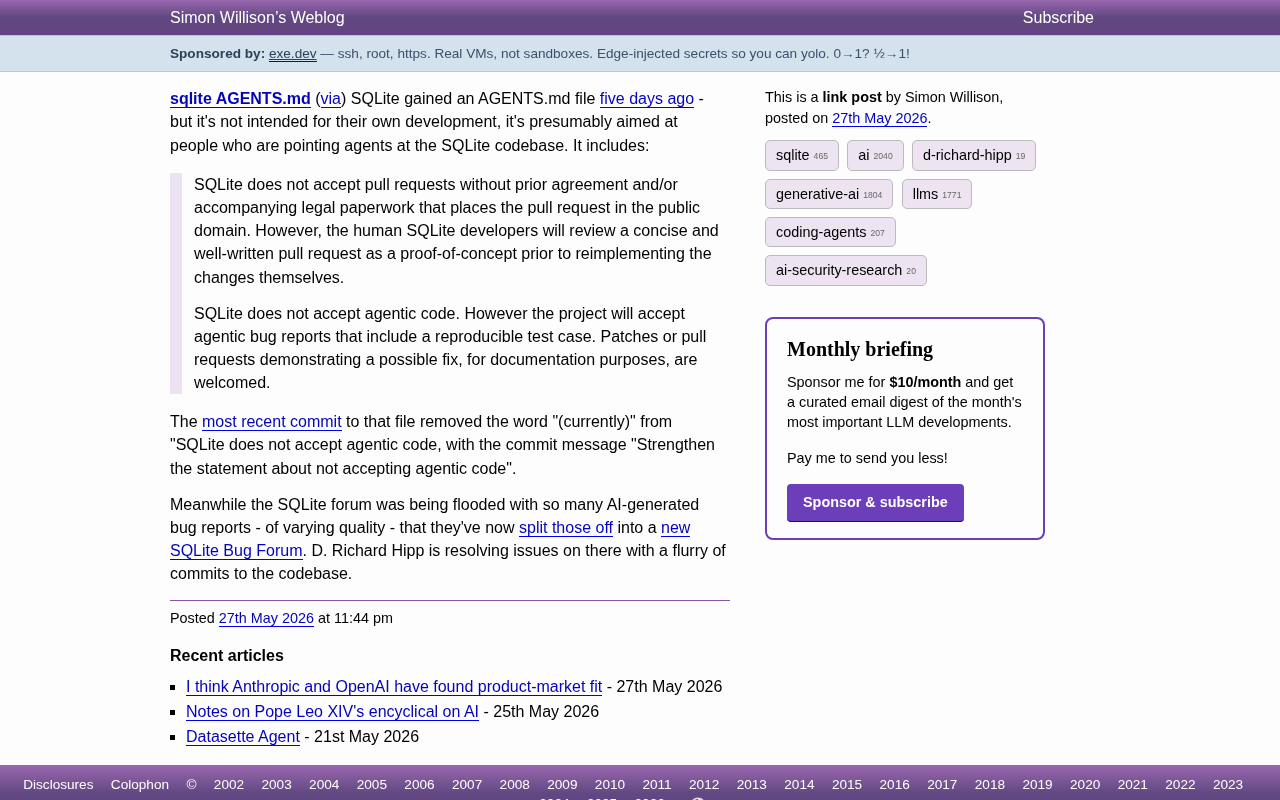
Five days ago, SQLite committed an AGENTS.md file to the master branch of its GitHub repository. Interestingly, this file isn't meant to guide SQLite's own development workflow — it's specifically aimed at external developers who point AI Agents at the SQLite codebase.
The file contains two core statements:
On Pull Requests: SQLite does not accept Pull Requests without prior agreement or legal documentation. All contributions must place code in the public domain. However, SQLite's human developers are willing to review concise, well-written PRs as proof-of-concept, then re-implement the changes themselves.
On AI-generated code: SQLite explicitly does not accept agent-generated code. However, the project welcomes Agent bug reports accompanied by reproducible test cases, and also welcomes patches or PRs submitted for documentation purposes to demonstrate possible fixes.
From "Does Not (Currently) Accept" to "Does Not Accept": A Hardened Stance
A telling detail: the most recent commit to AGENTS.md specifically removed the word "(currently)." The text changed from "SQLite does not (currently) accept agentic code" to "SQLite does not accept agentic code," with the commit message reading: "Strengthen the statement about not accepting agentic code."
This tiny change sends a clear signal: the SQLite team's position on AI-generated code is not a temporary stopgap measure but a carefully considered long-term decision. Removing "currently" means they have no intention of changing this policy in the foreseeable future.
AI Bug Report Flood: Forced to Open a New Forum
Equally noteworthy alongside the code contribution policy is the "AI flood" that the SQLite forum is experiencing. A massive volume of AI-generated bug reports has poured into the SQLite forum, varying wildly in quality and seriously disrupting normal community discussions.
Maintainer burnout in open source was already a widely recognized crisis well before the AI era. Multiple studies from the Linux Foundation and GitHub show that most critical open-source projects are sustained by only a handful of core maintainers, who bear enormous pressure from handling issues, reviewing PRs, and responding to users. The massive influx of AI-generated content is exacerbating this problem: automated tools can generate a seemingly plausible bug report or patch in seconds, but maintainers still need to spend hours verifying its validity.
To address this situation, the SQLite team made a pragmatic decision: divert AI-generated bug reports to a brand new SQLite Bug Forum. SQLite's creator, D. Richard Hipp, is working through these issues one by one on the new forum, fixing related bugs in the codebase through a series of commits.
This reveals an interesting contradiction: while AI-generated bug reports bring noise to the community, they do contain genuinely valuable findings. SQLite's approach of diverting AI bug reports to a separate forum is essentially an "attention protection mechanism" — using physical isolation to prevent low signal-to-noise content from polluting the core community's discussion space, while preserving the possibility of extracting real value from it. SQLite's response strategy is diversion rather than blockade — acknowledging AI's value in discovering bugs while protecting the main community's discussion quality through isolation.
The AI Governance Dilemma for Open-Source Projects
Dual Considerations: Legal and Quality
SQLite's rejection of AI code has at least two layers of reasoning.
First, the legal dimension: SQLite uses Public Domain licensing, the most thorough form of intellectual property relinquishment in the open-source world — unlike MIT, Apache, and other licenses, public domain means completely waiving copyright, allowing anyone to use, modify, and distribute the code without restriction, with no need for attribution or license retention. To ensure legal rigor, SQLite requires all contributors to sign specific legal documents. The copyright ownership question for AI-generated code remains unresolved across all major global jurisdictions: the U.S. Copyright Office has explicitly stated that purely AI-generated content is not copyrightable, but the boundaries of "human-AI collaborative" works remain unclear. Accepting AI-generated code could mean introducing content with uncertain copyright status — an unacceptable risk for a project known for its legal meticulousness.
Second, the quality dimension: SQLite is no ordinary open-source database project. As the world's most widely deployed database engine, it's estimated to run on over one trillion devices, built into every iPhone, every Android phone, every Chrome browser, and the Windows and macOS operating systems. SQLite's test suite contains over 90 million test cases, with test code hundreds of times longer than the source code itself, achieving close to 100% code coverage. This extreme engineering culture makes the team highly cautious about any external code contribution — they need to understand the intent behind every line of code, not merely verify its functional correctness.
Will AGENTS.md Become a New Standard for Open-Source Projects?
As coding agent tools like Cursor, GitHub Copilot Workspace, and Devin rapidly gain popularity, more and more open-source projects may need to establish similar policies. These tools can autonomously browse code repositories, understand project structure, generate code, and submit Pull Requests, dramatically lowering the barrier to contributing to open-source projects — but also bringing the side effect of a flood of low-quality automated contributions.
The filename AGENTS.md itself is quite telling — it parallels CONTRIBUTING.md (a guide for human contributors), specifically establishing behavioral norms for AI Agents. Its naming logic shares a kinship with robots.txt: the latter tells web crawlers which pages can be scraped, while the former tells AI Agents which behaviors are accepted by the project. There's no unified standard for this file format yet, but SQLite's practice may drive community consensus.
We may be witnessing the birth of a new convention: open-source projects need not only to tell human contributors how to participate, but also to explicitly tell AI Agents what they can and cannot do.
Conclusion
SQLite's approach demonstrates a mature AI governance philosophy: rather than blanket-rejecting all AI participation, it draws precise boundaries. Accept bugs discovered by AI, but not code written by AI; welcome AI as a proof-of-concept tool, but require final implementation by humans. This "AI-assisted, human-gatekept" model may be the most pragmatic strategy for open-source projects navigating the AI wave today.
Key Takeaways
- SQLite added an AGENTS.md file to its repository, explicitly stating it does not accept AI Agent-generated code, while welcoming AI bug reports accompanied by reproducible test cases
- The latest commit removed the word "currently," hardening the stance from "does not currently accept" to "does not accept," signaling a long-term policy rather than a temporary measure
- Due to a flood of AI-generated bug reports, SQLite was forced to open a dedicated Bug forum for triage management
- SQLite's strategy reflects a nuanced AI governance approach: accepting AI's value in finding bugs while insisting that code must be implemented by human developers
- AGENTS.md may become a new standard file for open-source projects dealing with AI Agents, complementing the traditional CONTRIBUTING.md
Related articles
 Industry Insights
AI Product Development in Practice: Model Selection, Building Moats, and Paths to Commercialization
Practical strategies for AI product development: why not to train models from scratch, when to use APIs vs. fine-tuning, building product moats, and the full path from evaluation systems to commercialization.
 Industry Insights
No Product Fits Your Needs? Building It Yourself Is the Best Starting Point for Indie Developers
Can't find a product that fits? Building from personal pain points is the best entry for indie developers. Niche needs + AI tools = rapid product creation.
 Industry Insights
OpenAI Codex Tutorials Mass-Copied on Bilibili, Highlighting AI Content Farm Problem
At least 9 Bilibili accounts mass-published identical OpenAI Codex tutorial videos, exposing content farm operations in the AI tools space.