What Problem Do You Most Want AI to Solve? A Deep Reflection on the Future Direction of AI
The AI industry is shifting from technology-driven to demand-driven, with its future direction to be shaped by all of society.
A tweet soliciting public expectations for AI sparked widespread discussion, reflecting the AI industry's paradigm shift from "technology-driven" to "demand-driven." The public most hopes AI will break through in four areas: healthcare, educational equity, scientific research, and daily efficiency. The article argues that AI's ultimate value lies in solving real problems rather than pursuing technical metrics, and its future direction should be collectively shaped by all of society.
A Simple Question, Backed by Infinite Expectations
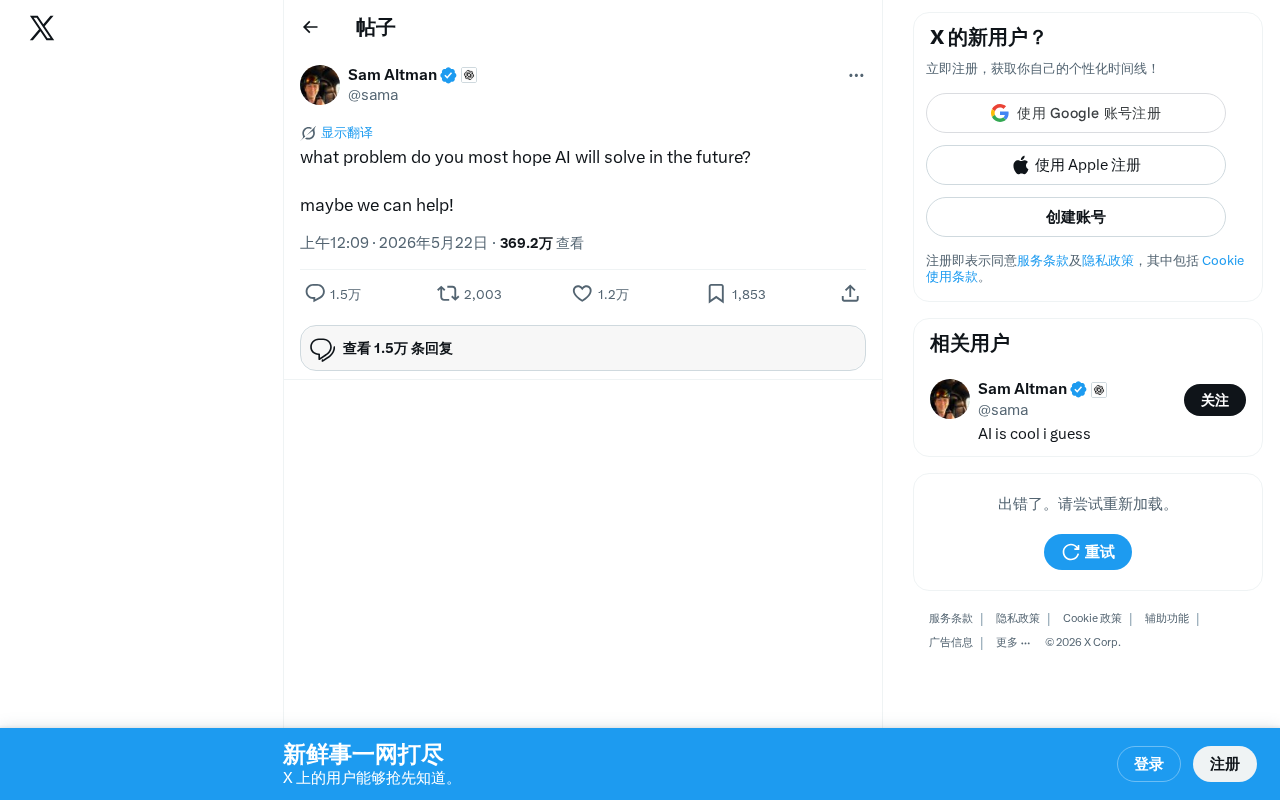
Recently, a brief tweet sparked widespread attention on social media: "What problem do you most want AI to solve in the future? Maybe we can help!"
This seemingly simple open-ended question actually touches on the most fundamental proposition in AI development — who should technology serve, and what problems should it solve? In an era where AI capabilities are iterating at breakneck speed, this question deserves serious consideration from everyone more than ever before.
From Technology-Driven to Demand-Driven: A Paradigm Shift in AI Development
Over the past few years, the development logic of the AI industry has been largely "technology-driven" — first achieving breakthroughs in model capabilities, then searching for application scenarios. The iteration of the GPT series, the emergence of multimodal models, and the rise of Agent frameworks have all followed this path.
Historical Context of the Technology-Driven Paradigm
The GPT series, multimodal technology, and the rise of Agent frameworks represent three typical stages of the "technology-driven" paradigm in the AI industry over the past five years. The GPT series, developed by OpenAI, grew from GPT-1 (2018) to GPT-4 (2023), with parameter counts expanding from 117 million to an estimated trillion-plus, establishing the foundational paradigm for large language models. Multimodal models (such as GPT-4V and Gemini) broke through the boundaries of single-text processing, enabling AI to simultaneously understand images, audio, and text. Agent frameworks (such as AutoGPT and LangChain) further equipped models with autonomous planning and tool-calling capabilities. All three leaps originated from laboratory breakthroughs, with commercial applications sought only afterward — a textbook manifestation of "technology-driven" logic.
But this model is undergoing a subtle transformation. More and more AI practitioners are beginning to think in reverse: not "what can we do," but "what do users truly need." This tweet is a microcosm of that mindset shift.
Why "Asking Questions" Matters More Than "Giving Answers"
When an AI team or developer proactively solicits needs from the public, it signals several things:
- Technical capabilities have achieved a certain level of generality, no longer confined to a single scenario
- The bottleneck for deployment isn't the technology itself, but finding truly valuable problems to solve
- User feedback has become the core driver of product iteration, rather than benchmark scores from the lab
It's worth noting that benchmarks are standardized evaluation systems for measuring model capabilities in the AI field, covering dozens of dimensions including MMLU (multidisciplinary knowledge), HumanEval (code generation), and HellaSwag (commonsense reasoning). However, the industry has gradually realized that a serious disconnect exists between "benchmark score optimization" and "real-world value" — models can achieve high scores on test sets through targeted training while performing poorly in actual applications. This phenomenon is called "benchmark overfitting" and represents Goodhart's Law in the AI domain: when a measure becomes a target, it ceases to be a good measure. This is the deeper reason why more practitioners are shifting toward "demand-driven" approaches — the rate at which real user pain points are resolved reflects AI's actual value far better than any standardized test score.
This is an important sign of the AI industry reaching maturity.
What Problems Do People Most Want AI to Solve?
Although this particular tweet doesn't display specific replies, drawing from similar discussions worldwide, we can identify several directions that attract the most attention:
1. Healthcare: From Precision Diagnosis to Drug Discovery
This is almost always the most popular field in such discussions. People hope AI can:
- Achieve early precision diagnosis of rare diseases, reducing misdiagnosis and missed diagnoses
- Dramatically shorten drug development cycles and reduce pharmaceutical R&D costs
- Democratize quality healthcare resources through AI, narrowing the urban-rural healthcare gap
AI applications in healthcare have moved from concept to clinical practice. At the diagnostic level, Google DeepMind's AI system has achieved specialist-level performance in retinal disease detection; the FDA has approved over 500 AI medical device software products. In drug discovery, Insilico Medicine has used AI to compress candidate drug discovery timelines from years to months. However, healthcare AI deployment faces three major obstacles: data privacy and compliance (regulations like HIPAA and GDPR strictly limit medical data circulation), explainability requirements (doctors need to understand AI's decision-making rationale, making "black box" models difficult to trust), and legal gaps in medical liability attribution. These challenges make the democratization of healthcare AI far more complex than the technology itself.
2. Educational Equity: The Ultimate Vision of Personalized Learning
"Give every child access to a world-class private tutor" — this is the most compelling vision in AI education. This vision has rigorous academic foundations: educational psychologist Vygotsky's "Zone of Proximal Development" theory posits that learning materials should be slightly above the learner's current level to achieve optimal learning outcomes. Economist Erik Brynjolfsson's research found that quality private tutoring can improve student performance by two standard deviations (the famous "2 Sigma Problem").
Modern AI education platforms (such as Khan Academy's Khanmigo and Duolingo's AI features) are democratizing this "private tutor effect" at extremely low cost to every learner worldwide by analyzing learners' answer patterns, error types, and learning pace in real time, dynamically adjusting content difficulty and presentation. Personalized learning path planning, real-time learning feedback, and barrier-free cross-language instruction — AI's potential in educational equity is far from fully realized.
3. Scientific Research: Accelerating the Expansion of Human Knowledge
From protein structure prediction (AlphaFold) to materials science and climate simulation, AI as a "scientific research accelerator" has already demonstrated astonishing potential.
AlphaFold is a protein structure prediction system released by DeepMind in 2020, hailed as one of AI's most milestone-worthy breakthroughs in fundamental science. The protein folding problem had puzzled biologists for 50 years — a protein's three-dimensional structure determines its biological function, but predicting spatial structure from amino acid sequences is extraordinarily complex. AlphaFold2 overwhelmingly surpassed all traditional methods in the CASP14 competition, achieving prediction accuracy approaching experimental measurement levels. As of 2023, AlphaFold has predicted the structures of over 200 million proteins, covering virtually all known organisms, with the entire database openly accessible. This achievement has directly accelerated research in drug discovery, vaccine design, and enzyme engineering, serving as the most powerful real-world footnote to "AI as a scientific accelerator." People hope it can help crack more fundamental scientific challenges and continuously push the boundaries of human knowledge.
4. Daily Efficiency: Freeing People from Repetitive Labor
This is the expectation closest to ordinary people — automating tedious paperwork, intelligently managing personal schedules and affairs, and freeing people from low-value repetitive labor so they can invest their time and energy in more creative endeavors.
Implications for AI Practitioners
Although this tweet is brief, the signal it conveys deserves attention from the entire industry:
First, maintain connection with real needs. In today's white-hot technology race, it's easy to fall into the trap of "technology for technology's sake." Regularly returning to users and listening to their genuine pain points is key to maintaining product vitality.
Second, open dialogue is more valuable than closed development. When you're unsure what to do next, the best strategy may be to simply ask users. Social media has dramatically lowered the barrier to such dialogue and made demand collection unprecedentedly efficient.
Third, AI's ultimate value lies in solving real problems. No matter how large the model parameters or how high the benchmark scores, if technology cannot tangibly improve people's lives, it remains just technology.
Conclusion: Everyone Should Seriously Answer This Question
"What problem do you most want AI to solve?" — This isn't just a product research question for developers; it's a question of our era addressed to everyone.
In a time when AI capabilities are growing exponentially, we as users, beneficiaries, and even potential stakeholders all have a responsibility to think about and express our expectations. Because the future direction of AI should not be determined solely by a small technical elite — it should be shaped collectively by everyone.
If this question resonates with you, take a moment to think seriously: what's your answer?
Key Takeaways
- The AI industry is shifting from a "technology-driven" to a "demand-driven" paradigm, with developers proactively soliciting real user needs
- Healthcare, educational equity, scientific research, and daily efficiency are the four major directions where the public most hopes AI will break through
- Open user dialogue helps AI products find truly valuable deployment scenarios better than closed development
- AI's ultimate value lies in solving real problems, not pursuing technical metrics for their own sake
- The future direction of AI should be shaped by society as a whole, not determined solely by technical elites
Related articles
 Industry Insights
AI Product Development in Practice: Model Selection, Building Moats, and Paths to Commercialization
Practical strategies for AI product development: why not to train models from scratch, when to use APIs vs. fine-tuning, building product moats, and the full path from evaluation systems to commercialization.
 Industry Insights
No Product Fits Your Needs? Building It Yourself Is the Best Starting Point for Indie Developers
Can't find a product that fits? Building from personal pain points is the best entry for indie developers. Niche needs + AI tools = rapid product creation.
 Industry Insights
OpenAI Codex Tutorials Mass-Copied on Bilibili, Highlighting AI Content Farm Problem
At least 9 Bilibili accounts mass-published identical OpenAI Codex tutorial videos, exposing content farm operations in the AI tools space.