WWDC Keynote Preview: Complete Siri Overhaul, Major AI Upgrades, and System Performance Optimization
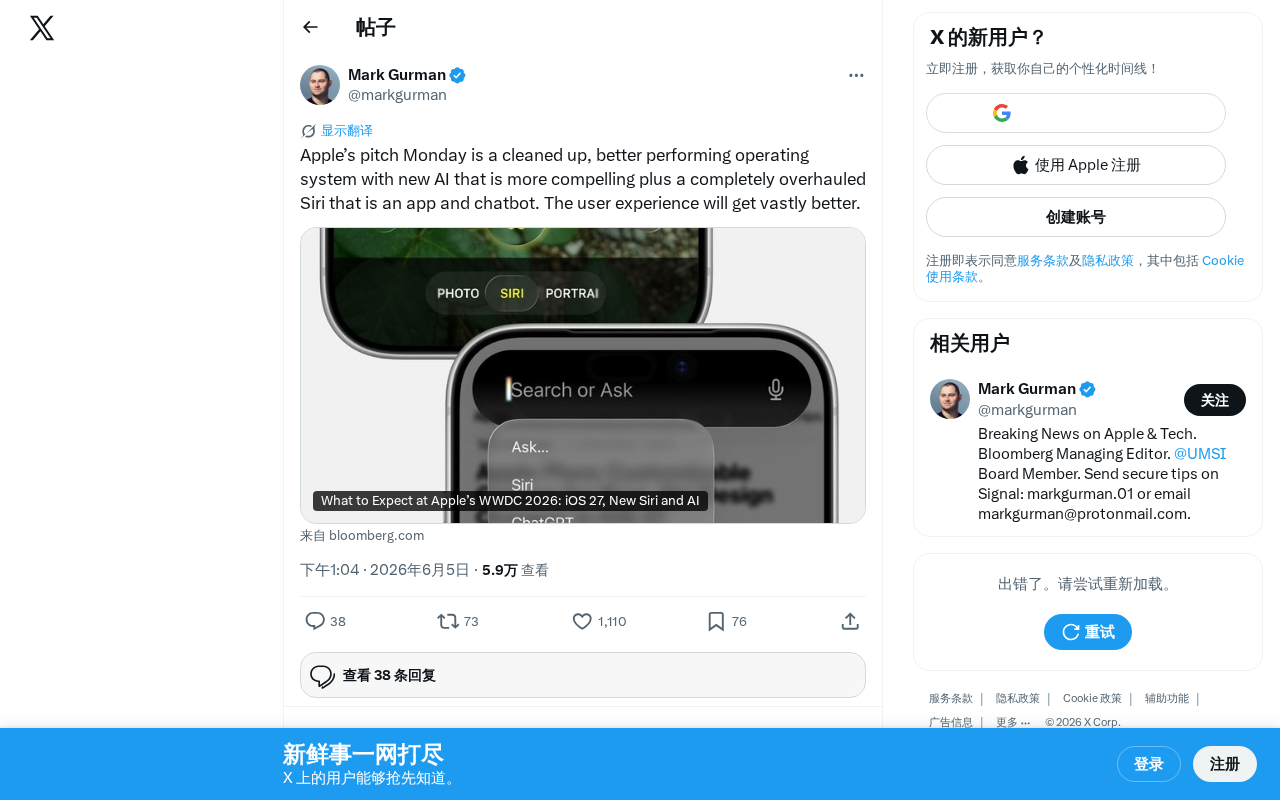
WWDC preview: Apple to unveil overhauled Siri, major AI upgrades, and leaner operating systems.
Apple's upcoming WWDC keynote is expected to deliver three major upgrades: a streamlined, better-performing operating system; more compelling Apple Intelligence AI features addressing last year's shortcomings; and a completely overhauled Siri that transforms from a basic voice assistant into a full chatbot with its own app interface. The changes could represent Apple's biggest software leap in years.
Apple Set to Showcase Fully Revamped Operating Systems and AI Experience
According to tech analysts sharing insights on social media, Apple will deliver a major system-level update at Monday's WWDC keynote, with core highlights including: a leaner and more efficient operating system, more compelling AI features, and a completely redesigned Siri.
Three Core Upgrade Directions
Operating System: Performance Optimization and Interface Streamlining
Based on leaked information, one of Apple's key focuses this time is "cleaning up" the operating system. This means we could see smoother animations, lower memory usage, faster app launch times, and potentially a streamlined UI design language. For iOS and macOS, which have been criticized in recent years for "feature bloat," this is a welcome direction.
The mention of "better performing" suggests Apple may have done extensive optimization work at the system level — especially good news for users with older devices, as the new system won't just cater to the latest hardware.
AI Features: From "Available" to "Actually Useful"
The leak mentions that the new AI will be "more compelling" — a telling choice of words. While Apple Intelligence, launched last year, was conceptually advanced, many users found it limited in functionality and slow to respond. This upgrade is clearly Apple's direct response to market feedback.
Apple Intelligence is the personal intelligence system first announced at WWDC 2024. Its core technical architecture employs a hybrid processing model combining on-device and cloud-based computation. On-device processing relies on Apple's custom Apple Silicon chips, running small language models locally through the Neural Engine to handle privacy-sensitive requests. For tasks requiring more computational power, requests are sent via Private Cloud Compute to Apple's purpose-built server clusters, which also run on Apple Silicon and use end-to-end encryption — Apple promises no user data is stored. The core purpose of this architecture is to strike a balance between AI capability and user privacy, representing a fundamental departure from OpenAI and Google's primarily cloud-based large model approaches.
Under competitive pressure from Google Gemini and OpenAI ChatGPT's continuous iterations, Apple needs to prove that its on-device AI plus cloud collaboration approach can deliver truly differentiated user value.
Siri Reborn: From Voice Assistant to App-Level Chatbot
The most eye-catching change is Siri being "completely overhauled." According to the description, the new Siri will serve a dual role as both an "app" and a "chatbot." This means:
- As a standalone app: Siri may have its own interface, supporting text conversations, multi-turn interactions, context memory, and other standard features of modern AI assistants
- As a chatbot: Siri will no longer be limited to simple command execution, but capable of more natural conversational interactions
This transformation is essentially Apple acknowledging the limitations of Siri as a pure voice assistant over the past decade-plus, formally moving toward the ChatGPT-style interaction paradigm. Siri launched in 2011 with the iPhone 4S as the world's first mainstream consumer voice assistant. Early Siri was based on traditional natural language processing pipelines, using an intent recognition plus slot-filling framework where voice commands were broken down into predefined intent categories before executing corresponding actions. While this architecture performed reliably on specific tasks, it lacked true language understanding and couldn't handle complex multi-turn conversations or open-ended questions. The large language model paradigm represented by ChatGPT, based on the Transformer architecture's autoregressive generation approach, can understand context and generate coherent text, fundamentally changing expectations for human-computer interaction. Siri's shift toward a chatbot model is essentially an upgrade from a rule-driven intent-matching system to a generative dialogue system powered by large models.
User Experience Set to Be "Vastly Better"
The leaker used "vastly better" to describe the overall improvement in user experience — a remarkably strong statement. If true, this could be Apple's biggest leap in software in recent years.
For Apple ecosystem users, deep system-level AI integration means no need to switch between multiple third-party AI apps — all intelligent features will be seamlessly embedded into daily workflows. This is Apple's signature "integration advantage" — when hardware, system, and AI work in concert, the consistency and fluidity of the experience is difficult for third-party apps to match.
Industry Impact and Outlook
If Apple truly delivers on these promises at WWDC, it will have profound implications for the entire AI assistant market landscape. With over 2 billion active devices in the Apple ecosystem, once Siri genuinely possesses modern AI chatbot capabilities, it will directly threaten user engagement time for products like ChatGPT and Google Assistant.
The key question is: Can Apple deliver AI capabilities comparable to or better than competitors while maintaining its privacy commitments? Apple's emphasis on on-device AI processing is rooted in technical concepts like differential privacy and federated learning. Unlike Google and OpenAI's heavy reliance on cloud-based data aggregation for training, Apple's approach requires completing as much inference computation as possible on-device. This places extremely high demands on model compression, knowledge distillation, and quantization techniques — requiring models with billions of parameters to be condensed to scales that can run in real-time on mobile chips while retaining core capabilities. This also explains why Apple Intelligence was relatively limited at launch, as on-device deployment is far more technically challenging than pure cloud-based solutions. Monday's keynote will provide the answer.
Key Takeaways
Related articles

PyCharm 2026.1 Deep Dive: Native AI Coding Assistant & Legitimate Licensing Guide
Deep dive into PyCharm 2026.1: native Claude AI integration, competitive analysis vs Cursor, official free and paid plans, and why to avoid pirated cracks.
CherryStudio + MCP: Tutorial for Build…
CherryStudio + MCP: Tutorial for Building Automated AI Agents and Local Knowledge Bases
Complete guide to building automated AI agents with Cherry Studio and MCP protocol, covering environment setup, MCP Server configuration, web scraping, Shell execution, and Ollama local knowledge base deployment.
MCP Hands-On Tutorial: Using AI to Aut…
MCP Hands-On Tutorial: Using AI to Automate Reverse Engineering of JS Encryption Algorithms
A detailed guide on MCP protocol setup and hands-on workflow showing how AI can automatically locate encrypted APIs, analyze obfuscated JS, set breakpoints, and restore sign algorithms to generate Python scraper code.