Xiaomi Open-Sources MiMo Code: Cross-Session Memory System Tackles AI Coding's Amnesia Problem
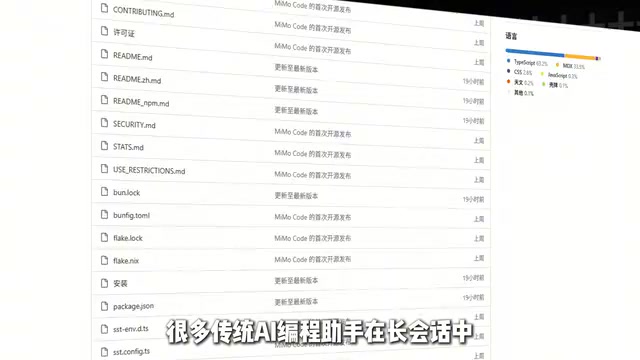
Xiaomi's open-source MiMo Code uses SQLite-based persistent memory to solve AI coding's context loss problem.
Xiaomi has open-sourced MiMo Code, an AI coding tool featuring a cross-session memory system powered by SQLite FTS5 full-text search. Unlike traditional AI assistants that forget everything between sessions, MiMo Code automatically extracts, compresses, and persists project knowledge for precise recall. It also features multi-Agent collaboration with specialized coding, review, testing, and verification agents, and supports flexible model integration via OpenAI-compatible APIs.
What's the most frustrating issue with AI coding assistants like Claude Code? It's not that they write bad code — it's that they can't remember. Cross-session context loss has long been a persistent pain point for AI coding tools. Xiaomi's newly open-sourced MiMo Code aims to solve this problem once and for all with a unique memory system. The project has already garnered 9.2K Stars on GitHub, signaling significant community interest.
How Severe Is the "Amnesia" Problem in Traditional AI Coding Assistants?
Developers who've used AI coding tools like Claude Code or Cursor have likely experienced this frustration: you spend half an hour discussing project architecture with the AI, settle on a technical approach, and then open a new session only to find the AI knows absolutely nothing about what was discussed before. You're forced to repeatedly explain the project background, coding standards, and technology choices — this repetitive work severely drains development efficiency.
The root cause is that most AI coding assistants have limited context windows, and sessions are isolated from each other. A large language model's Context Window refers to the maximum number of tokens the model can process in a single inference pass. Even the most advanced models like Claude 3.5 with its 200K token window can only handle roughly 150,000 lines of code — still woefully inadequate for real enterprise-scale projects. More critically, session isolation means every new conversation is a completely fresh inference instance, with the model unable to access any information from previous sessions. Some tools attempt to mitigate this through RAG (Retrieval-Augmented Generation) or long-context techniques, but RAG has limited retrieval precision, while long contexts suffer from the "Lost in the Middle" phenomenon — where the model's attention to information in the middle of the window drops significantly, causing critical context to be overlooked. This isn't simply a "memory" problem; it's an architectural deficiency.
MiMo Code's Core Weapon: A SQLite-Based Cross-Session Memory System
Xiaomi's MiMo Code offers an ingeniously engineered solution — it introduces a cross-session memory system powered by SQLite FTS5 full-text search.
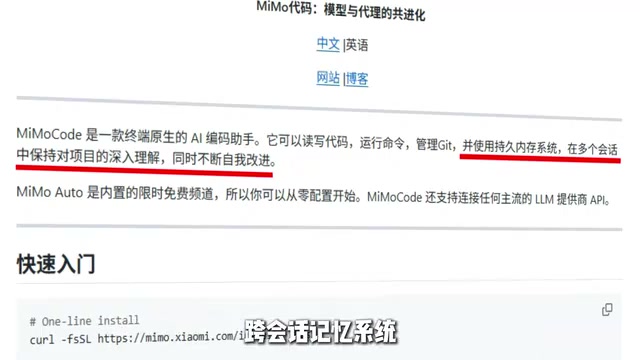
SQLite is an embedded relational database that requires no separate server process — the entire database is a single file, making it ideal as a storage engine for local applications. FTS5 (Full-Text Search 5) is SQLite's fifth-generation full-text search extension module, supporting advanced search features like BM25-based relevance ranking, prefix queries, and phrase matching. Compared to storing memories in plain text files, the advantage of using FTS5 indexing is that retrieval speed doesn't scale linearly with data volume — even when the memory store grows to tens of thousands of records, query latency remains at the millisecond level. Additionally, SQLite's ACID transaction properties ensure consistency and reliability of memory data during concurrent reads and writes, which is particularly important for scenarios where multiple Agents access the memory store simultaneously.
In simple terms, the working principle of this memory system can be broken down into three steps:
Automatic Extraction and Compression
During each session, MiMo Code automatically identifies and extracts key project information — including architectural decisions, coding standards, technology choices, bug fix records, and more. This information isn't stored verbatim but undergoes compression and structuring to ensure storage efficiency.
This process is essentially an Information Distillation strategy. During each session, conversations between the developer and AI may contain significant redundant information — exploratory questions, failed attempts, repeated confirmations, etc. Storing all this raw dialogue would not only waste storage space but also introduce noise during subsequent retrieval. Therefore, MiMo Code uses the LLM to summarize and structure session content, extracting high-value information such as architectural decisions, technical constraints, and coding conventions, storing them in the database as structured key-value pairs or tagged documents. This approach closely mirrors how human engineers maintain project Wikis or ADRs (Architecture Decision Records), except the entire process is automated.
Persistent Storage
Extracted information is stored in a local SQLite database with indexes built using the FTS5 full-text search engine. This means memories don't vanish when a session ends — instead, they accumulate like a continuously growing project knowledge base.
Precise Recall
When you ask a question in a new session, MiMo Code automatically retrieves relevant historical memories and precisely matches the context. According to the developers, this recall mechanism works efficiently even with large-scale projects containing over a million lines of code.
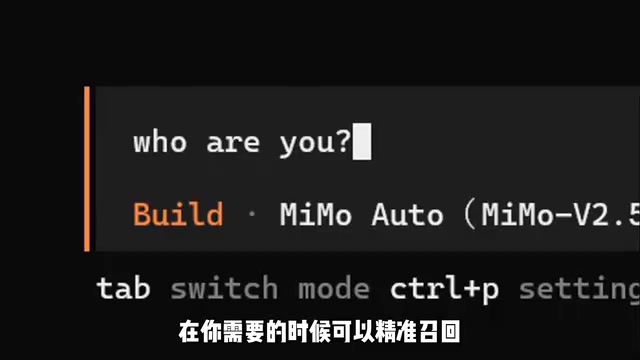
This design philosophy isn't entirely novel — similar "memory bank" approaches have existed in the community — but MiMo Code packages it into a complete, out-of-the-box system built on SQLite, a lightweight yet battle-tested technology stack, taking practicality a step further.
Multi-Agent Collaboration: Simulating Real Development Team Workflows
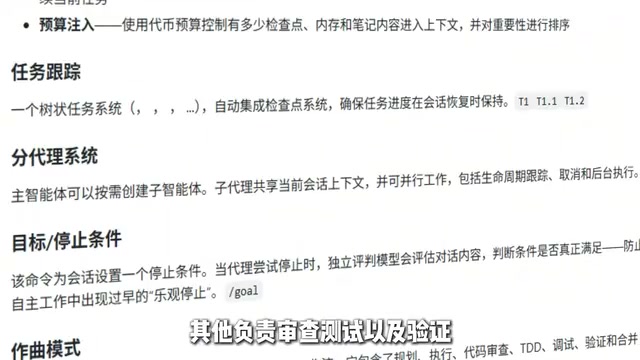
Another highlight of MiMo Code is its multi-Agent collaboration mechanism. Rather than having a single AI handle everything, it distributes tasks across multiple specialized Agents:
- Coding Agent: Handles core code writing
- Review Agent: Performs code review and identifies potential issues
- Testing Agent: Writes and runs test cases
- Verification Agent: Handles final quality verification
The multi-Agent collaboration mechanism originates from classical theories in distributed artificial intelligence and has experienced a renaissance in engineering practice as LLM capabilities have improved. The core idea is that a single Agent executing complex tasks is prone to Self-Consistency Bias — a tendency to believe its own generated content is correct, making it difficult to spot its own logical flaws. By introducing multiple Agents with different role definitions and system prompts, the system can simulate the role specialization and cross-review mechanisms found in human teams. Academia refers to this pattern as "Debate-based Reasoning" or "Society of Mind." In MiMo Code's implementation, the Coding Agent and Review Agent use different evaluation criteria and focus areas — the Review Agent may emphasize security vulnerabilities, performance bottlenecks, and code maintainability rather than just functional correctness, achieving more comprehensive quality control.
This division of labor mirrors the collaborative workflow of real software teams and theoretically can significantly improve code quality. After all, having the same AI both write and review its own code is far less effective than cross-validation from multiple independent perspectives.
Flexible Model Integration
In terms of model integration, MiMo Code demonstrates considerable openness. Users can choose from multiple approaches:
- MiMo Auto: Xiaomi's own automated mode
- Xiaomi MiMo Platform: Direct integration with Xiaomi's AI services
- Claude Code Configuration: Compatible with Claude Code usage patterns
- Custom OpenAI-Compatible API: Supports any model compatible with the OpenAI API format
The OpenAI-compatible API has become the de facto interface standard in the LLM space. This API specification defines standardized endpoint formats like /chat/completions and /embeddings, and virtually all major open-source and commercial model providers — including Ollama, vLLM, LM Studio, DeepSeek, Qwen, and others — offer compatible implementations. MiMo Code's choice to support this standard means users can deploy open-source models locally (such as Llama, Qwen, DeepSeek-Coder, etc.) and connect them through a unified interface, or switch to any cloud model service without any Vendor Lock-in. This design philosophy is known in the open-source community as a "Model-Agnostic" architecture — it decouples the tool layer from the model layer, allowing users to freely choose the most suitable model based on task complexity, cost budget, and privacy requirements.
This means MiMo Code is essentially a framework-level tool rather than a closed product tied to a specific model. You can pair it with your preferred LLM, which is undoubtedly more appealing in the open-source community.
Positioning Differences Between MiMo Code and Claude Code
From the MiMo series of models to the MiMo Code tool, Xiaomi's strategy in the AI open-source space is becoming increasingly clear. Xiaomi's previously released MiMo reasoning model already attracted industry attention, and now the launch of a developer-focused coding tool clearly signals the construction of a complete AI technology ecosystem.
That said, claiming MiMo Code is going "head-to-head with Claude Code" may be premature. Claude Code is backed by Anthropic's powerful model capabilities, while MiMo Code's core advantages lie more in its engineering-level memory system and multi-Agent architecture. The two have distinctly different positioning: Claude Code is a model-driven coding assistant, while MiMo Code is more of an enhanced coding framework.
But it's precisely this differentiated positioning that gives MiMo Code its unique value. For developers struggling with context loss, an open-source, customizable coding tool that can truly "remember" project history is definitely worth trying.
The 9.2K Star count also demonstrates genuine community demand for this type of solution. Since 2024, the AI coding tools space has undergone a significant competitive paradigm shift. Early competition focused on model capabilities themselves — who scored higher on benchmarks like HumanEval and SWE-bench. But as various models have converged in code generation ability, developer attention has shifted to the engineering experience: Is context management intelligent? Is workflow integration seamless? Is understanding of large codebases deep enough? Cursor rose rapidly with its IDE-level deep integration, Windsurf (formerly Codeium) redefined the coding conversation experience through Cascade streaming interaction, and Claude Code won over a cohort of hardcore developers with its terminal-native minimalist philosophy. MiMo Code's choice to focus on memory persistence and multi-Agent collaboration hits precisely on pain points that remain insufficiently addressed in the current tool ecosystem. Competition in AI coding tools is shifting from "whose model is stronger" to "whose engineering experience is better."
Related articles
Codex + Claude Code in Practice: From Vibe Coding to Enterprise-Grade AI Engineering
A deep dive into Codex and Claude Code for real-world AI programming—from Vibe Coding prototypes to Plan mode and SuperPAL engineering, with LLM selection strategies and enterprise workflows.
Hands-On Tutorial: Building an AI Trending News Dashboard from Scratch with Claude Code
Learn to build an AI trending news dashboard from scratch with Claude Code — no coding required. Covers CC setup, domestic model integration, and full-stack development.
HAMAS Multi-Agent Framework in Practice: A Guide to Building 5 AI Personas Working in Harmony
Learn how to build a multi-Agent AI team with the HAMAS framework: 5 role configurations, Skill mechanisms, gradient model scheduling, and solutions for AI hallucination and deception.