17 Million Lines of Code Challenge the Riemann Hypothesis: AI Proof Milestone or Trust Crisis?
Mathematician Alborg and Claude complete a Lean formal proof of the Generalized Riemann Hypothesis—machine-verified, but not yet human-understood.
Anthropic mathematician Seyvnt Alborg and AI Claude completed a formal proof of the Generalized Riemann Hypothesis in Lean, over 17.37 million lines of code, verified with zero errors by multiple independent checkers. The proof moves Stepanov's multiplicity method from finite fields to the integers via theta lifting, reaching error balance at about square root X and producing the critical line one half. But machine checking only confirms the conclusion follows from the code's statement; whether that statement is truly the Riemann Hypothesis still needs human review. The mathematical community is divided, and the Clay Institute still lists the problem as unsolved.
A Mathematician and an AI in 41 Days: A Code Proof of the Riemann Hypothesis
Mathematicians are staring at the same progress bar. This time, the answer they are waiting for comes from one person and one AI — Anthropic mathematician Seyvnt Alborg published a four-page explanation on his personal website, and the first sentence is: I believe that together with Claude, I have discovered a proof of the Riemann Hypothesis. But he didn't post a paper; he only posted code. The code is written in the Lean proof language: 14 compressed packages, over 1.7 million files, totaling 17.37 million lines. Alborg says that if it were forced into human-readable prose, it would exceed 250,000 pages.
The explanation includes a timeline listing 20 key steps from the start of the proof to its completion, each marked with a date. The first step is October 6, and the last step is November 16, with only three letters written: GRH, the Generalized Riemann Hypothesis. His scope is broader than the Riemann Hypothesis. According to this timeline, a problem that has plagued mathematicians for 167 years may have been conquered in only 41 days.
On the day of publication, MIT mathematician Sutherland had a computer run through all 17 million-plus lines of code from beginning to end, checking one by one whether each step of reasoning holds. The result: across more than 1.7 million files, not a single error. Then the Lean community's checker reviewed every file again, and all passed. Three other checkers, each independently written by different people, also all returned passes. Now, only the final and strictest official check is still running — the progress bar mentioned at the beginning is it.
Thus a situation unprecedented in the history of mathematics has arisen: machine checking says the proof is correct, but so far no one can explain clearly why it is correct, including the author himself. Alborg admits in the explanation that some parts of the timeline are merely him relaying summaries of Claude's techniques, and may make no sense at all.
Primes, Zeros, and the Cage of Square Root X
To understand the weight of this matter, we must start with primes. Primes are like atoms in the number world; every integer can be factored into a product of primes. But they are very unevenly spaced: 11 and 13 are adjacent, yet after 113 one must skip 14 numbers before the next prime. In 1859, the 33-year-old German mathematician Riemann wrote a paper in which he discovered a startling connection — how primes are distributed is completely determined by a sequence of zeros of a function. Once you know where these zeros are, you can precisely calculate how many primes there are in any range. Each zero is like a musical note; by stacking these notes one by one, you can reconstruct the positions of the primes.
In the paper, Riemann wrote: It is very probable that all roots are real. Here "roots" means zeros; simply put, all these notes line up on the same straight line. This was followed by another sentence: I have tried a few hurried attempts without success, and shall leave it aside for the time being. That aside lasted 167 years.
Mathematicians later discovered that the estimation error in the prime-counting function has always been confined within the "cage" of square root X. The Riemann Hypothesis says: no matter how far you count, this error can never escape the cage of square root X. And the reason the cage is of size square root X is precisely that all zeros lie on the vertical line with real part one half. If even one zero shifted slightly to the right, the wave it contributes would grow at a faster rate and would sooner or later push the error out of the cage. Therefore, "all zeros lie on the one-half line" and "the error is forever confined in the square root X cage" are actually saying the same thing.
The Riemann zeta function and its zeros
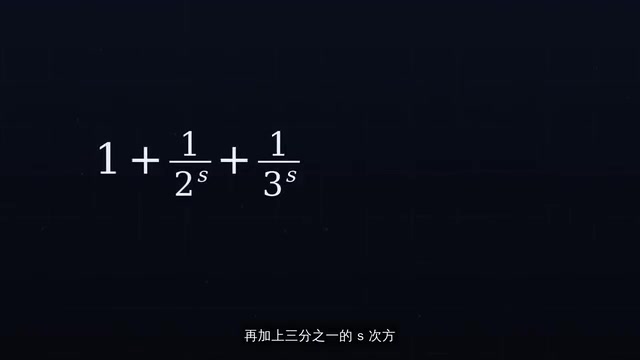
The "zeros" in the Riemann Hypothesis refer to the zeros of the Riemann zeta function (\zeta(s)). This function was first studied by Euler and is defined as the infinite series (\zeta(s)=\sum_{n=1}^\infty \frac{1}{n^s}), which by analytic continuation can be defined on the entire complex plane (except for a pole at (s=1)). Riemann discovered that the zeros of (\zeta(s)) fall into two classes: "trivial zeros," located at the negative even integers (s=-2,-4,-6,\dots); and nontrivial zeros, all lying in the strip (0<\mathrm{Re}(s)<1). The Riemann Hypothesis asserts that the real part of every nontrivial zero is exactly (\frac{1}{2}). In other words, they all line up on the vertical line in the complex plane whose real coordinate is (\frac{1}{2}). This line is called the "critical line," and the region (0<\mathrm{Re}(s)<1) is called the "critical strip." Each nontrivial zero corresponds to a "note" in the distribution of primes, and the extent to which a zero's real part deviates from (\frac{1}{2}) directly determines the growth rate of the prime-counting error.
Over a Century: Where Did Mathematicians Get Stuck?
From Riemann's death to Hilbert including the Riemann Hypothesis among his 23 problems, generation after generation of the finest mathematicians tried to conquer it. Their main approach can be imagined as advancing from right to left: first prove that in some region on the right there is not a single zero — a region called a "zero-free region," like a safety belt.
In 1896, the French mathematician Hadamard and the Belgian mathematician de la Vallée Poussin independently proved that there are no zeros on the line with real part equal to 1. With just this step, they proved the famous Prime Number Theorem. Three years later, de la Vallée Poussin expanded this line into a safety belt with width, but the belt gets narrower the higher it goes. In 1958, the Soviet mathematicians Vinogradov and Korobov independently improved the safety belt to today's best shape, but it still gets narrower the higher it goes, narrowing to almost zero at the end. For nearly 70 years since then, the shape of this safety belt has not undergone any essential improvement.
Another path is to directly count how many zeros lie on the one-half line. In 1914, the British mathematician Hardy proved that there are infinitely many zeros on the one-half line. There is also a widely circulated story about Hardy: he was to take a ship across the stormy North Sea, and before boarding he sent a friend a postcard saying, "I have proved the Riemann Hypothesis." His reasoning was that God would not let him drown with this honor that did not belong to him. He landed safely, and the postcard naturally did not count.

"Infinitely many" sounds like a lot, but what proportion of all zeros is that? Later mathematicians proved step by step that at least forty percent of the zeros lie on this line. In 1989 the proportion proved reached 40%, and in 2020 it reached 41.7%. In one hundred years, progress went from infinitely many to just over forty percent, while the Riemann Hypothesis demands one hundred percent. After computers appeared, people began to calculate zeros one by one and check them directly: in 1953 Turing used the University of Manchester's computer to verify the first 1,104 zeros, and by 2021 mathematicians Platt and Trudgian had rigorously verified the first 12 trillion zeros, all of them on the line, with not a single exception.
But data can be misleading. Within the range we can calculate, Gauss's estimate almost every time deviates from the true prime count by some amount, but in 1914 the British mathematician Littlewood proved that this size relationship will sooner or later reverse, and will reverse back and forth infinitely many times. The first reversal occurs near an enormous magnitude far beyond human computational capacity. Before that, all the data we can calculate tells you a false pattern. Therefore, no amount of verification can replace proof.
From the Vacuum World to the Integer World: A Bridge of Multiplicity
The key to this proof is hidden in another mathematical world. Mathematicians studying primes also have a clean world like Galileo's vacuum experiment: replace ordinary integers with arithmetic on a clock. Imagine a clock with only five marks; one hour after four o'clock returns to zero. This kind of addition, subtraction, multiplication, and division on a clock face is called a finite field in mathematics.
In the vacuum world, the Riemann Hypothesis was proved long ago. In 1933, the German mathematician Hasse proved that no matter how many marks the clock face has, the error between the number of solutions to an equation and the average estimate will not exceed twice the square root of the number of marks. Later the French mathematician Weil extended the result to more general curves, and in 1974 the Belgian mathematician Deligne proved the most general case and won the Fields Medal for it.

In the vacuum world, there is a particularly naive proof method, devised in 1969 by the Soviet mathematician Stepanov. The idea is somewhat like stamping: suppose you want to count how many cities are on a map; you design a route that is required to pass through every city and to stamp m items at each city, that is, to pass with multiplicity m. The total length of this route has an upper bound, so the number of cities is at most the total length divided by m. Here m is called the multiplicity in mathematics. The larger m is, the smaller the quotient and the more accurate the estimate; but to make the route go around each city m times, the route itself must be built longer, and the error instead grows larger. When the two are balanced, the total error is minimized, and that balance point happens to give the square root — the one-half power.
For decades, many mathematicians wanted to move this trick from the vacuum world back to the integer world, but all got stuck at the multiplicity step. Stepanov's method has a complete skeleton but lacks the component of multiplicity. What Alborg and Claude had to supply is precisely this step. In the explanation, Alborg revealed only one sentence, saying that this sentence alone would be enough to make fellow mathematicians fall off their chairs. According to an interpretation in the community not yet reviewed by mathematicians, there is no ready-made multiplicity in the integers, so one uses a long chain of interlocking mathematical operations — theta lifting — to imitate it. The length of this chain is equivalent to how many times one stamps. When the length of the chain reaches square root X, the several error terms balance, and one half arises at that moment.
Finite fields and the Weil conjectures
A finite field is a field containing only finitely many elements; the most typical example is the set of integers modulo a prime (p), (\mathbb{F}_p), in which addition and multiplication are performed modulo (p), like arithmetic on a clock. Over finite fields, one can define objects such as algebraic curves and zeta functions, which are highly parallel to the integer case. The Weil conjectures are a set of conjectures proposed by André Weil in 1949 about the properties of zeta functions of algebraic varieties over finite fields; the "Riemann hypothesis analogue" part asserts that the zeros of the zeta function of an algebraic curve over a finite field all have absolute value equal to (q^{-1/2}) (where (q) is the number of elements of the field), which corresponds exactly to the integer case of "real part equal to one half." In 1974, Pierre Deligne proved the most general Weil conjectures and won the 1978 Fields Medal for it. It is precisely this already-proved analogue in the "vacuum world" that provides a proof path that can be imitated for the Riemann Hypothesis in the integer world.
The Trust Crisis of Machine Proof: Why Is the Mathematical Community Divided?
What exactly does machine checking confirm? Lean is a proof language: you write a mathematical problem as code and write the proof process as code, and it checks whether each step of reasoning holds. If even one step is wrong, the entire proof fails. Lean users together maintain a public mathematical library called Mathlib, in which the Riemann Hypothesis problem has long been written, only two lines of code, with a comment beside it: whoever can give a proof of this problem is worth one million dollars. And the final conclusion of Alborg's proof uses exactly this ready-made problem statement, not one he wrote himself.
This point is very important, because passing machine checking can guarantee only one thing: that this conclusion is derived from the problem statement written in the code. As for whether the problem statement written in the code is exactly the Riemann Hypothesis we mean, that still requires human verification. For example, in Mathlib the Riemann zeta function is artificially set at the point 1 to approximately -0.977, whereas in mathematics textbooks it is infinite at this point. Therefore, when Mathlib writes the Riemann Hypothesis problem, it specifically adds a condition: s is not equal to 1, excluding this special point. Details like this require someone to check line by line.

17.37 million lines of code is equivalent to 7 times the entire Mathlib mathematical library. If a person reads one line every 10 seconds, 8 hours a day, without a single day off all year, it would take 16 and a half years to finish reading it. Using computers to help prove mathematical theorems is not new: in 1976 Appel and Haken used a computer to prove the Four Color Theorem, and at the time many mathematicians did not accept a proof that humans could not check line by line, until 2005 when it was verified step by step from beginning to end by another proof software, and the controversy gradually subsided. In 1998 Hales proved the Kepler conjecture; the paper was reviewed for 4 years, and the reviewers finally said they were 99% certain, so Hales simply led a team to spend more than ten years translating the entire proof into code that a computer could check step by step.
But in those two cases, a human-written proof came first, and the machine supplemented the checking. This time the order is reversed: first there is a machine-verified version, but no human-readable version yet. So the reaction of the mathematical community is not uniform. Sutherland said this is a historic moment. The British mathematician Maynard said that if it is ultimately fully verified, it is unquestionably a milestone in the history of mathematics. Terence Tao said that it will take time to truly digest this proof, and his first impression is that it has mobilized almost the full power of two sets of modern mathematical theories: the Langlands program and arithmetic geometry. The mathematician Granville criticized it, saying that what he released is a mess, and that he should first prepare a clear explanation before publishing. Experts in the Lean community also raised criticism: the code is very messy, there is not a single comment among the 17 million lines, and it does not cite anyone's research results.
The timing of the release also caused controversy. Just the day before the release, Anthropic had just listed on Nasdaq, and on the day of the release its stock closed down 8.5%, so some suspected that the timing was related to the stock price. In response, Alborg directly stated in the explanation: the timing is indeed very bad, but this speculation is wrong. There is also a coincidence: on the same day, the young Stanford mathematician Masullo also announced a 940-page proof of the Generalized Riemann Hypothesis written entirely by hand, and within a few hours someone used AI to lock onto problems in it. On one side is a human-written proof, over 900 pages, with flaws found within hours; on the other side is a machine-written proof, 17 million lines, with no error found so far, yet no one can understand it.
Lean and Mathlib
Lean is an interactive theorem prover and also a programming language, initiated in 2013 by Leonardo de Moura at Microsoft Research. Its core is a small and trustworthy kernel responsible for checking whether each line of proof code derives conclusions from premises according to logical rules. Users can use Lean to write mathematical definitions, theorems, and proofs as code, and the compiler verifies them step by step. Mathlib is a mathematical knowledge base jointly maintained by the Lean community, containing a large amount of formalized modern mathematics from basic set theory to algebraic geometry and analysis, and currently has more than a million lines of code and thousands of theorems. A key design in Mathlib is that all definitions and theorems must be strictly formalized and cannot contain "obvious" gaps. Therefore, when Alborg claims to have proved the Riemann Hypothesis, he must use the "Riemann Hypothesis" statement already in Mathlib, or give a statement equivalent to it; otherwise, even if machine checking passes, it cannot correspond to the Riemann Hypothesis as people understand it. This is also why the special convention in Mathlib for the Riemann zeta function at (s=1) becomes a focus of manual verification.
Final Thoughts: A Problem Picked Up by a Machine Still Needs to Be Understood by Humans
On the official website of the Clay Mathematics Institute, the Riemann Hypothesis is still marked as unsolved to this day. According to their rules, a proof must be formally published, must remain published for two full years, and must be generally accepted by the mathematical community before it counts. Alborg wrote a very personal passage in the explanation: he said that as a student, he had always kept a secret in his heart, treating the Riemann Hypothesis as his life plan decades later. He wrote that, naturally, one would feel that this is an endpoint; for me, it is like losing the main guiding light. But in this process, what I saw surprised me too much, and I believe this is the dawn of something greater. He said the first thing to do next is to understand this proof, simplify it, and then write it out properly so that more people can understand it.
167 years ago, Riemann wrote in his paper, "leave it aside for the time being." Today, this problem may have been picked up by a machine, but why it is correct still has to be understood by humans. By reading this far, you have already understood a few things. First, the Riemann Hypothesis says that the estimation error in the prime-counting function is forever confined in the cage of square root X. Second, the reason the cage is square root X is that all zeros of the zeta function line up on the one-half line. Third, this one half is a balance point of a seesaw in the vacuum world, and in this new proof, it is said to be so as well.
As for whether those 17 million lines of code really weld this cage shut? The progress bar at the beginning is still running.
The Clay Mathematics Institute and the Millennium Prize Problems
The Clay Mathematics Institute announced seven "Millennium Prize Problems" in 2000, and the solver of each problem will receive one million dollars. The Riemann Hypothesis is one of them (the others include the P vs NP problem, Yang-Mills existence and mass gap, existence and smoothness of the Navier-Stokes equations, the Hodge conjecture, the Poincaré conjecture, and the BSD conjecture). Among them, the Poincaré conjecture was solved by Perelman in 2003, but he refused the prize. The Clay Institute has clear rules for "solution": the proof must be formally published in a peer-reviewed mathematical journal, must remain published for two years, and must be generally accepted by the mathematical community before it can be recognized as solved. Therefore, even if Alborg's Lean proof ultimately passes all machine checks, it still needs to be understood, simplified, and formally published by human mathematicians before it can enter the temple of mathematical knowledge. This is also why Alborg emphasized in the explanation that "the next step is to understand this proof."
One-line Summary
Mathematician Alborg and Claude completed a formal proof of the Generalized Riemann Hypothesis in Lean; machine verification found zero errors, but humans have not yet understood it.
Paragraph Summary
Anthropic mathematician Seyvnt Alborg, working with the AI Claude, completed a formal proof of the Generalized Riemann Hypothesis using the Lean proof language, with more than 17.37 million lines of code, verified with zero errors by multiple independent checkers. The core of the proof is to move Stepanov's multiplicity method from finite fields to the integer world through a theta-lifting chain; when the chain length is about square root X, the errors balance and produce the critical-line one half. However, machine verification only guarantees that the conclusion follows from the problem statement in the code; whether the statement itself is the Riemann Hypothesis still requires manual verification. The mathematical community is divided: some call it a historic moment, others criticize the code as messy and uncommented, and Terence Tao believes digestion will take time. The Clay Institute still marks the Riemann Hypothesis as unsolved, because formal recognition requires human understanding and peer review.
Related articles

Meta Abandons 2030 Net Zero Target, Tech Industry Climate Pledges Face a Reckoning
Meta withdraws its 2030 net zero target in its 2026 sustainability report, triggering a chain reaction in tech climate pledges. This analysis examines the impact on competitive dynamics, ESG investment strategies, and industry self-regulation.

Philosopher Rejects Anthropic's AI Consciousness Argument: A Dangerous Business Narrative
Anthropic listed AI consciousness as a risk factor ahead of its IPO, prompting a prominent philosopher to publicly reject its consciousness argument. This article analyzes the business motives, scientific honesty, and AI industry narrative strategies behind the debate.

Amazon Acquires Decart's AI Optimization Tech for $7.5B to Pave the Way for Trainium Chips
Amazon reportedly acquires Decart's AI optimization tech and research team for $7.5B to strengthen Trainium's software ecosystem and pave the way for selling its custom AI chips externally. This article analyzes the deal logic, the critical role of optimization technology in chip competition, and its impact on the AI chip market.