Meta Abandons 2030 Net Zero Target, Tech Industry Climate Pledges Face a Reckoning
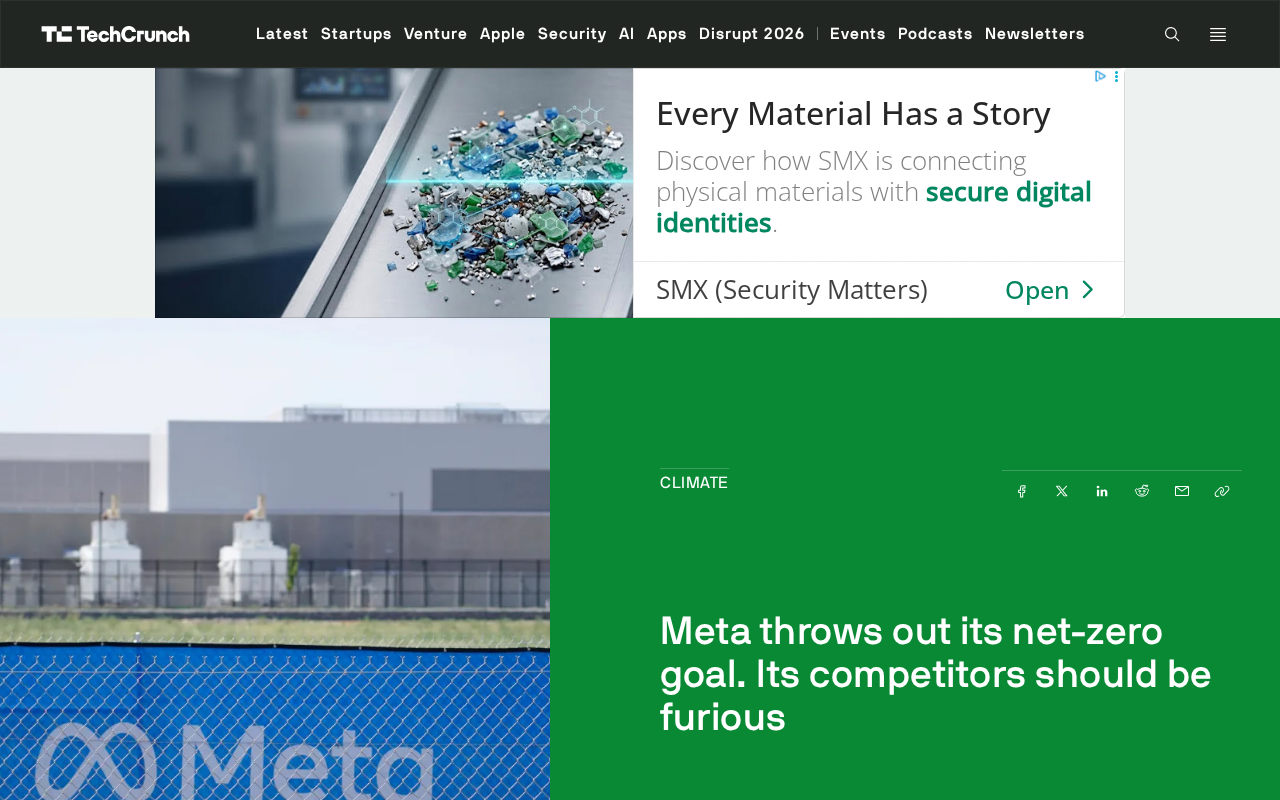
Meta's withdrawal of its 2030 net zero target creates an asymmetric advantage over companies upholding climate commitments in the AI race.
Meta officially withdrew its 2030 net zero emissions pledge in its 2026 sustainability report, a symbolic moment in the loosening of tech climate commitments. Surging AI compute demand and data center expansion have sharpened the conflict between decarbonization and growth; Meta chose to revise its target rather than slow AI investment. This changes the industry benchmark—companies upholding pledges bear higher costs while Meta focuses on AI, creating asymmetric competition—and may lower the threshold for followers and weaken ESG constraints.
Meta announced in its 2026 sustainability report that it is withdrawing its 2030 net zero emissions target, a decision that has set off a chain reaction across the tech industry. For competitors that have already invested substantial resources in honoring their climate commitments, Meta's retreat constitutes an unfair advantage in the competitive landscape.
What Meta's Withdrawal of Its Net Zero Target Entails
According to Meta's 2026 sustainability report, the company has officially abandoned its pledge to achieve net zero emissions by 2030. The news was first disclosed via an RSS feed and subsequently sparked widespread discussion in tech and environmental circles.
Meta did not offer a detailed technical explanation for the withdrawal in its report, but the decision itself sends a clear signal: against the backdrop of surging demand for AI compute and large-scale data center expansion, Big Tech's climate commitments are being tested by real-world pressure. Training and running large models consumes enormous amounts of electricity, and as Meta continues to ramp up its investment in AI infrastructure, the conflict between decarbonization pathways and business expansion is growing increasingly acute.
Net Zero refers to a company achieving a net balance at a given point in time by offsetting the greenhouse gas emissions generated across its value chain with an equivalent amount of emissions removed from the atmosphere. Tech companies typically pursue this through three pathways: improving energy efficiency, procuring renewable energy, and investing in carbon offset projects. The concept originates from the Paris Agreement's goal of limiting global warming to 1.5°C; the scientific community estimates that the world needs to reach net zero around 2050. Corporate-level net zero commitments are mostly voluntary, audited and certified by organizations such as SBTi (Science Based Targets initiative), but they lack legal enforceability. Meta's previously pledged 2030 net zero target was one of the most aggressive timelines in the tech industry, earlier than the EU's overall 2050 goal; the withdrawal means its timeline has slipped by more than a decade.
Why Competitors Should Be Angry
Climate commitments are essentially a form of industry self-regulation. When a leading company publicly withdraws its target, it effectively changes the competitive benchmark for the entire industry.
Companies still adhering to net zero targets face a dilemma: continuing to invest in green energy and carbon offsets means higher operating costs, while Meta, having shed the burden, can direct more resources toward the AI race. This asymmetric competition puts rule-abiding companies at a disadvantage. The more far-reaching impact is that Meta's move could weaken other companies' political will to maintain climate commitments—if the industry leader has pulled out, the psychological threshold for followers to do the same drops significantly.
From an investor perspective, the binding force of ESG assessment frameworks on tech companies may also loosen as a result. When a leading company openly deviates from climate targets and the market reaction is muted, the commercial value of climate commitments will be repriced.
ESG stands for Environmental, Social, and Governance—a framework investors use to evaluate companies' non-financial performance. ESG ratings (such as scores from MSCI and Sustainalytics) affect eligibility for inclusion in index funds, the cost of issuing green bonds, and institutional investors' holdings decisions. For tech companies, a higher ESG rating often means lower cost of capital and a broader investor base. When Meta publicly withdraws its climate target and the market does not impose significant penalties, the correlation between ESG ratings and financial returns will be called into question, and rating agencies' binding force on the tech industry may be weakened—this is precisely the meaning of "the commercial value of climate commitments will be repriced" in the text.
The Fragility of Tech Industry Climate Commitments
Meta's decision is not an isolated event. The net zero timelines previously set broadly across the tech industry were mostly built on assumptions of linear business growth, and the AI wave has shattered that premise. Data center electricity consumption is climbing at a rate far exceeding expectations, and the supply growth of green energy struggles to match the demand from compute expansion.
In this situation, companies face essentially three choices: slow down AI investment to maintain the pace of emissions reduction, ramp up green energy procurement to offset incremental emissions, or revise climate targets. Meta chose the third path. This choice exposes the fundamental flaw of voluntary climate commitments—in the absence of external mandatory constraints, the stability of a commitment depends on the magnitude of business pressure.
Carbon Offset refers to companies funding tree planting, carbon capture, or renewable energy projects to offset emissions they cannot directly reduce. It is a key component of many tech companies' net zero pathways, but it has been controversial in recent years: the actual emissions reductions of offset projects are difficult to verify, there are risks of "greenwashing," and offsets are not equivalent to real emissions reductions. Renewable energy procurement (such as PPAs, power purchase agreements) is another major tool, whereby companies sign long-term agreements with power generators to secure green electricity supply. However, the electricity demand growth of AI data centers has outpaced the construction cycles of new green energy projects, forcing companies to either rely on grid electricity that still contains fossil fuels or slow their expansion—this is precisely the technical root cause of why voluntary commitments are difficult to sustain under business pressure.
Potential Impact on the Industry Landscape
The impact of Meta's withdrawal of its net zero target will gradually manifest at three levels.
At the competitive level, companies adhering to climate commitments need to reassess their ESG investment strategies, and some may face pressure from shareholders to "align with industry practice."
At the policy level, regulators may use this as an opportunity to push for stricter disclosure requirements, converting voluntary commitments into mandatory obligations to compensate for the failure of industry self-regulation.
At the supply chain level, Meta's suppliers and partners may need to adjust their own carbon emissions management plans to match their customers' changed requirements.
It remains unclear whether other tech giants will follow suit in adjusting their climate targets, but Meta's decision has undoubtedly set a precedent for the industry. The trend of climate commitments degrading from "universal consensus" to "optional" deserves continued attention.
One-line Summary
Meta's withdrawal of its 2030 net zero target creates an asymmetric advantage over companies upholding climate commitments in the AI race.
Paragraph Summary
Meta officially withdrew its 2030 net zero emissions pledge in its 2026 sustainability report, marking a symbolic moment in the loosening of tech industry climate commitments. The article notes that surging AI compute demand and data center expansion have made the conflict between decarbonization pathways and business growth increasingly acute; Meta chose to revise its target rather than slow AI investment or increase green energy procurement. This decision changes the industry's competitive benchmark: companies upholding climate commitments bear higher operating costs, while Meta can concentrate resources on the AI race, creating asymmetric competition. The deeper impact is that a leading company's exit may lower the psychological threshold for followers, weaken the binding force of ESG assessments, and potentially push regulators to convert voluntary commitments into mandatory disclosure obligations.
Related articles

17 Million Lines of Code Challenge the Riemann Hypothesis: AI Proof Milestone or Trust Crisis?
Anthropic mathematician and Claude complete a Generalized Riemann Hypothesis proof in 17M lines of Lean code in 41 days—machine-verified with zero errors, yet no one can read it.

Philosopher Rejects Anthropic's AI Consciousness Argument: A Dangerous Business Narrative
Anthropic listed AI consciousness as a risk factor ahead of its IPO, prompting a prominent philosopher to publicly reject its consciousness argument. This article analyzes the business motives, scientific honesty, and AI industry narrative strategies behind the debate.
Amazon Acquires Decart's AI Optimization Tech for $7.5B to Pave the Way for Trainium Chips
Amazon reportedly acquires Decart's AI optimization tech and research team for $7.5B to strengthen Trainium's software ecosystem and pave the way for selling its custom AI chips externally. This article analyzes the deal logic, the critical role of optimization technology in chip competition, and its impact on the AI chip market.