1Password Unlocks a New AI Agent Capability: Automatic Login Without Exposing Passwords

1Password launches a login feature for AI agents: agents never touch passwords, and users authorize each login.
1Password has launched "1Password for Agents," allowing AI agents to complete account logins without viewing or touching the user's password. Its interaction logic is "request-approval": the agent initiates a login request, and after the user authorizes it, 1Password fills in the password in the background, with the password always remaining in the encrypted vault, continuing the zero-knowledge security model. The feature does not give agents free access to all linked accounts—users still need to authorize each login, but can set policies to reduce repeated approvals. The article argues that this marks password managers evolving from "tools for humans" to "infrastructure for human-AI collaboration," and could become a key piece in AI automation workflows. Meanwhile, the design requiring approval for each login seeks a balance between security and convenience, and may face consent fatigue challenges in the long term.
Password manager 1Password is tackling a long-standing problem for AI agents: how to let bots log into accounts for you without handing them the password. According to an RSS source, 1Password has launched a new feature called "1Password for Agents" that allows AI agents to complete account logins without viewing or touching the user's password. This doesn't give bots free access to all linked accounts—users still need to authorize each login request—but it could become the missing piece in AI automation workflows.
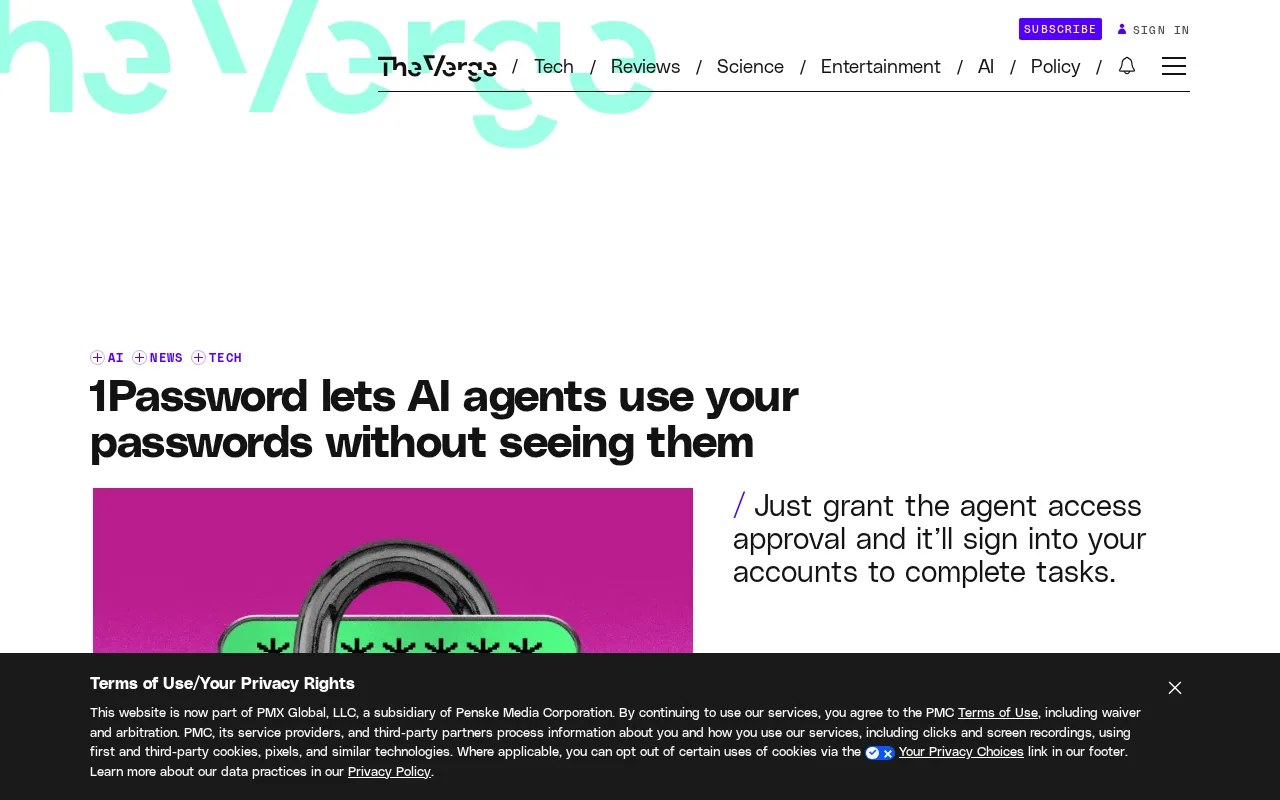
The AI agent password dilemma and 1Password's solution
Currently, AI agents often get stuck at the login step when performing automated tasks. Either the user has to manually enter the password, or the plaintext password is exposed to the agent program, creating security risks. 1Password for Agents attempts to find a balance between convenience and security: the agent initiates a login request, the user approves it, and 1Password fills in the password in the background—the agent never has access to the password itself.
This design continues 1Password's long-standing "zero-knowledge" security model—passwords always remain in the encrypted vault, and even 1Password itself cannot read them. Now, this principle is being extended to the AI agent scenario.
The zero-knowledge security model refers to a service provider designing and operating its systems so that it cannot access users' plaintext passwords or decryption keys. In 1Password's case, the user's master password and derived keys only participate in decryption locally; what is stored on the server is encrypted vault data. Even if the provider's database is compromised, attackers only get ciphertext. This model differs from traditional "server-side hash storage," which still relies on the provider correctly implementing security policies. The key prerequisites of zero-knowledge architecture are end-to-end encryption and key derivation functions (such as PBKDF2, Argon2), which determine the cost of brute-force attacks. Extending the zero-knowledge principle to the AI agent scenario means the agent can only obtain one-time authentication results or tokens and cannot access the plaintext password, thereby limiting the exposure surface at the architectural level rather than relying solely on policy constraints.
How the authorization mechanism works
Based on available information, the feature's interaction logic revolves around "request-approval." When an AI agent needs to log into an account, it sends a request to 1Password, and the user receives a notification and chooses whether to approve. Only after approval can the agent complete authentication through 1Password, but the password content is not passed to the agent in any form.
This mechanism is like issuing a one-time pass to an AI agent rather than handing over the key. For automated workflows that require frequent logins to multiple services, users can also set policies to reduce the burden of repeated approvals, though the specific implementation details have not been fully disclosed.
OAuth 2.0 and the "request-approval" pattern have similarities: OAuth allows third-party applications to access resources on behalf of the user through access tokens issued by an authorization server without obtaining the user's password. The interaction logic of 1Password for Agents can be understood as an "authorization agent" model for a local password vault—the agent initiates a request, the user approves it, and the password manager completes authentication; the password itself never leaves the vault. Unlike standard OAuth, there is no separate resource server participating in token exchange here; instead, the password manager directly fills in the credentials. Understanding this difference helps assess the feature's scope in cross-application automation: it solves the problem of "how agents borrow human credentials" rather than replacing standard server-side authorization protocols.
Significance for the AI automation ecosystem
1Password's move sends a clear signal: password managers are evolving from "tools for humans" to "infrastructure for human-AI collaboration." As AI agents take on more browser operations, API calls, and cross-application tasks, secure authorization at the identity authentication layer becomes essential.
If this model is widely adopted, in the future when AI agents access sensitive services, users may no longer need to manually transfer passwords; instead, trusted authorization can be completed through an intermediary layer like 1Password. This both reduces the risk of password leaks and makes automation workflows smoother.
AI agents generally refer to software systems capable of autonomously perceiving their environment, making plans, and invoking tools (browsers, APIs, command lines, etc.) to achieve goals. Unlike traditional script automation, AI agents often need to make dynamic decisions, so they frequently encounter login, identity verification, and other steps that require credentials. Current mainstream approaches include hardcoding passwords in environment variables, using session cookies saved by the browser, or having the agent directly read from a key management service. These approaches either expand the exposure surface or are difficult to audit. 1Password for Agents attempts to shift credential use from "agent holds" to "agent borrows," making identity authentication an infrastructure layer that can be authorized, revoked, and audited—especially critical for multi-agent collaboration and long-running automation.
Rebalancing security and convenience
Each login still requires user approval, which means 1Password for Agents will not yet allow AI agents to act fully autonomously. This conservative design is reasonable—at a stage when AI agent reliability has not been fully verified, retaining ultimate human control is wise. But in the long run, whether users will suffer from approval fatigue and loosen permissions as a result will determine whether this feature can truly scale.
1Password has not yet announced a specific launch date or support scope for the feature. But it is foreseeable that competition around AI agents in the password management space has only just begun.
Consent fatigue refers to users gradually tending to click "allow" without scrutiny when faced with frequent permission confirmation requests, thereby weakening the actual effectiveness of security mechanisms. This phenomenon has been widely observed in mobile app permissions, OAuth authorization, and browser extensions. For 1Password for Agents, which requires user approval for each login, consent fatigue is the core risk to large-scale adoption: if the approval frequency is too high, users may set overly permissive policies, rendering "ultimate human control" nominal. Mitigation approaches typically include per-session authorization, batch approval within time windows, adaptive adjustment of confirmation frequency based on risk levels, and providing clear audit logs. Whether these designs can strike a balance between security and efficiency will directly affect the feature's adoption rate in automation workflows.
One-line Summary
1Password launches a login feature for AI agents: agents never touch passwords, and users authorize each login.
Paragraph Summary
1Password has launched "1Password for Agents," allowing AI agents to complete account logins without viewing or touching the user's password. Its interaction logic is "request-approval": the agent initiates a login request, and after the user authorizes it, 1Password fills in the password in the background, with the password always remaining in the encrypted vault, continuing the zero-knowledge security model. The feature does not give agents free access to all linked accounts—users still need to authorize each login, but can set policies to reduce repeated approvals. The article argues that this marks password managers evolving from "tools for humans" to "infrastructure for human-AI collaboration," and could become a key piece of identity authentication in AI automation workflows. At the same time, the design requiring approval for each login seeks a balance between security and convenience, and may face the challenge of consent fatigue in the long term. 1Password has not yet announced a launch date or support scope.
Related articles

world2vec: Building Mechanistic World Models with Latent Dynamics Learning
world2vec proposes a reward-free method for learning mechanistic world models via latent dynamics, faithfully reproducing systems over long horizons with at least an order of magnitude fewer parameters than DreamerV3, TD-MPC2, and LeWM, and achieving accurate system identification on 71 attractor benchmarks.

A New KL-DRO Paradigm: Adaptive Scenario Generation Around a Learned Density Model
KL-DRO research proposes centering the KL ball on a learned density model instead of the empirical distribution, with adaptive scenario generation guiding sampling toward the worst case. Experiments show lower cost under distribution shift when records are scarce and the model can extrapolate, with comparable in-distribution cost.

ODE Samplers for Discrete Diffusion Models: Exponential Residual Flows Accelerate Generation
Discrete diffusion models lack deterministic ODE sampling? This article introduces Exponential Residual Flows (ERFs), which introduce continuous residual variables per token to construct piecewise ODEs for deterministic sampling and support consistency distillation acceleration. Superior to prior methods on code and text generation tasks.