A Beginner's Guide to Forward Deployed Engineers (FDE): The New Species of the AI Era
FDEs are a key role in AI implementation, originating from Palantir's deep customization and requiring reusable solutions and fine-tuning capabilities.
The article systematically reviews the origins, reasons for emergence, skill path, and implementation challenges of the FDE (Forward Deployed Engineer) role. The FDE model originates from Palantir's practice of deep customization for intelligence agencies, with the core being to station engineers at customer sites and bridge the gap between standardized products and differentiated needs. Its essential difference from outsourcing lies in solution reusability: switching customers only requires adjusting parameters and environment rather than rewriting core logic. In the AI era, the cost of prototype validation has dropped significantly, making this high-labor-input model economically feasible. In terms of skills, it is recommended to first master Agent development and private model deployment, then go deeper into fine-tuning and RAG, and finally pretraining, with difficulty increasing in that order. Enterprise implementation requires addressing challenges such as vague requirements, scope creep, and rising acceptance thresholds, and fine-tuning capability is often the key to meeting business standards.
What Is an FDE: Starting from Palantir
FDE (Forward Deployed Engineer) is becoming a key role in the wave of AI implementation. The origin of this position can be traced back to Palantir—a company known for serving government and intelligence agencies. Early on, while doing intelligence analysis for the CIA, it discovered that counterterrorism analysts and counter-proliferation analysts worked in completely different ways, and standardized products simply could not satisfy both types of needs at the same time.
Features designed by programmers sitting in the office and making guesses, after being relayed through layer after layer, are already distorted by the time they reach engineering implementation. This is a long-standing pain point in the software industry. Palantir's solution was: do not build a universal product, but build a deeply customizable platform and send the best engineers to the customer site.
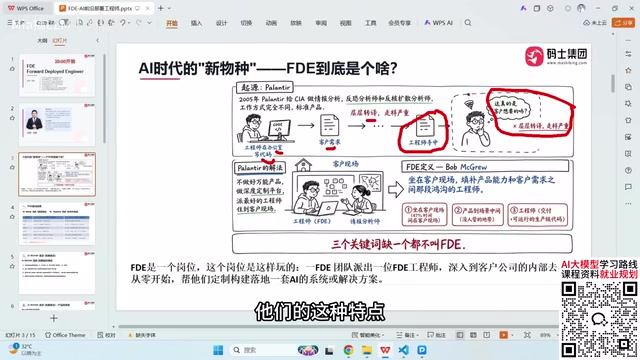
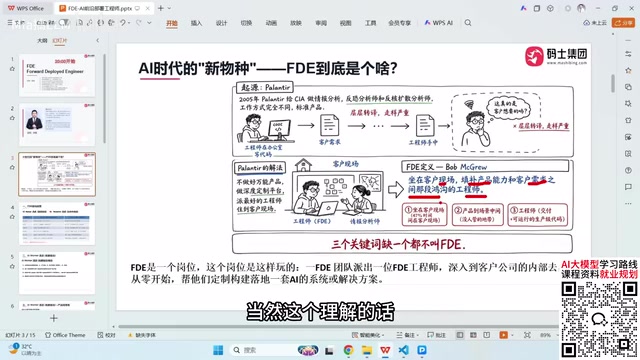
This is the core positioning of an FDE—sitting at the customer site, bridging the gap between product capabilities and customer needs. The difference from traditional outsourcing is that an FDE also carries product manager responsibilities and needs to help customers build customized AI systems or solutions from scratch. But the key lies in the word "product": if the project done at every customer site cannot be reused, then it is essentially still outsourcing, not FDE. A true FDE team should have a set of industry solutions that are parameterizable and quickly adaptable, so that switching to another customer only requires adjusting the environment and variables for deployment.
Why FDE Truly Emerged Only in the AI Era
Some may ask: why did this model not become widespread during the outsourcing era? The answer lies in the cost structure. In the past, a core engineer might earn as much as 800,000 yuan per year, and the company's overall burden could approach 1 million yuan. Sending that person to a customer site for a month could cost several hundred thousand yuan in labor. In the traditional model, producing a prototype or demo took a long time, so companies naturally were unwilling to keep their most expensive engineers by the customer's side for extended periods.
AI has changed this equation. Large models and agent technologies have greatly shortened the prototype validation cycle, and the feasibility of FDEs rapidly iterating and validating on site has increased significantly. At the same time, enterprises' expectations for AI implementation are no longer "buy a standardized SaaS," but "make it actually run here." This mismatch between supply and demand is exactly where the value of FDEs lies.
AI Agent refers to a software system that uses large models as its reasoning core and can autonomously plan steps, call tools (such as search, databases, and business APIs), and adjust actions based on execution results. Unlike traditional "question-and-answer" model calls, agents have the ability to decompose tasks and invoke tools over multiple rounds, and can complete relatively complex business processes end to end. This is precisely the foundation that enables FDEs to quickly build prototypes at customer sites: many enterprise needs do not require training a model from scratch, but rather connecting existing large models with the customer's business systems through tool calls. However, agents still have boundaries in reliability, controllability, and performance evaluation, which is why complex projects still need RAG and fine-tuning to fill the gaps.
What to Learn If You Take the FDE Path
If you plan to pursue the FDE direction, building your technical stack requires a clear prioritization. According to a sharing by teacher Li Jin on Bilibili, a reasonable path is: first master AI Agent development and private/local model deployment, then gradually go deeper into fine-tuning and RAG (Retrieval-Augmented Generation), and only after that move on to pretraining.
In terms of difficulty, fine-tuning is less difficult than RAG, and RAG is less difficult than pretraining. This order is not arbitrary—many projects have hard standards during acceptance, and relying only on the agent layer may get stuck at "90 points" and fail to improve further. Fine-tuning or RAG must be introduced to reach the "95 points" required by the business. Therefore, fine-tuning is not optional; it is a capability FDEs must master in the later stage.
Teacher Li Jin himself initially worked deeply in biometrics and face recognition. In the past two years, he has focused on deeply integrating traditional microservices with multi-agent systems and RAG retrieval technologies, and has end-to-end implementation capabilities from underlying algorithms to AI applications. This kind of composite background is exactly the typical profile of an FDE—one must understand the boundaries of algorithms, be able to implement engineering solutions, and also be able to communicate with customers.
RAG (Retrieval-Augmented Generation) is a technical paradigm that combines external knowledge bases with large models: before the model generates an answer, relevant fragments are first retrieved from enterprise documents, databases, or knowledge bases and injected into the prompt as context, and then the model answers based on these fragments. It solves problems such as outdated model knowledge, inability to access private data, and the tendency to fabricate facts, without retraining the model, at a cost far lower than fine-tuning. For enterprise scenarios, RAG enables AI systems to "understand" the customer's internal business documents and specifications, and is a key means for FDEs to quickly deliver usable AI applications at customer sites. Its difficulty lies not in calling the model, but in engineering details such as document chunking, vectorization, recall ranking, and performance evaluation.
Fine-tuning refers to continuing to train a pretrained large model with labeled data from a specific domain so that the model's behavior, style, or task capabilities better fit business requirements. Compared with RAG, fine-tuning changes the model's own parameters, so it can improve the model's stability and format compliance on specific tasks, but it requires high-quality datasets and compute investment, and the cost of updating knowledge is relatively high. In FDE practice, fine-tuning is often used as a "last mile" measure to push an agent solution from 90 points to the 95 points required for acceptance.
Common Pitfalls in Enterprise Implementation
The working scenario of an FDE determines that it will inevitably face the practical friction of enterprise implementation. Customer requirements are often vague and changeable. During on-site communication, "I want this, I want that" is the norm, and FDEs need to identify real requirements and control scope creep.
Another challenge is solution reuse. If every project starts from scratch, the team will fall into an inefficient outsourcing-style cycle. FDE teams need to accumulate reusable industry components and deployment frameworks, and keep on-site customization at the level of parameters and environment rather than rewriting the core logic every time.
In addition, the technical threshold for acceptance standards is rising. Enterprise customers increasingly know exactly what they want, and their requirements for agent performance have shifted from "it can run" to "it can meet the standard," which directly forces FDEs to have practical fine-tuning and RAG capabilities.
The Essence of the Role and the Capability Profile
Overall, FDE is a composite role spanning algorithms, engineering, and product. It requires practitioners to understand the technical boundaries of large models and agents, translate technology into solutions that customers can understand, and also have product thinking to ensure that deliverables are reusable.
For those who want to enter this direction, starting with AI Agent development, gradually filling in fine-tuning and RAG capabilities, and at the same time accumulating understanding of industry scenarios is a relatively pragmatic path. The value of an FDE lies not in writing the most code, but in making AI truly run in the customer's business.

Related articles

Skykea Showdown: A Hilarious Variety Show Experience of a Minecraft Airship Building Competition
Skykea Showdown is a Minecraft airship building racing variety show. This article analyzes its two-phase build + hole race format, airship mod lift physics, secret mission design, and team confrontation dynamics—ideal for game content creators.

Did the US Midterms Vote No to AI Data Centers? A Map Reveals the Truth
After the US midterms, media claimed voters rejected AI data centers, but a map shows restrictive votes are concentrated in a few Ohio townships, affecting less than 1% of US towns—the national anti-AI wave is exaggerated.

ApexW Optimizer Benchmark: Matches 8-bit AdamW in Unsloth with Lower Memory Usage
Developer shares benchmark of ApexW optimizer in Unsloth: ApexW 8bit has lower optimizer state memory (47.101 MB) and slightly better final loss than 8-bit AdamW, but similar speed. Needs independent reproduction.