A Medieval Medical Scroll: Exploring John of Arderne's Sweden Scroll

John of Arderne's early 15th-century Sweden Scroll illustrates how digital humanities preserves pre-modern medical knowledge.
This article provides contextual background on a medieval medical scroll (c. 1425–1435) associated with the celebrated English surgeon John of Arderne, best known for his illustrated manuscripts documenting anal fistula surgery. The 'Sweden Scroll' is likely a copy of his work preserved at a Swedish institution. The article examines the advantages of the scroll format for presenting sequential anatomical diagrams, and discusses the significance of digitizing such documents within the Digital Humanities — enabling high-resolution access and new research methods. Due to limited source material, the article focuses on background context rather than a detailed analysis of the scroll's contents.
An Overlooked Medieval Medical Document
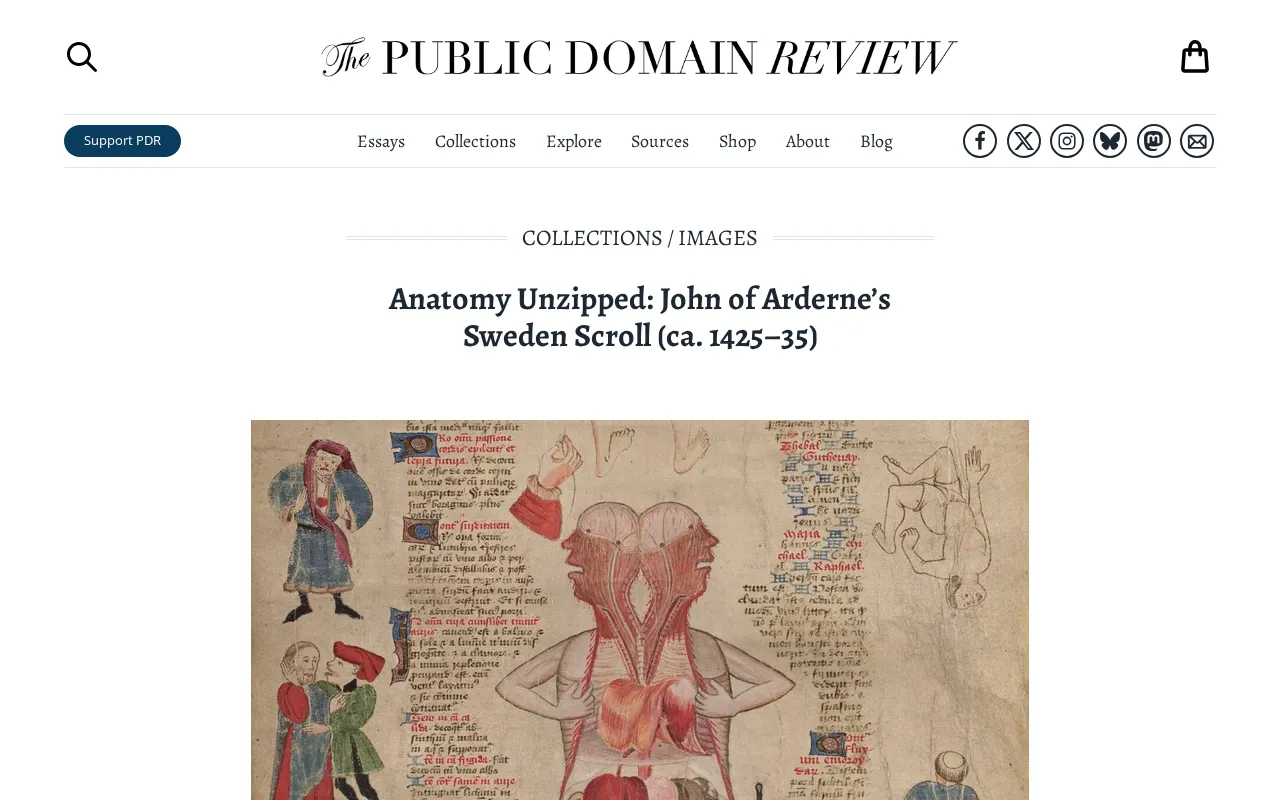
Anatomy Unzipped: John of Arderne's Sweden Scroll focuses on a medieval medical scroll dating to the early 15th century (approximately 1425–1435), associated with the renowned English surgeon John of Arderne. Documents of this kind offer a rare window into how pre-modern medical knowledge was transmitted and recorded.
Because the source material is extremely limited — originating from a low-engagement share with no body text or discussion — this article can only provide contextual background based on clues from the title, rather than a deep analysis of the scroll's contents.
Who Was John of Arderne?
John of Arderne is widely regarded as one of the most important surgeons of medieval England. He is best known for his documented treatments of surgical conditions such as anal fistula, and his works — which circulated widely as illustrated manuscripts — held considerable practical value in their time. The so-called "Sweden Scroll" is most likely a copy or derivative text from the European transmission of his medical writings, now held at an institution in Sweden.
The Significance of the Scroll Format
Medieval medical knowledge was often presented in scroll (volumen) rather than bound codex form. This format made it easy to unroll and consult continuous text and images — particularly well-suited for displaying anatomical diagrams and surgical procedures in sequence. The title Anatomy Unzipped aptly evokes the idea of progressively unfurling and interpreting the visual content of such a scroll.
Arderne lived from around 1307 to 1392, practicing first in Nottingham before moving to London. His most important work, Practica de Fistula in Ano (c. 1376), documented anal fistula surgery in detail — including excision and suturing techniques — with a success rate remarkable for the era. Unlike many of his contemporaries who relied heavily on ancient Greek and Roman authorities, Arderne prioritized clinical observation and practical experience. His manuscripts are distinguished by their numerous detailed illustrations depicting instrument use and post-operative care, making them especially valuable as they were copied and disseminated. Some historians of medicine regard him as an early forerunner of modern surgical thinking.
Value for Digital Humanities and the History of Science
The digitization and public presentation of historical documents like this one is a hallmark activity of the Digital Humanities field. Through high-resolution scanning, annotation, and online publication, researchers can bring long-forgotten manuscripts back into public and scholarly view — which is one reason such materials appear in technology community discussions.
Digital Humanities refers to the interdisciplinary field that applies computing technologies and digital tools to humanistic research, encompassing methods such as digital transcription, image recognition, geospatial annotation, and computational linguistic analysis. For medieval medical manuscripts specifically, digitization goes beyond simply making high-resolution images publicly accessible: it also includes using multispectral imaging to recover faded ink, and employing text mining to compare variant readings across different copies. Institutions such as the Wellcome Collection and the British Library have been actively advancing this work in recent years, opening rare materials — previously accessible only to a handful of specialists — to researchers and the general public worldwide, and significantly lowering the barriers to medical history research.
Conclusion
Due to the limited information available in the source material, this article cannot delve into the scroll's specific anatomical content, its transmission history, or any scholarly debates surrounding it. Readers interested in exploring this topic further are encouraged to consult digitized primary materials published by the relevant museums or libraries for authoritative information.
Related articles

AI Comic Drama with WorkBuddy from Scratch: A Step-by-Step Skill Pack Installation Guide
Learn how to create AI comic dramas with WorkBuddy from scratch. This guide covers installation, Skill pack import and invocation, plus a script generation demo with manual revision tips to get you through the first step from script to storyboard.

WorkBuddy Agent Runs the Entire GEO Database Mining Pipeline with a Single Prompt
WorkBuddy agent automates GEO database mining: from data search and curation to batch correction, differential analysis, co-expression networks, feature gene screening, and immune infiltration—a single prompt generates a complete bioinformatics report, greatly lowering the barrier to bioinformatics analysis.

PC Memory Wasted? Hacker News Debates Centralized Data Centers
Hacker News users argue that personal computer memory is wasted and should be centralized in data centers, sparking debate on centralized vs. distributed computing resource allocation. This article analyzes the logic behind the claim, the costs of centralization, and new tensions in memory resource allocation in the AI era.