A New Approach to Sparse Tensor Decomposition: Breakthrough in Anomaly Detection for Multivariate Functional Data

Two sparse CP tensor decomposition methods significantly outperform PCA/TRPCA baselines by aligning penalty structures with expected fault patterns.
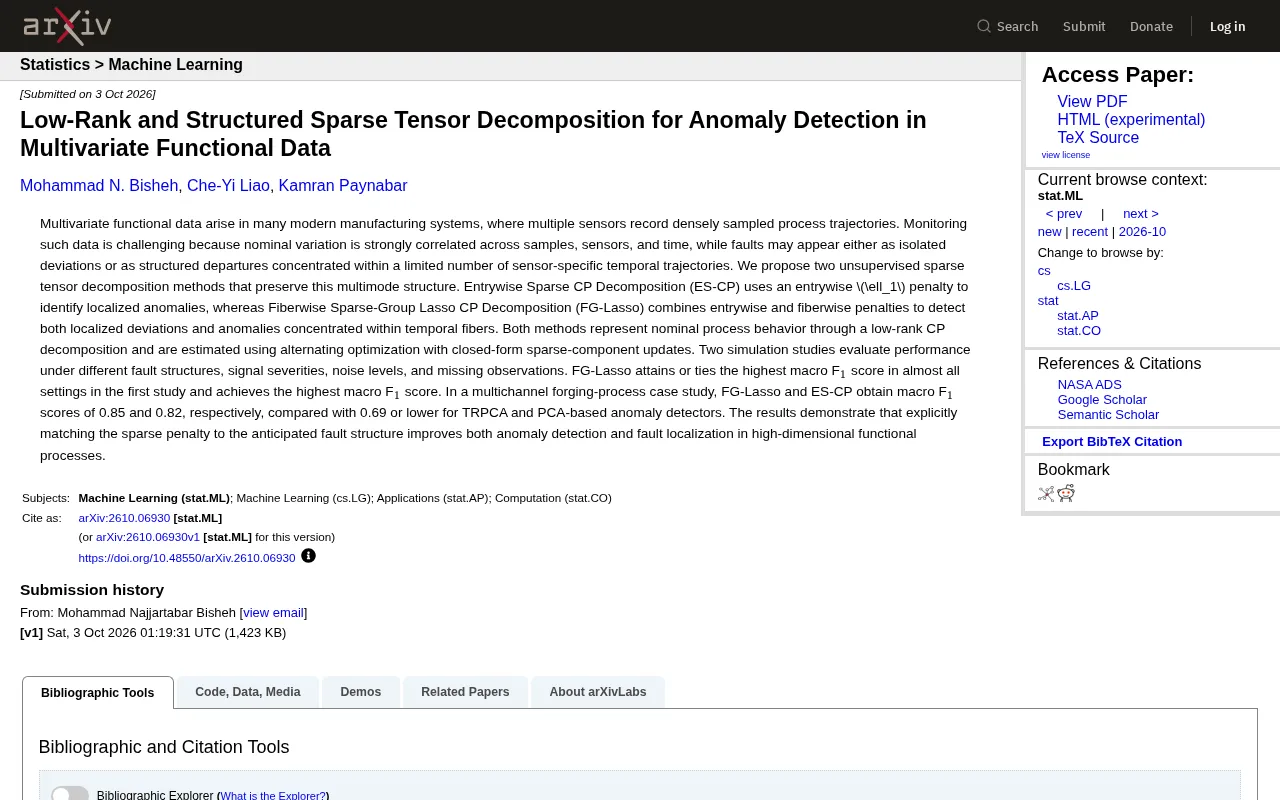
Modern manufacturing generates multivariate functional data with complex correlations across samples, sensors, and time. Traditional methods that flatten data struggle to handle both local deviations and structured faults. This study proposes two unsupervised sparse CP tensor decomposition methods: ES-CP uses element-wise ℓ₁ penalties for isolated anomalies, while FG-Lasso combines element-wise and fiberwise penalties to detect sustained sensor trajectory deviations. Both use alternating optimization with closed-form updates. Experiments and a multi-channel forging case study confirm FG-Lasso (macro F₁=0.85) and ES-CP (0.82) significantly outperform TRPCA and PCA (≤0.69), validating the value of aligning sparse penalty structures with expected fault patterns.
The Challenge of Anomaly Detection in Manufacturing Systems
Modern manufacturing systems deploy sensors extensively, with each sensor recording process trajectories at high sampling rates — forming what is known as Multivariate Functional Data. Monitoring this type of data is an inherently challenging task: normal-state fluctuations exhibit strong correlations across samples, sensors, and time dimensions, while genuine faults can manifest either as isolated local deviations or as structured anomalies concentrated within specific time trajectories of a small subset of sensors.
Traditional anomaly detection methods often struggle to handle both of these fundamentally different fault modes simultaneously. A recent study published on arXiv (arXiv:2610.06930v1) targets this pain point by proposing two unsupervised sparse tensor decomposition methods that aim to precisely capture anomalies while preserving the multimodal structure of the data.
Two Sparse Tensor Decomposition Methods
At the core of this research is the use of CP decomposition (CANDECOMP/PARAFAC) to construct a low-rank representation that characterizes normal process behavior, upon which different sparse penalty terms are introduced to identify anomalies. The two methods each have their own focus:
Element-wise Sparse CP Decomposition (ES-CP)
ES-CP applies an element-wise $\ell_1$ penalty, targeting the identification of localized anomalies. This approach is sensitive to isolated, scattered anomalous points throughout the data, making it well-suited for capturing deviations that do not exhibit obvious spatial or temporal clustering characteristics.
Fiber-wise Group Lasso CP Decomposition (FG-Lasso)
FG-Lasso goes a step further by combining element-wise penalties with fiberwise penalties. This means it can detect not only local deviations but also structured anomalies concentrated within a specific temporal fiber. In real-world manufacturing scenarios, a sensor continuously deviating from its normal trajectory over a particular time window is a common fault pattern — and FG-Lasso is specifically designed to match this type of expected fault structure.
Both methods are estimated via alternating optimization, and the sparse components have closed-form solution updates, ensuring computational feasibility.
Experimental Validation and Performance
The study designed two simulation experiments to systematically evaluate method performance under varying fault structures, signal strengths, noise levels, and missing observation conditions. Results show that FG-Lasso achieved or tied for the highest macro F₁ score in nearly all settings of the first study, demonstrating the most robust overall performance.
Even more compelling is the real-world case study on a multi-channel forging process. In this industrial setting:
- FG-Lasso achieved a macro F₁ score of 0.85
- ES-CP achieved a macro F₁ score of 0.82
- The comparison methods TRPCA and PCA-based anomaly detectors only reached 0.69 or lower
This gap clearly demonstrates that in high-dimensional functional processes, explicitly aligning sparse penalties with the expected fault structure can simultaneously improve both anomaly detection and fault localization capabilities.
Methodological Value and Application Prospects
The value of this research lies not only in leading benchmark metrics, but more importantly in providing a structure-aware modeling paradigm. Most traditional methods (such as PCA and TRPCA) tend to flatten data or ignore its inherent multimodal tensor structure, causing them to fail when faced with complex faults correlated across sensors and time.
By using CP decomposition to preserve structural information across the sample, sensor, and time dimensions — supplemented by targeted sparse constraints — ES-CP and FG-Lasso achieve dual improvements in detection accuracy and interpretability. They can not only determine whether an anomaly has occurred, but also localize which sensor and which time period the anomaly affects.
For the fields of intelligent manufacturing, industrial IoT, and process monitoring, the significance of these methods is clear: when we have prior knowledge about the likely forms of faults, choosing a sparse penalty structure that matches those expectations can yield substantial performance gains over general-purpose algorithms. This also provides a replicable paradigm for future work on designing customized anomaly detection models that incorporate domain knowledge.
Related articles

LLM Application Development: A High-Paying Career Guide for Ordinary People
LLM application development offers fresh graduates up to 35K/month, with SP offers reaching 600K. This article explains the core skills, how to break in, and how ordinary people can seize AI opportunities through learning by doing.

Say Goodbye to AI Influencer Faces: A Complete Guide to Creating Visual Assets for AI Comic Dramas from Scratch
Bilibili creator shares a full workflow for zero-basics AI comic drama visual assets: use Doubao Work skills with script-first, visual references, and real-person texture to escape AI influencer faces, then lock character and scene consistency with asset sheet layouts, weapon detail images, scene nine-grids, and cinematic color palettes.

The AI Production Pipeline Behind Great Videos: From Research to Agent Validation
AI video production isn't just a model race. This article breaks down a transferable four-step pipeline: researching professional workflows, organizing a skill checklist, configuring agents, and experimental validation—and explains how general-purpose LLMs like DeepSeek can replace paid tools to run the entire process.