A New Approach to World Model Planning: Continuity-Aware Priors Boost Success Rates
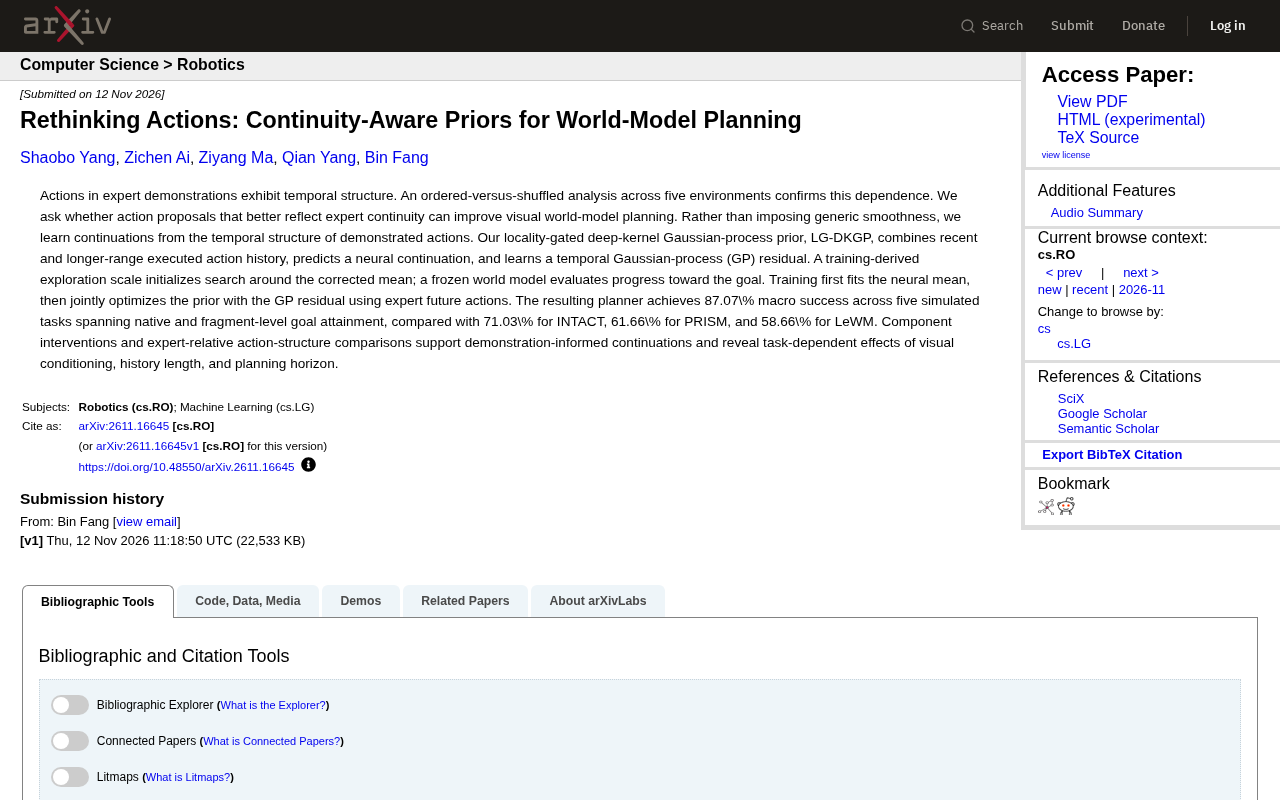
Learning action temporal continuity priors from expert demonstrations significantly boosts visual world-model planning success rates.
The article introduces a new study on visual world-model planning. Conventional methods treat actions as independent samples, ignoring the clear temporal continuity of actions in expert demonstrations. Through an "ordered vs. shuffled" analysis across five environments, researchers confirm this dependency and propose a Locally Gated Deep-Kernel Gaussian Process prior (LG-DKGP), which fuses recent and long-term action history, predicts neural continuations, and learns temporal Gaussian process residuals to generate action proposals closer to expert behavior. On five simulated tasks, its macro success rate significantly outperforms baselines such as INTACT, PRISM, and LeWM; component intervention experiments further support demonstration-informed continuity and reveal task-dependent effects of visual conditioning, history length, and planning horizon.
Visual world-model planning often treats actions as independently sampled, but actions in expert demonstrations exhibit clear temporal structure. A new study proposes a continuity-aware prior that makes action proposals more closely align with expert behavior, thereby significantly improving planning success rates.
The Temporal Structure of Actions: An Overlooked Key Clue
In expert demonstrations, actions are not random or independent but exhibit temporal continuity. Through an "ordered vs. shuffled" comparative analysis across five environments, the researchers confirmed the existence of this dependency—shuffling the action order destroys its intrinsic structure. This finding prompted them to ask: if action proposals could better reflect expert continuity, could visual world-model planning be improved?
Conventional methods tend to impose generic smoothness constraints, but this study chooses to learn continuity from the temporal structure of demonstrated actions.
World-Model Planning is a class of methods that perform forward rollouts based on a learned environment dynamics model to optimize action sequences. The agent first "imagines" in latent space the future state after executing an action, then evaluates that action's contribution to achieving the goal. Since real environment interaction is costly, world models allow planning to be done internally—but this also means the quality of action proposals directly determines search efficiency. If proposals deviate from the distribution of expert behavior, even an accurate model will struggle to find effective paths. Understanding this is key to seeing why the temporal structure of actions becomes a critical variable affecting planning success.
LG-DKGP: Locally Gated Deep-Kernel Gaussian Process Prior
The researchers propose a Locally Gated Deep-Kernel Gaussian Process prior (LG-DKGP). Its core idea is to combine recent action history with longer-term action history, predict neural continuations, and learn temporal Gaussian process (GP) residuals.
Specifically, LG-DKGP works as follows:
- History fusion: It considers both recent and long-term action history to capture continuity across different time scales.
- Neural continuation prediction: It predicts the neural continuation of the next action based on history.
- GP residual learning: It learns temporal Gaussian process residuals to correct the predictions.
- Exploration-scale initialization: It initializes search from an exploration scale derived during training, sampling around the corrected mean.
- Frozen world-model evaluation: It uses a frozen world model to evaluate progress toward the goal.
Training proceeds in two steps: first fit the neural mean, then jointly optimize the prior and the GP residual using expert future actions.
Gaussian Process (GP) is a nonparametric Bayesian model that characterizes a distribution over functions via a mean function and a covariance (kernel) function, making it naturally suited for modeling sequences with smoothness or temporal correlation. In an action prior, a GP provides a predictive mean and uncertainty (variance), enabling the planner to sample around a reasonable mean while controlling the exploration range based on uncertainty. A deep kernel combines the representational power of deep neural networks with GP uncertainty estimation: the neural network extracts features from action history, and the GP kernel defines temporal correlations in that feature space. LG-DKGP uses exactly this structure to jointly model the trend term of neural continuation and the correction term of the GP residual.
Experimental Results: Significantly Outperforming Baselines
On five simulated tasks (covering both native and segment-level goal achievement), the LG-DKGP planner achieves a significantly higher macro success rate, substantially surpassing baselines such as INTACT, PRISM, and LeWM. Component interventions and comparisons of expert-relative action structure support demonstration-informed continuity, and reveal task-dependent effects of visual conditioning, history length, and planning horizon.
Although specific numbers are omitted here, the magnitude of the performance gains indicates that action continuity priors have substantial value in world-model planning.
Macro success rate is an aggregate metric measuring a planner's overall performance across multiple tasks or task segments, typically computed by first calculating the success rate for each task and then averaging them; it therefore reflects generalization rather than incidental superiority on a single task. Component intervention (ablation/intervention) refers to removing or replacing key modules one at a time (e.g., the GP residual, long-term history, exploration-scale initialization) and observing changes in performance to confirm whether each component truly contributes to the gains. Together, these two evaluation approaches answer "why the method works" and "which part is responsible," which is more persuasive than simply comparing final success rates.
Implications and Outlook
This study reminds us that the temporal structure of actions is an information source that cannot be ignored in planning. By learning continuity priors from expert demonstrations rather than imposing generic constraints, search can be guided more effectively. In the future, adaptively adjusting history length and planning horizon to meet the needs of different tasks will be a direction worth exploring.
This article is based on the paper "Rethinking Actions: Continuity-Aware Priors for World-Model Planning."
One-line Summary
Learning action temporal continuity priors from expert demonstrations significantly improves visual world-model planning success rates.
Paragraph Summary
The article introduces a new study on visual world-model planning. Conventional methods treat actions as independent samples, ignoring the clear temporal continuity of actions in expert demonstrations. Through an "ordered vs. shuffled" analysis across five environments, the researchers confirm this dependency and propose a Locally Gated Deep-Kernel Gaussian Process prior (LG-DKGP), which fuses recent and long-term action history, predicts neural continuations, and learns temporal Gaussian process residuals to generate action proposals that more closely match expert behavior. On five simulated tasks, the method's macro success rate significantly outperforms baselines such as INTACT, PRISM, and LeWM. Component intervention experiments further support demonstration-informed continuity and reveal task-dependent effects of visual conditioning, history length, and planning horizon.
Related articles
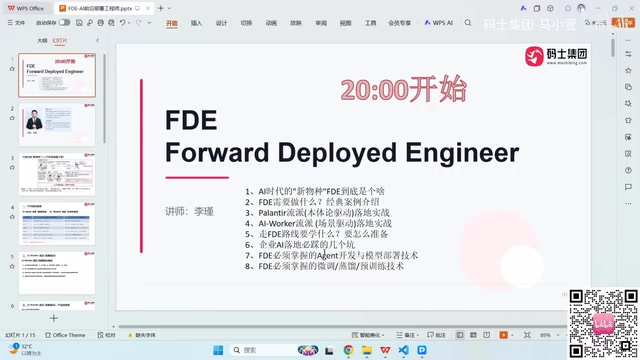
FDE (Forward Deployed Engineer): A New Species in the AI Era, from Beginner to Enterprise Practice
FDE (Forward Deployment Engineer) is a new species in the AI era. This article explains its origins, the Palantir and AI Walking schools, the skill stack (agent development, fine-tuning, deployment), and common pitfalls in enterprise implementation, helping you go from beginner to practice.

The Ultimate Codex Tutorial: From Zero to Hands-On in 40 Minutes
A complete beginner's Codex tutorial: from GPT account registration and desktop installation to login error troubleshooting, permission and quota setup, and Pro membership upgrades—a step-by-step guide to getting started with an AI coding assistant, plus common fixes and practical advice.
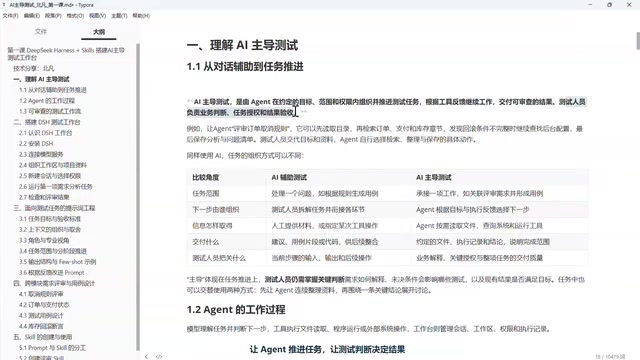
AI-Driven Testing in Practice: How Agents Are Reshaping the Testing Workflow
Starting from how Agents work, this article analyzes the practical path of AI-driven testing: how task planning, tool calling, and feedback loops reshape the testing workflow, and the boundaries and acceptance authority human testers must retain.