A New Take on Conversational Memory: Paired Evaluation of Fact Compression and Retrieval Augmentation
Paired evaluation shows compressed memory leads on factual questions, but wording-dependent and adversarial questions require raw text.
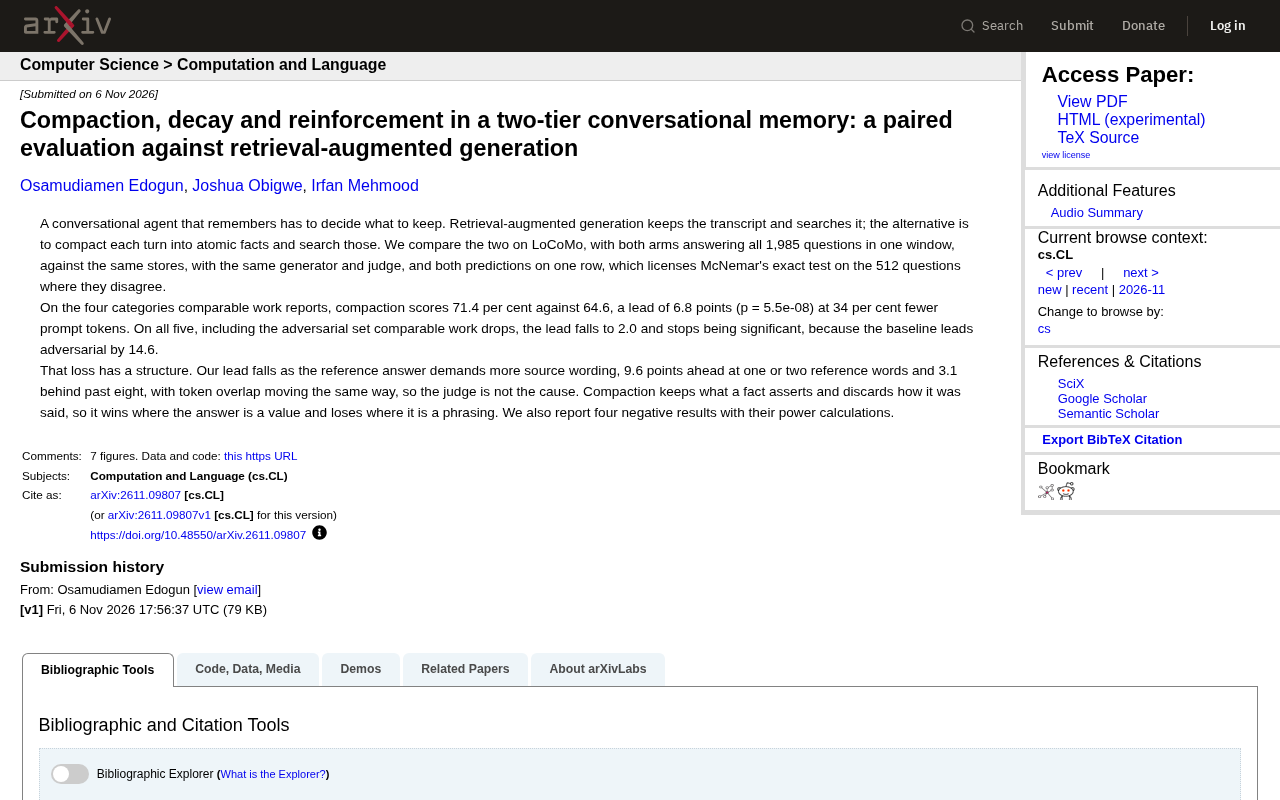
A paired evaluation on the LoCoMo dataset compared retrieval-augmented generation and fact compression for conversational memory. Both systems answered all 1,985 questions, with McNemar exact tests on 512 discordant cases. On four comparable categories, compression led with fewer prompt tokens, statistically significant. However, including adversarial categories reduced the lead to non-significance, as the baseline performed better there. Further analysis showed compression's advantage declined as reference answers required more source-text wording, with token overlap showing the same trend, indicating it retains factual content but discards expression. The study suggests hybrid approaches or query-type routing and reports four negative results with power calculations.
The Choice Between Two Memory Strategies
When a conversational agent needs to remember history, it must decide what to keep. Retrieval-augmented generation (RAG) retains the raw conversation records and searches them; the alternative is to compress each turn into atomic facts and then search those facts. A recent paired evaluation on the LoCoMo dataset compared these two approaches, providing empirical evidence for this design choice. According to the study, both systems answered all 1,985 questions within the same window, using the same storage, the same generator, and the same judge, and placed their predictions side by side, allowing a McNemar exact test on the 512 questions where they disagreed.
The significance of this paired design lies in controlling variables, enabling a cleaner attribution of differences between the two strategies. Rather than stopping at overall accuracy, the researchers further deconstructed the structural reasons behind the performance differences.
McNemar's exact test is a statistical test for paired binary data, suitable for comparing differences in outcomes between two conditions for the same set of subjects. In conversational memory evaluation, the two systems each produce correct or incorrect predictions for the same question, forming paired data. The test focuses on samples where the two predictions disagree (one correct, one incorrect) and examines whether the direction of errors is symmetric, thereby determining whether the accuracy difference between the strategies is significant. The exact version calculates p-values based on the binomial distribution without relying on large-sample approximations, making it suitable for cases with a small number of discordant samples.
Advantages and Boundaries of the Compression Strategy
On the four categories of comparable work reports, the compression strategy achieved a clear lead while using fewer prompt tokens. This advantage was highly statistically significant. However, when the adversarial category was included, the lead shrank and lost significance, because the baseline performed better on the adversarial category.
This loss is not random. The study shows that as the reference answers require more wording from the source text, the compression strategy's lead gradually diminishes and even reverses. Token overlap exhibits the same trend, indicating that the judge is not the cause of the difference. The compression strategy retains what the facts assert but discards how they are expressed, so it wins when the answer is a value and loses when the answer is a particular wording.
The adversarial category typically refers to questions deliberately designed to induce model errors, such as queries containing distractor information, requiring negation reasoning, or contradicting common patterns. On such questions, the model cannot answer solely by matching high-frequency facts but must handle the context more carefully. The baseline system retains the raw conversation records, making it more resilient to adversarial queries with subtle wording or requiring reference to the original text. After including such questions in the evaluation, the compression strategy's overall lead was diluted, indicating that its weakness is concentrated in scenarios requiring fine-grained linguistic information.
Token overlap is a metric measuring the degree of token-level overlap between generated answers and reference answers, commonly used to automatically assess the similarity between generated and reference texts. Higher overlap indicates that the answer's wording is closer to the source text. This metric is independent of the judge, so when the compression strategy's advantage decreases as the overlap requirement rises, biases from judge preference can be ruled out, attributing the difference to the strategy's retention of expression. This provides corroborating evidence for the explanation that "compression retains factual content but discards expressive form."
Memory Design from a Multi-Source Perspective
According to the study, compression and retrieval augmentation are not simply superior or inferior; rather, they suit different query types. For factual questions, compressed atomic facts can provide more direct answers at lower token cost; for questions requiring precise wording or contextual details, retaining raw conversation records is more advantageous.
This finding has practical implications for the memory architecture design of conversational agents: a single strategy may not cover all scenarios, and a hybrid approach or routing by query type may be more reasonable. The researchers also reported four negative results and their power calculations, providing a reference baseline for future research.
Routing by query type is a design pattern for hybrid memory architectures: at inference time, the system first determines whether the query is factual, wording-dependent, or adversarial, then selects different pathways such as compressed memory or raw retrieval. Routing can be implemented based on rules, classifiers, or lightweight models, at the cost of additional judgment overhead and misrouting risk. The value of this pattern lies in letting each memory strategy handle only the queries it excels at, thereby balancing token cost and answer fidelity rather than using a single strategy for all scenarios.
Practical Implications
For developers building conversational memory systems, this evaluation highlights several key points. First, the compression strategy has an advantage in token efficiency, making it suitable for cost-sensitive scenarios where questions are predominantly factual. Second, adversarial and wording-dependent questions require additional handling mechanisms, such as retaining raw text snippets or introducing hybrid retrieval. Finally, the evaluation methodology itself is worth adopting: paired design, the same judge, and exact tests can more reliably reveal strategy differences.
There is no one-size-fits-all answer to conversational memory management; understanding the applicable boundaries of different strategies is more important than pursuing improvements in a single metric.
Related articles

Seven Years of Evolution: How Far Has the Foldable Come From the First Generation?
From the first foldable to today's latest models, what has seven years changed? Shallower creases, higher brightness, thinner bodies, and smoother software migration—has the foldable crossed the chasm from enthusiasts to ordinary users? This article discusses the question based on a video comparison.

When Did Humans Start Eating Salt? A 10,000-Year History of Salt
When did humans start eating salt? From salt use at the dawn of agriculture 11,000 years ago to ancient seawater evaporation and rock salt mining, and on to the salt trade, salt taxes, and Gandhi's Salt March, this article traces salt's key role in human civilization.
Microsoft Paza Research: How African Language Speech Recognition Breaks Through Architecture and Data Bottlenecks
Microsoft's Paza research evaluates 53 speech models across 39 African languages, revealing architecture choice matters more than pre-training coverage, 200-300 hours is the practical data threshold, and language typology deeply influences recognition performance.