A New Take on PDF Narration: AI Voice That Understands Formulas, Charts, and Two-Column Papers

An AI narration tool built for academic PDFs, with semantic formula reading and two-column layout support.
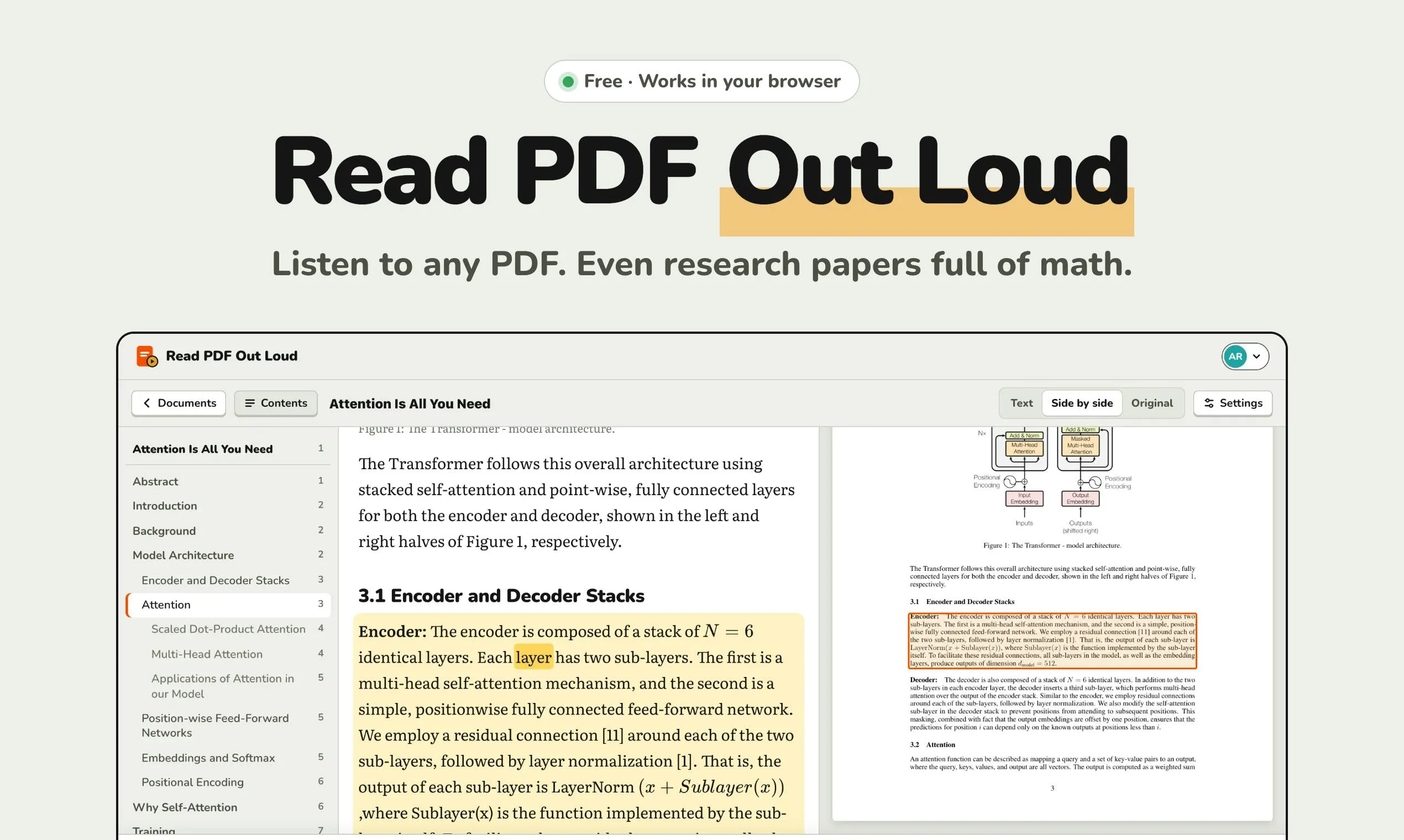
Accurate PDF Narration is a vertical TTS tool targeting academic papers and technical books, addressing three core pain points: scrambled reading order from two-column layouts, character-by-character formula noise, and citation markers that disrupt flow. Its key differentiator is reading formulas and code "by meaning," alongside figure explanations and word-by-word highlighting. With 500 free pages per month, the product is still early-stage with limited market validation, but it represents the broader AI TTS shift from "can read" to "actually understands" — combining document comprehension with speech synthesis.
The Technical Challenges of Making PDFs "Speak"
Converting a PDF to speech sounds simple — isn't it just text-to-speech (TTS)? But anyone who's actually tried knows that academic papers and technical books are a nightmare for TTS tools. Two-column layouts throw off reading order, mixing text from left and right columns into incoherent jumbles. Mathematical formulas get read out character by character, turning into meaningless noise. Figures, page numbers, and citation markers interrupt the flow of narration.
A product called Accurate PDF Narration has launched on Product Hunt, targeting exactly these "hard problems." Rather than a general-purpose document reader, it's designed specifically for the complex structures found in research papers and books.
Core Capability: Reading by "Meaning," Not by Character
According to the product's official description, its key features map directly onto the pain points of traditional TTS:
Reading Two-Column Papers in the Correct Order
The two-column layout common in academic papers is where most readers fail. Ordinary tools scan line by line, alternating between a sentence from the left column and one from the right — making the content completely incomprehensible. This tool claims to recognize page layout structure and process two-column content in the natural order a human would read it.
Reading Formulas and Code "By Meaning"
This is where the real challenge lies. If a mathematical formula is read character by character, ∫f(x)dx becomes a string of symbolic noise. The product emphasizes that "equations and code are read by meaning" — converting formulas and code blocks into understandable spoken language rather than mechanically reciting symbols. For researchers who regularly need to "listen" to papers, how well this actually works will directly determine the product's value.
Technically, reading formulas "by meaning" typically involves two stages. First, formula recognition: parsing mathematical symbols in the PDF into a structured intermediate representation (such as LaTeX or MathML). This alone demands robust PDF parsing, since formulas in academic papers are often embedded as images or use non-standard encoding. Second, semantic conversion: translating the structured formula into natural spoken language — for example, rendering
∫₀¹f(x)dxas "the definite integral of f(x) from 0 to 1." Rule-based systems tend to break down on complex nested formulas, while large language models have a natural advantage in understanding formula semantics and generating fluent spoken descriptions. Code blocks follow similar logic — reading them character by character produces a flood of punctuation and indentation noise; a better approach is to describe what the code actually does. This is the product's most central — and hardest to verify — technical claim.
Figure Explanation and Noise Filtering
The tool provides explanations for figures and tables, while automatically skipping page numbers and citation markers. These elements are distractions during narration, and removing them significantly improves the listening experience's coherence.
The product also features word-by-word highlighting (every word lights up) for visual synchronization — listen and follow along simultaneously, which suits learners who want to absorb content through both eyes and ears.
Use Cases and Pricing
The typical user profile for this kind of tool is fairly clear: graduate students and researchers who need to consume large volumes of literature during commutes, workouts, or household chores; and knowledge workers with reading difficulties, visual fatigue, or a preference for auditory input.
The product uses a free-tier model: 500 pages free per month. For light users — say, reading a few papers or a chapter or two from a book each month — this quota should be sufficient. Heavy users will likely need a paid plan.
It's worth understanding the competitive landscape in the "vertical TTS" space. Speechify is currently the highest-market-share general document reader, supporting multiple languages and file formats, but handling academic formulas is not its core focus. NaturalReader is similarly general-purpose, emphasizing voice naturalness. Over the past two years, with the spread of large language models, academic AI tools like Elicit and Consensus have also expanded toward "literature digestion" — but their direction is Q&A and summarization, not voice narration. The vertical niche of "academic PDF audio" remains relatively unoccupied, which is both an opportunity for Accurate PDF Narration and a sign that user education costs will be high — convincing target users that this pain point warrants a dedicated tool.
An Honest Assessment: An Early-Stage Product
One thing worth noting: this product's current numbers on Product Hunt are quite early-stage — 3 upvotes, 1 comment, ranked 20th. Market validation is still limited. It sits in the Productivity, Education, and Artificial Intelligence categories, and was built by independent developer Hasitha.
The "vertical TTS" space itself isn't new — established players like Speechify and NaturalReader already exist, along with various LLM-based document Q&A tools. Accurate PDF Narration's differentiated bet is on "accurately handling complex academic documents" as a focused capability. If its claimed features — formula narration, two-column recognition, and so on — hold up in real testing, it will be genuinely compelling for a specific audience. If they turn out to be marketing copy with mediocre actual performance, it'll be hard to stand out in a competitive market.
A Signal Worth Watching
From a product-thinking perspective, Accurate PDF Narration reflects a broader trend: AI TTS is evolving from "can read" to "reads correctly and comprehendingly." Pure speech synthesis is already mature technology. The real barrier has shifted to understanding document structure, semantics, and specialized content — precisely where large language models can make a difference.
For readers tracking AI application development, this product's interest lies not in its current scale, but in what it demonstrates: a product form that combines document understanding with speech synthesis. Curious users can take advantage of the free quota to personally verify the core features, using real papers and books to test whether it's truly as "accurate" as advertised.
Related articles

Last Week Tonight Exposé: The Dangerous Ties Between Politicians and White Supremacy
Last Week Tonight investigates Georgia Senate candidate Mike Collins and Florida candidate Marshall Rawson, exposing their multiple ties to white supremacists and the Republican Party's silent response.
AI Buzz Weekly: GPT-6.5 Leak, New Claude Model, and MiniMax's Cost-Effectiveness
This week's AI buzz roundup: suspected GPT-6.5 leak, Microsoft configs showing GPT-6.1 Tera, Anthropic's new model that can identify entire classes of bugs, disappointing early Gemini 4 Carbon results, and MiniMax M3.1 Flash beating Claude Opus 5 and GPT-5.6 Sol in benchmarks at extremely low cost.

AI Briefing: Gemini 4 Carbon Released, Ant Open-Sources Ling-3.1
AI Briefing: Google releases Gemini 4 Carbon qubit model, claiming to surpass Opus 5.5 with half-price tokens; Ant open-sources Ling-3.1-1019 for real-task Personal Agents; domestic AI drug discovery succeeds in 18 of 19 projects, hitting all 6 GPCR targets; zero-revenue company valued at $20B raises another $1B; Sichuan convenience store robot sales fail.