A Panoramic Map of 381 AI Agent Projects: An Ecosystem Navigator Organized by Use Case

A use-case-organized directory of 381 AI Agent projects to help developers cut through tool overload.
Facing the explosive growth of AI Agent tooling, one developer maintains the "AI Agent Software Roadmap" — a structured directory of 381 projects organized by primary use case rather than GitHub star count, with particular depth in local Agent deployment and the MCP protocol ecosystem. The author transparently labels each entry's review depth, from documentation screening to focused source code review, which boosts credibility. Hosted on GitHub and open to community contributions, this living directory helps teams quickly build a structured understanding of the ecosystem as a starting point for technology evaluation.
A Growing Directory of the AI Agent Ecosystem
As the AI Agent space explodes in growth, developers no longer face a shortage of tools — they face choice overload. Every day, new agent frameworks, orchestration tools, and MCP services emerge on GitHub. For many teams, the real pain point has become: how do you quickly find the right tool for a specific problem among hundreds of projects?
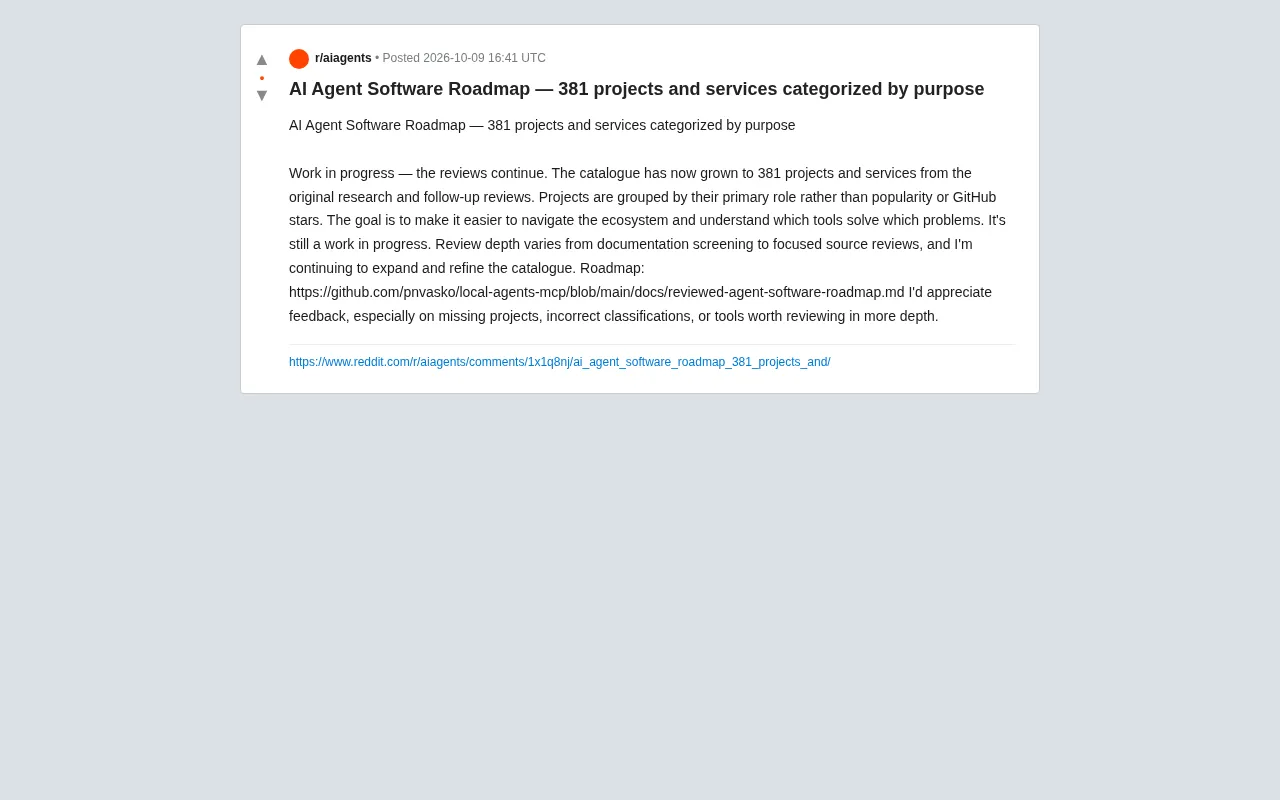
A developer shared on Reddit a project he actively maintains called the "AI Agent Software Roadmap," which currently catalogs and categorizes 381 AI Agent-related projects and services. The core philosophy is clear: rather than ranking by GitHub stars or popularity, every tool is organized by its primary role.
Why "Organized by Use Case" Beats "Ranked by Popularity"
Most "Awesome List"-style tool collections on the market pile entries together by star count or notoriety. That approach is useful for tracking trends, but nearly useless for actual technology selection — a high-star project doesn't mean it fits the problem you're trying to solve right now.
The author of this Roadmap took a different approach: understand what problem a tool solves first, then place it in the appropriate category. This means when you need to find a "locally deployable Agent runtime" or an "MCP protocol-related service," you can navigate directly to the relevant group instead of sifting through a long popularity-ranked list one by one.
The repository path (local-agents-mcp) reveals that the author has a deep interest in local Agent deployment and the MCP (Model Context Protocol) ecosystem — which likely means this directory carries higher information density in those specific sub-domains.
MCP (Model Context Protocol) is an open protocol proposed by Anthropic in late 2024, designed to standardize how AI models interact with external tools and data sources. The core idea is analogous to the standardization of USB connectors: different Agent frameworks and LLM applications can connect to file systems, databases, API services, and other external resources through a single protocol specification, without needing to write custom integration code for every combination. MCP Servers are a key part of this ecosystem — developers can wrap any functionality as a standard MCP service, callable by any Agent that supports the protocol. Because the MCP ecosystem itself is expanding rapidly, a directory category focused specifically on local deployment and the MCP protocol carries strong practical value for teams building Agent systems in private environments.
Depth of Coverage and Credibility: An Honest "Work in Progress"
To the author's credit, this directory isn't presented as a definitive authority. He explicitly states it is a "Work in Progress" and honestly discloses that the depth of review varies across entries:
- Some projects received only documentation screening;
- Others underwent focused source code reviews.
This candid acknowledgment of inconsistent review depth actually strengthens the directory's credibility. For users, it signals the need to distinguish between entries: those that have been deeply reviewed are more trustworthy, while entries that only passed a documentation scan still require independent verification.
How to Use It and Contribute
The full Roadmap is hosted on GitHub (in the docs directory of the pnvasko/local-agents-mcp repository) and is presented as a Markdown document. For teams conducting Agent technology evaluations, this kind of structured directory can serve as a starting point for ecosystem scanning: first locate candidate tools by use case, then conduct deeper evaluation based on your specific context.
The author is also openly soliciting community feedback, particularly welcoming three types of contributions:
- Add missing projects — point out tools not yet included in the directory;
- Correct miscategorizations — suggest fixes for entries placed in the wrong category;
- Recommend tools worth deeper investigation — identify which projects deserve more review effort.
This open, collaborative model means the directory's quality will improve iteratively as community participation grows.
What This Means for Developers
At a time when the AI Agent toolchain is highly fragmented, the value of a well-organized, opinionated, and continuously updated ecosystem map lies not in exhaustively listing every project, but in reducing cognitive overhead. The number 381 itself illustrates a reality: the Agent ecosystem has grown too large for any single developer to fully grasp.
For engineers hoping to stay current in this space, rather than blindly bookmarking scattered tool links, it's worth following structured, living directories organized by problem domain — they help you quickly build a structured mental model of the entire ecosystem and provide useful filtering signals when making specific technology choices. That said, always cross-reference the review depth noted for each entry, and treat items that haven't been deeply verified with appropriate caution.
The fragmentation of the AI Agent toolchain stems from the fact that this field is still in a "pre-standardization" phase: orchestration frameworks (such as LangGraph, AutoGen, and CrewAI), runtime environments, memory management, and tool-calling protocols all have multiple competing implementations at each layer, and the pace of iteration is extremely fast. Unlike mature software ecosystems where de facto standards already exist, Agent developers often need to simultaneously evaluate architectural philosophy, community activity, and compatibility with existing infrastructure. In this context, a use-case-organized ecosystem directory helps developers first confirm "whether a mature solution already exists for a given type of requirement" before diving into specific tool comparisons — avoiding repeated research investment in directions that have yet to establish best practices.
Related articles

LLM Application Development: A High-Paying Career Guide for Ordinary People
LLM application development offers fresh graduates up to 35K/month, with SP offers reaching 600K. This article explains the core skills, how to break in, and how ordinary people can seize AI opportunities through learning by doing.

Say Goodbye to AI Influencer Faces: A Complete Guide to Creating Visual Assets for AI Comic Dramas from Scratch
Bilibili creator shares a full workflow for zero-basics AI comic drama visual assets: use Doubao Work skills with script-first, visual references, and real-person texture to escape AI influencer faces, then lock character and scene consistency with asset sheet layouts, weapon detail images, scene nine-grids, and cinematic color palettes.

The AI Production Pipeline Behind Great Videos: From Research to Agent Validation
AI video production isn't just a model race. This article breaks down a transferable four-step pipeline: researching professional workflows, organizing a skill checklist, configuring agents, and experimental validation—and explains how general-purpose LLMs like DeepSeek can replace paid tools to run the entire process.