A Week of Security Turmoil: Node.js/PHP RCE, PyPI Poisoning, and Enterprise Identity Defenses

Node.js/PHP RCE, PyPI poisoning, and a CA key compromise converge in one week, highlighting supply chain and root-of-trust risks.
This article reviews the security incidents disclosed in WorkOS's blog: Node.js and PHP fixed RCE vulnerabilities, a malicious LiteLLM release appeared on PyPI, and eMudhra's CA key was compromised. These correspond to runtime risk, supply chain poisoning, and erosion of the root of trust, with the attack surface spreading from the application layer to underlying infrastructure. The article stresses synchronizing RCE patches with identity hardening, reducing supply chain risk via dependency locking and integrity checks, and requiring trust store updates and emergency rotation after CA compromise. WorkOS recommends defense in depth across dependency governance, runtime hardening, and identity boundary defense, treating identity infrastructure as core to security architecture.
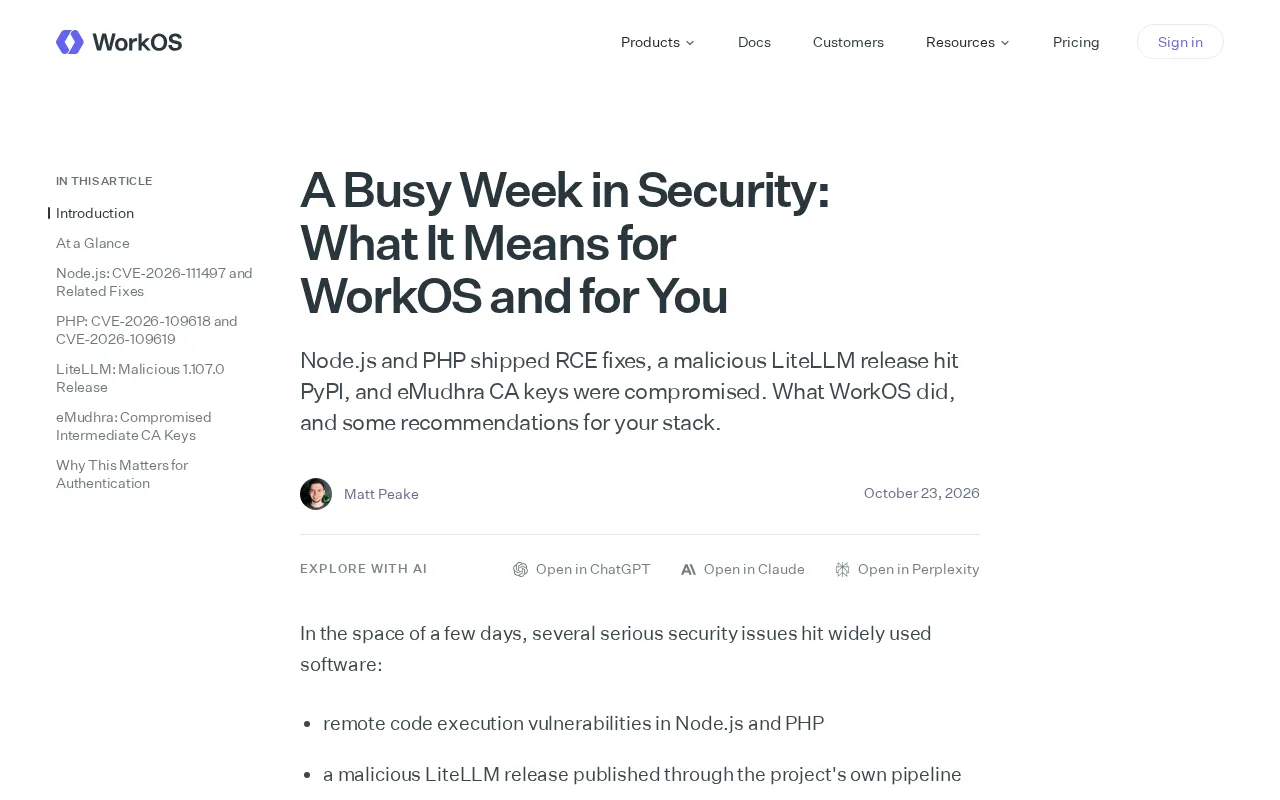
Over the past week, software supply chain and runtime security have raised alarms in quick succession: Node.js and PHP patched vulnerabilities that could lead to remote code execution (RCE), a malicious LiteLLM release appeared on PyPI, and eMudhra's CA key was reported compromised. WorkOS summarized these incidents in its official blog and offered protection recommendations for developer stacks. Based on that blog post and public vulnerability information, this article analyzes the impact of these incidents on enterprise identity authentication and developer workflows.
Node.js and PHP: Runtime Risks Behind RCE Patches
According to the WorkOS blog, Node.js and PHP recently released security patches fixing vulnerabilities that could be exploited for remote code execution. RCE vulnerabilities are dangerous because once an attacker successfully exploits one, they can execute arbitrary commands on the target server, steal credentials, move laterally, or plant backdoors. For teams building web applications and APIs on these runtimes, upgrading promptly is the first priority.
From an identity security perspective, RCE vulnerabilities often become a shortcut for attackers to bypass the authentication layer. Even if an enterprise has deployed SSO and multi-factor authentication, once the application server is compromised, attackers can still steal session tokens or directly access backend resources. WorkOS emphasized in the post that runtime vulnerability remediation should not be done in isolation but should advance in tandem with hardening identity boundaries.
RCE (Remote Code Execution) refers to an attacker injecting malicious input to make a target system execute arbitrary code or system commands without authorization. Common trigger paths include insecure deserialization, template injection, command concatenation, and prototype pollution in dependency libraries. Once successful, attackers typically run commands with the privileges of the application process, allowing them to read environment variables, access database credentials, write persistent backdoors, and even expand control through lateral movement within the internal network. Unlike information disclosure vulnerabilities, RCE often directly leads to host compromise and is therefore frequently rated as the highest severity level. For enterprises, fixing RCE is not just about patching; it also requires restricting process privileges at the runtime level, isolating sensitive configurations, and combining log auditing to promptly detect abnormal command execution behavior.
Malicious LiteLLM Release on PyPI: Another Warning About Supply Chain Poisoning
The blog disclosed that a malicious LiteLLM release appeared on PyPI. LiteLLM is a Python library commonly used to uniformly call APIs from multiple large model providers, and it is popular among AI application developers. The malicious version may have been implanted with code to steal API keys or environment variables, posing a direct threat to teams using the library.
Supply chain poisoning is characterized by strong stealth: developers install dependencies through normal package management commands but may unknowingly introduce attacker code. WorkOS recommends that teams review dependency lock files, enable package integrity verification, and monitor abnormal outbound network behavior. For AI applications, the consequences of API key leakage are particularly severe, potentially leading directly to stolen model usage quotas or outflows of sensitive data.
Dependency lock files (such as Python's requirements.txt and poetry.lock, and Node.js's package-lock.json) record the exact versions and hashes used at build time, preventing an installation from accidentally pulling a newly published malicious or destructive version. Package integrity verification uses hash comparison or digital signatures to verify that downloaded content matches the official release, such as the hash verification provided by PyPI, Sigstore signatures, and npm's integrity field. With these mechanisms enabled, even if an upstream repository suffers account hijacking or poisoning, the build process can block suspicious packages at the installation stage. Combined with private mirrors and dependency admission policies, teams can also limit the range of packages that can be introduced, reducing the probability of attacks such as typosquatting and package name squatting.
eMudhra CA Key Compromise: The Chain Reaction of an Eroded Root of Trust
According to the blog, eMudhra's CA key was compromised. CA (Certificate Authority) keys are the root of trust in public key infrastructure; once leaked, attackers may forge certificates and then conduct man-in-the-middle attacks or impersonate legitimate services. The impact of such incidents usually extends beyond a single organization to all downstream systems that rely on that CA's certificates.
WorkOS noted in the post that a CA key compromise forces relying parties to update trust stores, revoke affected certificates, and reassess certificate lifecycle management strategies. For enterprise identity teams, this means checking the issuance chain of their own service certificates, confirming whether there is any association with the affected CA, and preparing emergency rotation plans.
A CA (Certificate Authority) is a trusted third party in public key infrastructure responsible for issuing and managing digital certificates. Browsers and operating systems have built-in lists of trusted root certificates, and only certificates issued by these root certificates or their subordinate intermediate CAs are considered valid. Once a CA key is leaked, attackers can use it to issue seemingly legitimate certificates and conduct man-in-the-middle attacks on any domain without triggering browser warnings. The standard process for responding to such incidents includes removing the affected root certificate from trust stores, revoking certificates it issued, publishing revocation information through OCSP or CRL, and pushing relying parties to reissue certificates. Certificate Transparency logs also help detect abnormal issuance behavior.
WorkOS's Response and Recommendations for Developer Stacks
In its blog, WorkOS explained its response measures to the above incidents and provided a series of recommendations for developer stacks. Overall, these recommendations revolve around three levels:
- Dependency governance: Lock dependency versions, verify package integrity, and monitor abnormal behavior to reduce the risk of supply chain poisoning.
- Runtime hardening: Apply security patches for runtimes such as Node.js and PHP in a timely manner to reduce the RCE attack surface.
- Identity boundary defense: Add defense in depth beyond the authentication layer to prevent a single point of compromise from leading to total failure.
The blog also mentioned that against the backdrop of frequent security incidents, enterprises should treat identity infrastructure as a core component of security architecture rather than an auxiliary feature. This means considering credential management, session security, and the principle of least privilege at the architecture design stage.
Implications for Enterprise Identity Architecture
The combination of incidents this week reveals a common trend: the attack surface is spreading from the application layer to the supply chain and the root of trust. The Node.js/PHP RCE vulnerabilities are traditional runtime risks, the malicious PyPI package is a supply chain risk, and the CA key compromise touches trust infrastructure. Together, these three mean that a single protective measure is unlikely to cover all risks.
For enterprises using WorkOS or similar identity platforms, it is recommended to regularly audit third-party dependencies, establish vulnerability response processes, and implement rotation strategies for critical certificates and keys. Security is not a one-time task but an engineering practice that requires continuous investment.
This article is compiled based on WorkOS's official blog and public vulnerability information. For specific technical details and fixed versions, please refer to the official announcements of each project.
Defense in Depth means not relying on a single security control but layering protections across multiple levels so that if one layer is breached, the others can still limit the impact of an attack. In the context of identity and access management, this typically includes replacing long-lived credentials with short-lived tokens, binding and rotating sessions, enforcing least privilege and on-demand authorization, implementing secondary authentication for sensitive operations, and correlating identity provider logs with endpoint detection data for analysis. Runtime vulnerabilities and supply chain poisoning often bypass boundary authentication; the value of defense in depth is that even if an application process beyond the authentication layer is compromised, attackers will find it difficult to obtain persistent, broad access using stolen tokens.
One-line Summary
Within one week, Node.js/PHP RCE, PyPI poisoning, and CA key compromise overlapped, highlighting supply chain and root-of-trust risks.
Paragraph Summary
This article reviews the security incidents disclosed in WorkOS's blog over the past week: Node.js and PHP fixed vulnerabilities that could lead to remote code execution, a malicious LiteLLM release appeared on PyPI, and eMudhra's CA key was compromised. The three types of incidents correspond respectively to runtime risks, supply chain poisoning, and erosion of the root of trust, with the attack surface spreading from the application layer to underlying infrastructure. The article emphasizes that RCE patches need to advance in tandem with identity boundary hardening, that the supply chain should reduce risk through dependency locking and integrity verification, and that CA compromise requires updating trust stores and emergency rotation. WorkOS recommends building defense in depth across three levels—dependency governance, runtime hardening, and identity boundary defense—and treating identity infrastructure as the core of security architecture.
Related articles

LangChain Retry Middleware Configuration: Practices and Selection Guide
Based on Reddit community discussion, this article analyzes LangChain ModelRetryMiddleware retry parameter configuration practices, covering the selection logic and alternatives for key options like max_retries, backoff_factor, and jitter.

Texas Senate Race in Trouble: Why Are Republicans Nervous?
Texas Senate race stirs Republican anxiety. Based on street interviews, this article analyzes the Democratic offensive in funding, organization, and running everywhere, and how Republicans are defending "Texas, Texas" amid the political pendulum effect.

Gemini Chat Now Generates and Edits Google Docs Directly, a New Breakthrough in Office Productivity
Google Gemini's chat interface now generates and edits PDF, Google Docs, Sheets, Slides, Markdown, TXT, and code files. Available to all users; web supports all formats, mobile only PDF for now.