Ableton Live 13 Released: The Next Evolution of the Digital Audio Workstation

Ableton Live 13 trends on Hacker News, triggering tech community discussion about creative tools and version updates.
The Ableton Live 13 official page earned 276 points and 299 comments on Hacker News, with comment volume close to upvotes, indicating clear division or extensive shared experience. The article explores why Live has spread into a broader technical creator community—Session View's non-linear, real-time composability suits programmers' interest—and notes that major updates to mature software face a dilemma over how much to change, as users are highly sensitive to workflow shifts. It recommends the official page for accurate info and community discussion as context, with hands-on experience being most valuable.
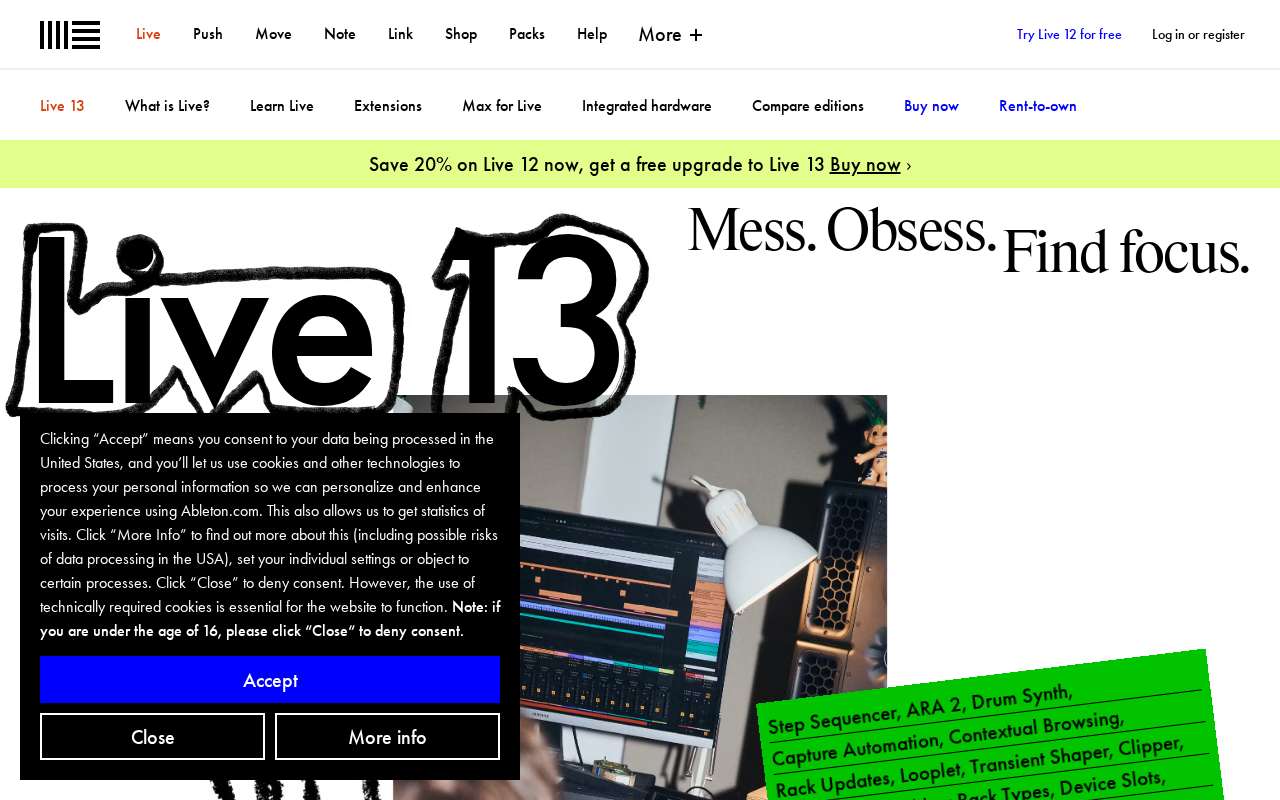
The Ableton Live 13 page appeared on the Hacker News front page and quickly racked up over 200 points and nearly 300 comments. For professional software aimed at music producers, this level of discussion is unusual—it shows that Live has long been more than a tool for DJs and electronic musicians, and has permeated a broader community of technical creators.
A "quiet" major version update
Judging from the official page, Ableton's presentation of Live 13 continues the brand's customary restraint: no exaggerated marketing slogans, with the focus placed on features and workflow itself. This is consistent with Ableton's long-standing product philosophy—Live's core competitiveness has never been about piling on parameters, but about interaction design that "turns ideas into sound faster."
The discussion volume on Hacker News (276 points, 299 comments) reflects the community's interest in this update. The number of comments is close to the number of upvotes, a ratio that usually means the topic is clearly divisive or has triggered a flood of shared experiences and comparisons.
Why the tech community also cares about music software
From tool to creative paradigm
Ableton Live was originally known for the clip-based arrangement of Session View, a non-linear workflow later borrowed by many other software products. For programmers, Live's appeal lies in how it takes "real-time" and "composability" to the extreme: signal chains, routing, and parameter mapping can all be reassembled like building blocks.
This is one reason Live shows up in Hacker News discussions. The tech community has a natural interest in topics like "how creative tools shape the way we create," and every major Ableton release is essentially a fresh answer to that question.
Session View is Ableton Live's most iconic interface mode, centered on Clips arranged in a grid: each column represents a track, each row represents a Scene, and users can freely trigger audio or MIDI clips in any cell without following the sequential order of a traditional timeline. This design makes "improvised collage" and "live recombination" possible, complementing the linear arrangement of Arrangement View. For readers with a technical background, Session View can be understood as an event- and state-based workflow—clips are like reusable functions, scenes are like preset combinations of calls, and the triggering process resembles real-time scheduling. This non-linear structure was later borrowed in various forms by software such as Bitwig and Logic, and it established Live's position in electronic music and live performance.
The dilemma of major version updates
For mature software, major version updates always face a contradiction: too many changes break long-time users' muscle memory, while too few make it hard to justify an upgrade. Live's user base is extremely sensitive to workflow, and any adjustment to the interface or keyboard shortcuts can spark discussion. The scale of nearly 300 comments on Hacker News precisely illustrates this sensitivity.
Signal chains and routing are key concepts for understanding Live's workflow. In Live, audio and MIDI signals flow level by level through tracks, Return Tracks, and the Master, with users controlling signal splitting via Send amounts and enabling conditional triggering of effects such as compressors via Sidechain. Parameter mapping, meanwhile, allows any knob or fader to be bound to a MIDI controller, forming "macros" that can be manipulated live. Together these mechanisms form a modular signal-processing graph whose flexibility approaches that of a graphical programming environment. Precisely for this reason, Live's users often treat the project file itself as a kind of "program," and any change to the signal-chain structure directly affects the reproducibility of existing projects—which also explains why major version updates are especially sensitive among the user base.
How to view this release
For creators already using Live, whether to upgrade depends on how well the new features fit their own workflow; for those still on the fence, the release of Live 13 is a moment to reassess. Given that the official Ableton page provides complete release notes and a trial entry point, hands-on experience is more informative than any review.
Interestingly, the official Ableton page is the first-hand source of product information, while community discussion provides supplementary context at the level of use cases. Only by combining the two can one form a relatively complete judgment about a version update.
Frequently Asked Questions
Is Ableton Live 13 suitable for beginners? The Live series has always offered tiered versions for entry-level users; for specific differences, refer to the version comparison on the official page.
Where can I see the discussion about this update? There is a corresponding discussion thread on Hacker News, with a comment section containing plenty of real user feedback.
How do I get the most accurate feature information? Rely on the official Ableton page; community discussion is suitable as a reference rather than a basis.
One-line Summary
Ableton Live 13 hit the Hacker News trending list, sparking discussion in the tech community about creative tools and version updates.
Paragraph Summary
The Ableton Live 13 official page earned 276 points and 299 comments on Hacker News, with discussion volume close to upvotes—indicating either clear division in the community or a wealth of shared experience. The article examines why Live has permeated a broader community of technical creators beyond DJ tools: Session View's non-linear workflow and real-time composability let signal chains, routing, and parameter mapping be reassembled like building blocks, matching programmers' natural interest in creative tools. At the same time, major version updates to mature software face the dilemma of "how much to change," and Live users are highly sensitive to interface and shortcut changes. The article suggests relying on the official page for accurate information and treating community discussion as supplementary context, with hands-on experience more informative than reviews.
Related articles

Don't Let Permission Pop-ups Scare Users Away: On-Demand Requests Are the Right Approach for AI Plugins
AI plugins that show a permission wall at install time can scare users away. Based on a technical sharing video, this article analyzes the friction caused by requesting all permissions upfront and introduces on-demand permission requests that ask only when needed, improving the user experience and trust of AI tools.

Perplexity Decider Free for a Week, Plus Compute Grants and Credit Matching
Perplexity Decider V1.3 and Flash V1.3 are free on OpenRouter for a week, plus Infirst.net offers up to $10K compute grants for open-source AI projects and Cognition provides $15K Devin credits with 1:1 matching for startups.

Motorcycle Infiltration: Russia's Drone War of Attrition in Ukraine
An analysis of Russia's motorcycle infiltration tactics in Ukraine: using speed to cross drone kill zones, accepting high casualties to find gaps in Ukrainian defenses, and exploring drone suppression and two Ukrainian response paths.