Advanced LangChain Guide: From Using It to Understanding the Underlying Principles

LangChain advanced learning should shift from API usage to source code and design patterns.
The article addresses the bottleneck developers hit after mastering LangChain basics and proposes an advanced path from "using it" to "understanding the principles." It notes that official docs and video tutorials mostly cover basic operations, while what's really tested is internal mechanics like Chain call chains, the Agent execution loop, memory storage and retrieval, and tool-call serialization. The strategy has two steps: start with core abstractions like Runnable, BaseLanguageModel, BaseTool, and AgentExecutor, focusing on the Runnable pipeline protocol and its relationship with LCEL; then trace AgentExecutor source code to grasp the ReAct loop, tool-call parsing, and error handling, and dig into the VectorStore and Retriever interfaces. In practice, refactor an existing Strands Agent with LangChain, using cross-framework comparison to accelerate understanding, and participate in open-source community discussions.
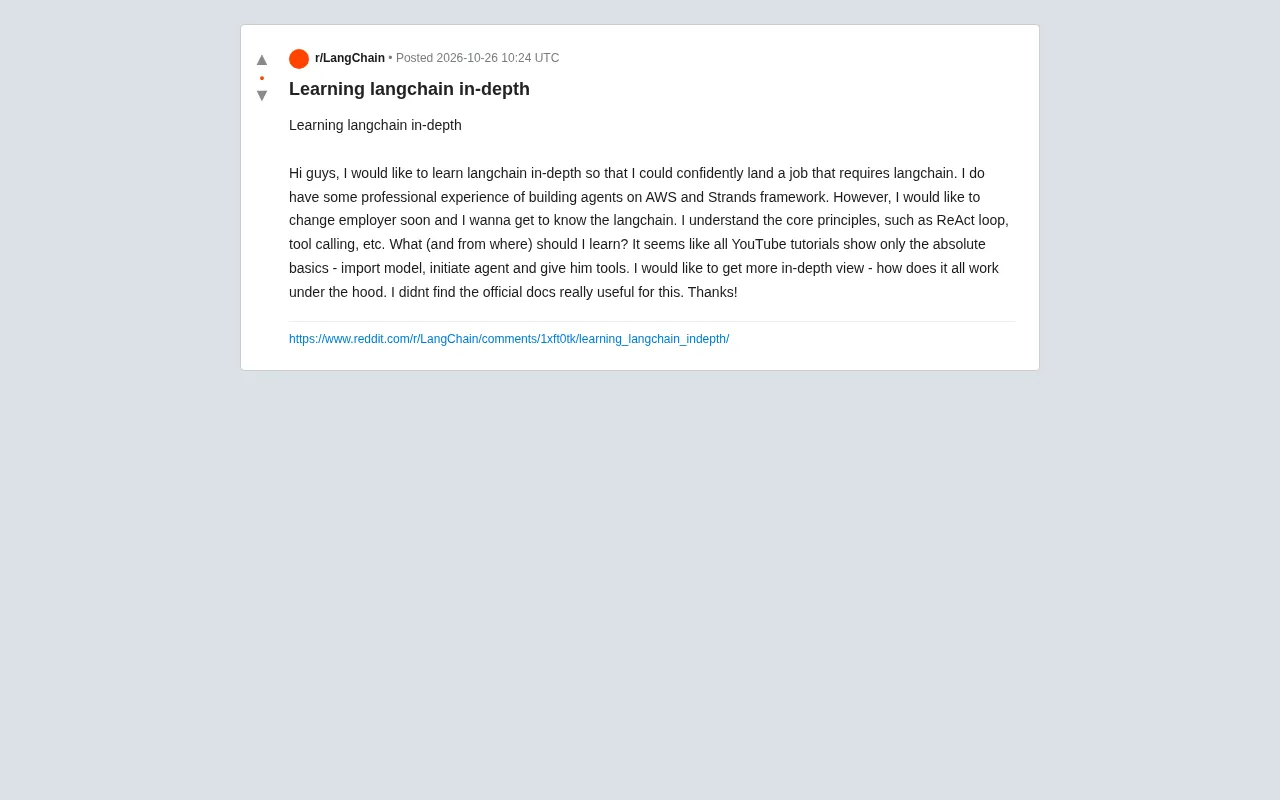
In the field of AI application development, LangChain has become one of the go-to frameworks for building agents, RAG systems, and complex workflows. But many developers hit the same bottleneck after mastering the basics: how to truly understand how it works under the hood, rather than staying at the introductory stage of "import a model, create an Agent, bind tools." A developer's question on Reddit recently struck a chord—he already had experience building Agents with the AWS Strands framework, but felt confused about LangChain's underlying implementation and wanted an advanced learning roadmap.
Why Official Docs and Video Tutorials Aren't Enough
The developer admitted that tutorials on YouTube almost uniformly demonstrate basic operations, and the official documentation falls short when it comes to explaining internal mechanisms. This isn't an isolated case. LangChain's abstraction layers lower the barrier to entry, but they also hide a lot of detail—the call chain of a Chain, the Agent's execution loop, how memory is stored and retrieved, the serialization of tool calls. These are exactly what gets tested in interviews and real projects.
To break through this layer, the learning path needs to shift from "using the API" to "reading source code and design patterns."
Start with the Core Abstractions
I recommend first mastering a few key base classes: Runnable, BaseLanguageModel, BaseTool, AgentExecutor. Understanding the Runnable pipeline protocol is the key to understanding the entire framework—LCEL (LangChain Expression Language) chained calls are essentially compositions of the Runnable interface. Once you grasp how invoke, batch, and stream uniformly handle input and output behind the scenes, many "black box" behaviors become transparent.
LCEL (LangChain Expression Language) is the declarative orchestration syntax that LangChain has promoted since version 0.1, using the pipe operator | to chain multiple Runnable objects together, e.g. prompt | model | parser. Its core convention is: any object implementing the Runnable protocol can be composed, and the output on the left side of the pipe automatically becomes the input on the right. Under the hood, LCEL converts chained calls into nested invoke calls through RunnableSequence, and automatically inherits capabilities like batch, stream, and ainvoke without having to implement them separately for each chain. The key to understanding LCEL is recognizing that it's not syntactic sugar, but a composition contract based on the Runnable interface—which is exactly why the original text emphasizes that "understanding the Runnable pipeline protocol is the key to understanding the entire framework."
The AgentExecutor Execution Loop
You already understand the ReAct loop and tool calling. The next step is to trace the AgentExecutor source code: how it parses the tool-calling intent from the LLM output, how it constructs intermediate steps, how it handles tool return results and decides whether to continue the loop. Pay special attention to timeout control, error handling, and the implementation of max iterations—these are critical to production stability.
ReAct (Reasoning + Acting) is a prompting paradigm that has the LLM alternate between reasoning and acting: the model first outputs a thought (Thought), then decides which tool to call (Action) and provides input (Action Input). The framework executes the tool and feeds the result (Observation) back to the model, looping until the model gives a final answer (Final Answer). LangChain's AgentExecutor is essentially the runtime implementation of this loop—it is responsible for parsing the Action and Action Input from the LLM output, calling the corresponding tool, splicing the Observation back into the prompt, and deciding when to terminate based on parameters like max_iterations and early_stopping_method. The "parsing the tool-calling intent from the LLM output" mentioned in the original text refers precisely to the ReAct text-parsing step, and modern LangChain also supports the model's native function calling to replace text parsing—the two go through different output parser branches in AgentExecutor.
The Underlying Implementation of Memory and Retrieval
For RAG scenarios, dig into the interface design of VectorStore and Retriever, and understand how embedding models, similarity search, and document splitters collaborate. Don't just call asRetriever()—try implementing a simple Retriever yourself. This will help you understand where LangChain's abstraction boundaries lie.
VectorStore and Retriever are two different levels of abstraction: VectorStore handles vector storage and similarity retrieval (e.g. similarity_search) and is a lower-level storage interface; Retriever is a more general retrieval interface that only exposes get_relevant_documents (or invoke in newer versions). Any object that can return documents based on a query can be a Retriever—it doesn't have to be a vector store. asRetriever() simply wraps a VectorStore into a Retriever adapter, and in between you can also insert strategies like MMR, similarity thresholds, and multi-query rewriting. The original text suggests implementing a simple Retriever yourself precisely because this layer of abstraction is the most easily obscured by asRetriever()—when you implement it yourself, you're forced to confront three key decision points: query construction, document scoring, and return format.
Practice-Driven Advanced Strategies
Reading source code alone can get you lost. A more effective approach is to practice with questions in mind: try refactoring the Agent you previously built with the Strands framework using LangChain, and compare the two frameworks' design differences in tool calling, state management, and error recovery. This kind of migration-based learning lets you quickly identify LangChain's design philosophy.
Actively participating in the open-source community is also an important path—LangChain's GitHub Issues and Discussions contain a wealth of discussions about internal mechanisms, and the background behind many design decisions can be found there.
AWS Strands Agents is an agent framework open-sourced by AWS in 2025, adopting a "model-driven" design philosophy: developers only need to define tool functions and a system prompt, and the model autonomously plans the calling order—the framework itself does not enforce an explicit ReAct-style loop. This contrasts with LangChain's AgentExecutor, which exposes the loop, parsing, and termination conditions as configurable components, offering more control but requiring more boilerplate code. The original text suggests refactoring a Strands-built Agent with LangChain, and its value lies in this: when you discover which components need to be explicitly configured in LangChain for things that Strands does "implicitly," the design trade-offs of the two frameworks become very concrete—this makes it easier to build intuition for abstraction levels than simply reading source code.
Summary
The depth of mastering LangChain doesn't lie in memorizing more APIs, but in understanding the design trade-offs behind its abstraction layers. Start from the Runnable protocol, trace the AgentExecutor execution chain, dig into the underlying implementation of memory and retrieval, and then consolidate your understanding through cross-framework migration practice—this path can help you move from "knowing how to use it" to "understanding the principles," building real competitiveness in interviews and complex projects.
One-line Summary
Advanced LangChain learning should shift from API usage to source code and design patterns, understanding the trade-offs behind the abstraction layers.
Related articles

WebMCP Security Guide: Three Hints That Make AI Agents Safer
The Chrome team demonstrates three security hints for WebMCP tools: readOnlyHint eliminates invalid confirmation dialogs, consequentialHint forces human confirmation for high-risk operations, and untrustedContentHint defends against indirect prompt injection—improving AI agent security with one or two lines of code.

Why Turbulence Is the Hardest Problem in Fluid Mechanics — and How AI Could Crack It
Why is turbulence the hardest problem in fluid mechanics? This article, based on a Lex Fridman podcast conversation, explores turbulence's multi-scale nature, comparisons with classical thermodynamics, and how AI might simplify turbulence description by discovering coordinate transformations — examining the intersection of vortex formation with mathematics and physics.

R.L. Stine Google Talk: How the Master of Horror Ignites Kids' Passion for Reading
At a Google talk, R.L. Stine shares his accidental pivot from comedy to horror, his principles for children's horror, how phones impact storytelling, and how Goosebumps motivates kids to read.