Why Turbulence Is the Hardest Problem in Fluid Mechanics — and How AI Could Crack It

Turbulence resists description by a few macroscopic quantities due to multi-scale coupling; AI may discover concise coordinate transformations.
Based on an interview with a fluid mechanics researcher on the Lex Fridman podcast, the article explores why turbulence remains an unsolved problem in classical physics. The core issue is turbulence's multi-scale nature: unlike gases described by a few macroscopic quantities like temperature and pressure, turbulence's large, medium, and small vortices all affect overall behavior and cannot be simplified. The researcher poses an AI-style question: can we find coordinates or a representation that describes turbulence as concisely as thermodynamics does? Physics breakthroughs often follow coordinate transformations, and AI's task is to learn from massive data the transformation forms that should exist but are hard to write explicitly. Problems stalled in the 1970s and 1980s due to limited compute are now golden opportunities for AI. Vortex merging, stretching, and folding reveal rich structure within chaos and are key scenarios for testing AI's representational capability. The article concludes that AI's role in turbulence is not black-box replacement but discovering hidden concise representations, with profound impacts on airfoil design, cardiovascular flow analysis, and beyond.
Turbulence: The Unsolved "Multi-Scale" Problem of Classical Physics
In a Lex Fridman podcast episode, a fluid mechanics researcher called turbulence "the hardest problem in fluid mechanics." Its difficulty doesn't come from mystery — it comes from one fundamental property: multiple scales.
"Turbulence is what happens when a complex fluid tumbles, mixes, and moves — like those beautiful fluid sketches by da Vinci, where every scale matters. Big vortices, medium vortices, small vortices — they all affect lift, drag, and overall behavior."
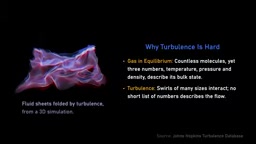
This is fundamentally different from the air we're familiar with. The gas in a room consists of about 10^23 particles, and each particle's motion seems chaotic — but the great success of classical thermodynamics is that we don't need to track every particle. A handful of macroscopic quantities — temperature, pressure, density — fully describe its behavior.
But turbulence has no such "simple description." Air flowing over a wing, blood inside the heart, water in a river — every detail at every scale must be tracked, or the next step of evolution can't be predicted. This computational incompressibility is exactly why turbulence is a "Millennium Prize"-level problem.
The Navier-Stokes equations are the fundamental equations describing fluid motion, independently derived in the 19th century by French physicist Claude-Louis Navier and British physicist George Gabriel Stokes. They are essentially Newton's second law expressed for fluids: the acceleration of a fluid element equals the sum of pressure gradient forces, viscous forces, and external forces. For incompressible fluids, the equation is written as (\partial_t \mathbf{u} + (\mathbf{u}\cdot\nabla)\mathbf{u} = -\nabla p/\rho + \nu \nabla^2 \mathbf{u}), where (\mathbf{u}) is the velocity field, (p) is pressure, (\rho) is density, and (\nu) is kinematic viscosity. The equation looks concise but is extremely complex due to the nonlinear convection term ((\mathbf{u}\cdot\nabla)\mathbf{u}). The question of existence and smoothness of Navier-Stokes solutions is one of the seven "Millennium Prize Problems" announced by the Clay Mathematics Institute in 2000, with a $1 million prize. Turbulence is precisely the typical solution behavior of these equations at high Reynolds numbers, so understanding turbulence is closely tied to conquering this mathematical challenge.
Finding Turbulence's "Temperature and Pressure": A Coordinate Transformation Revolution
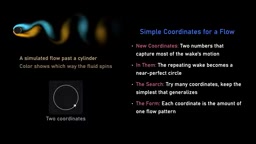
Faced with this complexity, the researcher posed a question with a strong AI flavor: Does there exist a set of coordinates or a representation that can describe turbulence as concisely and accurately enough as temperature and pressure describe a gas?
"This is a perfect AI problem," he said in the interview. "Just as fish already solved this problem through hundreds of millions of years of evolution."
This line of thinking has a deep physics tradition behind it. All great physics breakthroughs have come after coordinate transformations — Newton's F=ma works because we first put the Sun, not the Earth, at the center of the universe.
"We need to search through massive amounts of simulation and observational data for a simple coordinate system that makes the description of the fluid simple, generalizable, and physically beautiful. This requires both brute-force enumeration of large amounts of data and coordinate transformations, and deep mathematical insight."
The Golden Problem Stuck by Compute
The researcher particularly pointed to a pragmatic path: go back to the problems that smart people proposed in the 1970s and 1980s but that were stuck due to limited compute. These problems are exactly where AI is best suited today.
"We already know from first principles roughly what form these coordinate transformations should take — they're just too complex to write down. Now give AI more data and more compute, and see if it can learn these transformations that should exist."

This means AI's role in turbulence is not "black-box replacement" but discovering hidden concise representations — a third path between pure mathematical derivation and pure data fitting.
In fluid mechanics, the Reynolds number (Re) is a dimensionless parameter for determining flow regime, defined as the ratio of inertial forces to viscous forces: (Re = \rho U L / \mu), where (U) and (L) are characteristic velocity and length, and (\mu) is dynamic viscosity. When Re is small, viscous forces dominate, the flow is stable and layered — called laminar flow. When Re exceeds a critical value (e.g., about 2000–4000 for pipe flow), inertial forces overwhelm viscous forces, small perturbations are amplified, the flow becomes unstable and gradually transitions to turbulence. The higher the Reynolds number, the wider the range of scales in turbulence — from the largest energy-containing vortices to the smallest dissipative vortices, the scale ratio can reach on the order of Re^{3/4}. This is the physical root of turbulence's "multi-scale" nature: engineers must resolve all scales simultaneously to accurately predict the flow, and computational cost rises sharply with Re. Thus, the Reynolds number is not only a criterion for flow regime but also a key parameter for understanding why turbulence computation is so difficult.
Direct Numerical Simulation (DNS) is the most accurate method in computational fluid dynamics: it solves the Navier-Stokes equations directly without introducing any turbulence model, and thus can capture flow structures at all scales. But the cost is that grid resolution must be fine enough to resolve the smallest dissipative scale (the Kolmogorov scale), and computational cost scales roughly with Re^{3}. For an aircraft wing (Re~10^7), DNS requires on the order of 10^{12} grid points or more — far beyond the capability of current supercomputers. Therefore, engineering commonly uses reduced-order methods like Large Eddy Simulation (LES) or Reynolds-Averaged Navier-Stokes (RANS), but these rely on empirical models and have limited accuracy in complex flows. The "problems stuck by compute in the 1970s and 1980s" the researcher mentioned refer precisely to coordinate transformation or turbulent structure theories that require DNS-level detail but couldn't be verified due to insufficient compute. Today, AI's involvement promises to learn cross-scale representations from limited high-fidelity data, thereby bypassing DNS's computational barriers.
Vortex Formation: The Beauty of Order in Chaos
Another moving aspect of the interview is the observation of vortex formation. When two vortices meet, they interact and merge in extremely interesting ways — a red vortex and a blue vortex, and you can clearly see the moment they fuse and connect.
But turbulence is far more than the merging of vortices. It also stretches, folds, and tangles its trajectories like spaghetti.
"It's not random. There's a lot of structure in there — just at many scales and very tangled."

This "chaotic but structured" property is exactly AI's forte: capturing hidden patterns in highly nonlinear data. Traditional numerical simulation relies on grid resolution — the smaller the scale, the greater the computational cost. But if a unified cross-scale representation can be learned, it may be possible to drastically reduce computational cost while maintaining accuracy.
The Intersection of AI and Fluid Mechanics
Several clear judgments can be distilled from this conversation:
- The fundamental difficulty of turbulence is multi-scale coupling — unlike gases that can be described by a few macroscopic quantities, every scale of turbulence affects overall behavior.
- AI's potential contribution lies in discovering coordinate transformations — mapping complex flows into a concise, generalizable representation space, rather than merely making predictions.
- Mathematics and data-driven approaches are not opposed — physical intuition points to possible forms of transformation, and AI is responsible for explicitly constructing them in a vast search space.
- Fine structures like vortices are the touchstone for representation capability — whether a unified framework can describe vortex generation, merging, and stretching is key to measuring model quality.
For engineering, this means more efficient airfoil design, more precise cardiovascular flow analysis, and more reliable weather and ocean models. For AI research, turbulence provides a testbed with both physical constraints and extremely high complexity — it requires models not only to fit data but also to discover interpretable structure.
As the researcher said, fish already "solved" this problem long ago. What humans need is to find that coordinate system that makes the problem simple.
One-line Summary
Turbulence is hard to describe with a few macroscopic quantities due to multi-scale coupling; AI may discover concise coordinate transformations.
Paragraph Summary
Based on an interview with a fluid mechanics researcher on the Lex Fridman podcast, the article explores why turbulence remains an unsolved problem in classical physics. The core issue is turbulence's multi-scale nature: unlike gases that can be described by a few macroscopic quantities like temperature and pressure, the large, medium, and small vortices of turbulence all affect overall behavior and cannot be simplified. The researcher poses an AI-style question: can we find a set of coordinates or a representation that describes turbulence as concisely as thermodynamics does? Physics breakthroughs often follow coordinate transformations, and AI's task is to learn from massive data the transformation forms that should exist but are hard to write down explicitly. Problems stalled in the 1970s and 1980s due to limited compute are now golden opportunities for AI. The merging, stretching, and folding of vortices reveal rich structure within chaos and are key scenarios for testing AI's representational capability. The article concludes that AI's role in turbulence is not black-box replacement but discovering hidden concise representations, which will have profound impacts on airfoil design, cardiovascular flow analysis, and beyond.
Related articles

AI Comic Drama with WorkBuddy from Scratch: A Step-by-Step Skill Pack Installation Guide
Learn how to create AI comic dramas with WorkBuddy from scratch. This guide covers installation, Skill pack import and invocation, plus a script generation demo with manual revision tips to get you through the first step from script to storyboard.

WorkBuddy Agent Runs the Entire GEO Database Mining Pipeline with a Single Prompt
WorkBuddy agent automates GEO database mining: from data search and curation to batch correction, differential analysis, co-expression networks, feature gene screening, and immune infiltration—a single prompt generates a complete bioinformatics report, greatly lowering the barrier to bioinformatics analysis.

PC Memory Wasted? Hacker News Debates Centralized Data Centers
Hacker News users argue that personal computer memory is wasted and should be centralized in data centers, sparking debate on centralized vs. distributed computing resource allocation. This article analyzes the logic behind the claim, the costs of centralization, and new tensions in memory resource allocation in the AI era.