Agent Development Engineer: Pivoting to AI from Zero and Catching the Hot New Role Companies Are Desperate to Fill
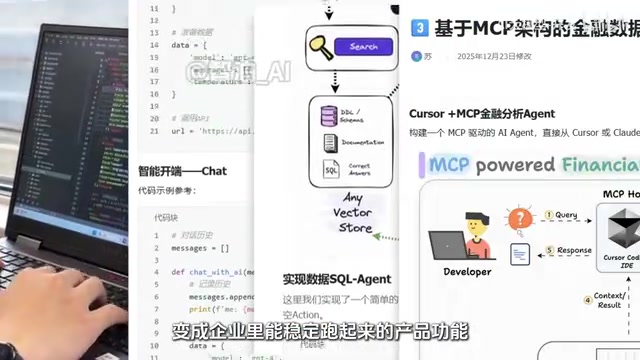
Agent Development Engineer is a new hiring hotspot—a pure engineering role ordinary people can enter in four steps.
The article notes that ByteDance, Meituan, Alibaba, and Tencent are hiring Agent Development Engineers in large numbers, with junior pay up to two to three times previous salaries. It's a pure engineering role requiring no deep learning—just process decomposition and tool orchestration. The article lays out a four-step entry path: prompt engineering, RAG knowledge bases, Agent workflows, and real-scenario practice.
Why Did Agent Development Engineer Suddenly Become So Sought After?
Recently, the job market has sent a signal that many people didn't expect: ByteDance, Meituan, Alibaba, and Tencent are all frantically hiring for a role called "Agent Development Engineer." Junior positions with one to two years of experience can pay two to three times your previous salary; career changers with less than a year in the field are being offered 35K, and there's no worry about being replaced by AI. This isn't a joke—it's a new profession being created in the AI era.
What does this role actually do? One sentence explains it: turn the capabilities of large models into product features that can run reliably inside a company. It sounds like algorithm work, but the reality is the exact opposite—you don't need to understand deep learning, and you won't be tested on Transformer and Attention; that's what algorithm roles that publish papers do. Agent development is a pure engineering role. What matters is whether you can break down business processes, connect tools, and handle things when they go wrong. In plain terms: when a user asks a question, the system you build can decide on its own what to insert, what to call, and which process to follow, and finally give a reliable answer—without a human directing it step by step.
What Companies Lack Most Isn't Algorithms—It's People Who Can Connect Both Sides
At first glance, many people think Agent development is like an AI version of API calling. But look at the job market and you'll see this is one of the hardest roles for companies to fill right now: people who know algorithms don't understand business, people who understand business don't understand AI, and there are very few people on the market who can connect the two. What makes Agent development valuable is that it hits the real pain points of bosses.
Every company wants to integrate AI into business processes to cut costs and improve efficiency, but no one can make it happen. Leadership focuses on three things: Can the process be standardized? Can AI really do the work for people? Will it fail after launch? The answers to these questions aren't in papers—they're in engineering implementation. Whoever can break a vague business requirement into an automatable process, and whoever can make large models output reliably in real-world scenarios, will be right at the center of this wave of demand.
According to the view in this Bilibili tutorial series, the core competitiveness of an Agent development engineer isn't model theory—it's process decomposition ability and tool orchestration ability. These happen to be skills that traditional software engineers and business people can transfer over.

A Four-Step Path for Ordinary People to Enter Agent Development
So how can ordinary people get in on this trend? The core is three words: learn by doing. You don't need to start by grinding through low-level algorithms—just follow these four steps.
Step 1: Learn Prompt Engineering
First, understand how to make large models output what you want reliably and obediently. After this step, you'll be able to build your first working thing: automatic meeting minutes, automatic daily report generation, automatic sales scripts. The point of this step is to go from "knowing how to use AI" to "being able to direct AI."
Prompt Engineering refers to the technique of designing and optimizing the instructions (prompts) given to large models to guide them toward stable, expected outputs. It doesn't involve modifying model parameters; instead, it leverages the model's existing understanding and generation capabilities and uses techniques such as role setting, task decomposition, format constraints, and few-shot examples to reduce output randomness. For Agent development, prompt engineering is the foundation of foundations—it determines whether subsequent tool calls and process orchestration can run reliably. Mastering prompt engineering means you can turn vague requirements into clear instructions the model can execute. This is the key leap from "knowing how to use AI" to "being able to direct AI."
Step 2: Learn to Build RAG Knowledge Bases
Learn to feed a company's own materials to AI so its answers are grounded in evidence. After this step, you'll be able to build a private knowledge base for your team. According to the tutorial author's observation, this is the capability companies most often implement and are most proud to show—because what companies care about most is whether AI can speak based on their own data.

RAG (Retrieval-Augmented Generation) is a technical architecture that combines an external knowledge base with a large model. Its core process is: when a user asks a question, the system first retrieves the most relevant snippets from the company's private document library, then feeds those snippets as context to the large model so it generates an answer based on real materials. This has two key benefits: first, it solves the problem that large models "don't know a company's internal situation"; second, it significantly reduces the probability of model hallucination. RAG systems typically include document parsing, text chunking, vector embedding, vector database retrieval, and answer generation. It is currently one of the most mainstream and cost-effective approaches for companies implementing AI applications.
Step 3: Learn Agent Workflows
Learn to connect multiple AIs into an automated pipeline so that everything from input to output is fully automated. After this step, you'll have the core delivery capability of an Agent engineer: turning a vague business requirement into an automation process that runs reliably.

Agent Workflow refers to using a large model as the "decision hub" to connect multiple steps, tools, and external systems into a task pipeline that runs automatically. Unlike a single Q&A interaction, an Agent in a workflow autonomously decides what to do next based on the current state—for example, first calling a search tool to look up information, then calling a calculation tool to process data, and finally calling a writing tool to generate a report. Common workflow patterns include sequential chains, conditional branches, and loop retries. Mastering Agent workflows means you can decompose and orchestrate a complex, multi-step, multi-tool business requirement into a stable, deliverable automated system—and this is precisely the core delivery capability of an Agent development engineer.
Step 4: Practice with Real Scenarios
Don't wait for someone to teach you step by step. Pick a workflow around you and redo it with AI. As long as it actually runs, it's not a toy—it's your Agent engineer portfolio and the strongest evidence you can bring to an interview.
Why This Role Deserves Ordinary People's Attention
Looking at hiring data, Agent development has relatively loose requirements regarding professional background, and career changers and students from non-elite universities also have opportunities. Junior roles with one to two years of experience can pay two to three times your previous salary, and senior roles have no ceiling. This combination of "not-too-high barrier, strong demand, and fast salary jumps" is rare in today's job market.
The deeper logic is this: no matter how powerful large models become, companies still need someone to translate them into business processes that can run. This translation work won't disappear in the short term; instead, it will increase as AI applications spread. For people who want to pivot into AI but are deterred by the algorithm barrier, Agent development is a more realistic path—it doesn't test whether you understand Transformer, but whether you can connect business and tools.
One-line Summary
Agent Development Engineer is becoming a new hiring hotspot—a pure engineering role that ordinary people can enter in four steps.
Paragraph Summary
The article points out that major companies such as ByteDance, Meituan, Alibaba, and Tencent are hiring "Agent Development Engineers" in large numbers, with junior roles paying two to three times previous salaries. This is a pure engineering role that doesn't require deep learning or Transformer knowledge; its core capabilities are breaking down business processes and orchestrating tools to turn large model capabilities into stable product features for companies. What companies lack most are people who understand both business and AI—people who can connect both sides. The article offers a four-step path for ordinary people to enter the field: prompt engineering, RAG knowledge base construction, Agent workflows, and hands-on practice with real scenarios. It emphasizes that a real portfolio is more persuasive than theoretical certificates and that learning by doing is the most effective way in.
Related articles
9Router Tutorial: A Free AI Token Solution for Claude Access
Complete 9Router tutorial: deploy an open-source AI routing proxy in two commands, aggregate free providers like KiRo AI, Gemini, and OpenCode, and use AI tokens free in the Claude client via Combo multi-model scheduling.

Cursor Agent SDK Released: Build Your Own AI Agents with Code
Cursor opens its Agent SDK: Agent-as-Code with Markdown instructions and TypeScript tools, one-command deploy, or self-host as a Node process. Pricing and independent testing still missing.

Cloudflare Open-Sources Security Audit Skill: Turning AI Agents into Code Auditors
Cloudflare open-sources Security Audit Skill, letting AI Agents run six-stage security audits with adversarial validation to cut false positives and output structured findings.json.