Agent Skills Explained: Progressive Disclosure Architecture and Comparison with MCP

Agent Skills uses modular skill packs and progressive disclosure to let general-purpose Agents expand specialized capabilities on demand.
Based on live course content, this article systematically organizes Agent Skills, an open standard released in October 2025. A skill is a folder containing SKILL.md that encapsulates instructions, metadata, and optional script resources; Agents automatically load them when needed, acquiring specialized capabilities as "pluggable plugins" without retraining or building separate Agents. The article uses the "secretary loading skill packs" analogy to illustrate its low cost and high flexibility, notes that progressive disclosure is its architectural soul: loading skill information on demand to avoid context waste and support dynamic combination, compares Skills with Function Calling, MCP, and Multi-Agent, and finally provides a learning path and trend assessment.
In the field of AI agent development, an architecture called Agent Skills is generating widespread discussion. Some developers regard it as a "game-changing" technical design, whose core value lies in giving otherwise single-purpose Agents nearly unlimited expansion possibilities. This article is based on the live course content of teacher Lian Pengju from Mashibang Education on Bilibili, systematically organizing the concept, principles, and practical applications of Agent Skills, and providing a comparative analysis with MCP, Function Calling, and Multi-Agent architectures.
What Are Agent Skills: Equipping Agents with Modular Skill Packs

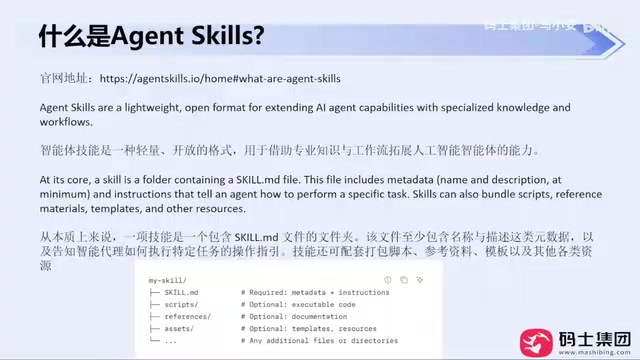
According to the official documentation, Agent Skills is a lightweight open-source format that extends AI agent capabilities through specialized knowledge and workflows. Specifically, a skill is a folder containing a SKILL.md file that stores metadata and operational instructions guiding the agent to complete specific tasks, along with optional resources such as scripts, reference materials, and templates.
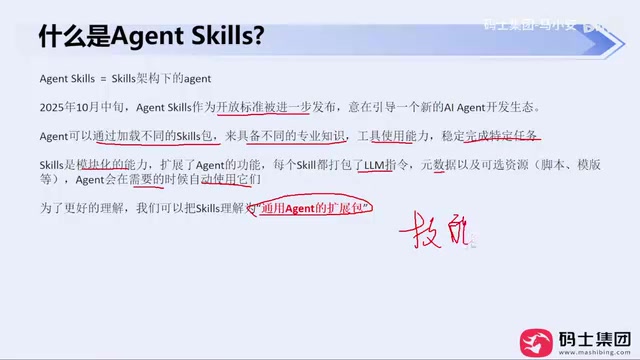
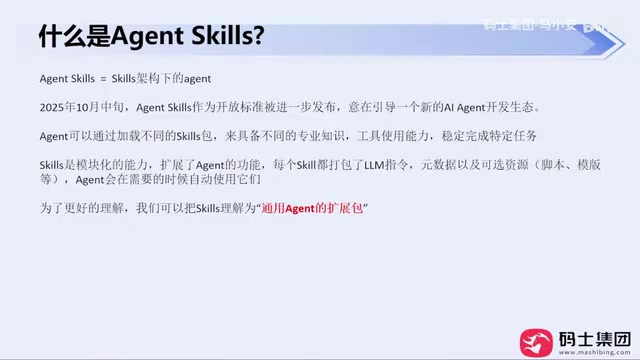
This definition isn't beginner-friendly. In plainer terms: Agent Skills equals an Agent under the Skills architecture. Released as an open standard in mid-October 2025, it aims to guide a new Agent development ecosystem—Agents gain different specialized knowledge and tool-usage capabilities by loading different skill packs, thereby completing diverse tasks. Each skill packages instructions, metadata, and optional resources, and the Agent automatically invokes them when needed.
Essentially, Skills are expansion packs for general-purpose Agents. Just as a programmer originally needs to start from programming syntax, then learn databases and frameworks, and finally be able to do project development; with Skills, they only need to load the corresponding skill pack to directly possess project development capability.
A Real-Life Analogy: The Secretary and Skill Packs
The course uses a very vivid example to illustrate the value of Skills. Suppose you are the boss of a company and have a secretary with decent basic abilities, but they have shortcomings in professional matters such as writing contracts, making posters, and booking flights. You have two traditional solutions: first, spend several months sending them to professional training—high cost and long cycle; second, recruit specialized talent—also incurring additional costs.
Agent Skills offers a third approach: don't train people, don't hire more people, but package various professional capabilities into pluggable plugins. When you need to write a contract, load the legal expert skill pack; when you need to make a poster, load the design skill pack; when you need to arrange a business trip, load the travel management skill pack. Unload when done to release resources.
This modular, low-cost, highly flexible design is precisely the core essence of Agent Skills—load what you need, and leave when done. For Agent developers, this means they don't need to rebuild a complete Agent for every niche scenario, but instead quickly expand capability boundaries by combining skill packs.
Progressive Disclosure: The Architectural Soul of Skills
The course title mentions the concept of "progressive disclosure," which refers to the Agent gradually loading and disclosing relevant skill information at runtime based on task needs, rather than exposing all capabilities to the model at once. This design brings two direct benefits: first, it prevents the context window from being filled with irrelevant skill information; second, it allows the Agent to dynamically combine multiple skills to handle complex tasks.
For developers, progressive disclosure means that the definition of the skill list and the design of invocation tools need to follow specific specifications—skill descriptions must be clear enough for the Agent to judge when to invoke them, and skill granularity should be moderate to avoid excessive fragmentation. This is also why the course later elaborates on "how to define the Skills list and invoke Skills tools."
Context Window refers to the maximum number of tokens a large language model can process in a single inference, including the sum of input prompts and output generation. It is equivalent to the model's "short-term memory" capacity; once exceeded, the earliest content will be truncated or the request will fail. In Agent scenarios, every loaded tool definition, skill description, or reference material consumes context budget, so the more skills there are and the more verbose the descriptions, the less space remains for actual task reasoning. Progressive disclosure directly addresses this constraint: initially only the skill's name and brief description are exposed to the model, and only when the model determines that a certain skill is needed are the complete SKILL.md instructions and associated resources loaded into context. This stands in stark contrast to cramming all tool schemas into the system prompt at once, and is also a key advantage of the Skills architecture in terms of scalability.
Comparison of Skills with MCP, Function Calling, and Multi-Agent
The course plan explicitly includes a comparison of Skills with MCP (Model Context Protocol), Function Calling, and Multi-Agent architectures. Although the live content focuses mainly on conceptual explanation, several key difference dimensions can be outlined:
Function Calling is a tool invocation mechanism at the model level; developers define function signatures and the model decides when to call them. It solves the "single tool invocation" problem, but context management becomes a bottleneck as the number of tools increases.
MCP is a standardized protocol connecting models with external data sources and tools, focusing on context provisioning and standardized tool access. It is more like a set of "interface standards" that allow different tools and data sources to be accessed by models in a unified way.
Agent Skills, on the other hand, leans more toward the capability encapsulation level, packaging instructions, scripts, and resources into reusable skill units, emphasizing modular combination and progressive loading. It solves the problem of "how to enable an Agent to quickly acquire new specialized capabilities."
Multi-Agent architecture completes tasks through collaboration among multiple specialized Agents, each with a single responsibility. Skills can be viewed as a capability expansion solution within a single Agent, complementing Multi-Agent—the former reduces the necessity of building multi-Agent systems, while the latter still has irreplaceable value in complex collaborative scenarios.
Understanding the boundaries of these concepts helps make reasonable technology choices in actual projects, rather than blindly stacking architectures.
The structural specification of SKILL.md is key to understanding how Skills are implemented. This file typically consists of two parts: YAML frontmatter and a Markdown body. The frontmatter declares metadata such as the skill's name and description, where the description directly determines whether the Agent can correctly judge "when to invoke this skill" during the progressive disclosure phase, so it needs to be written specifically and distinguishably, avoiding semantic overlap among multiple skill descriptions. The body uses natural language to describe the operational workflow, input/output conventions, and precautions, and may reference scripts, templates, and reference documents in the same directory. The resource organization of the skill folder makes skills versionable, distributable, and reusable, essentially crystallizing "prompt engineering" into an engineering artifact. When designing the skill list, developers should control the granularity of individual skills—too coarse makes them hard to reuse, while too fine leads to skill proliferation and increased selection costs.
Learning Advice and Trend Assessment
The course instructor repeatedly emphasizes one point: large model-related skills have become a required course for IT practitioners, whether in frontend, backend, mobile, or product roles, and interviews will more or less touch on them. Agent Skills, as a representative design of modular capability expansion, is worth developers investing time to understand deeply.
From a learning path perspective, it is recommended to first master the basic concepts of Skills and the structural specification of SKILL.md, then practice defining and invoking skill lists through actual projects, and finally conduct architecture-level comparative practice combining MCP and Multi-Agent. The B2B project practice planned in the course is an appropriate scenario for testing this knowledge.
Whether Agent Skills can become the standard paradigm of the Agent development ecosystem still needs time to verify. But the "pluggable capability" approach it represents is already changing the way developers build intelligent agents. For technical professionals who want to maintain competitiveness in AI application development, this is undoubtedly a technical direction worth paying attention to.
One-line Summary
Agent Skills uses modular skill packs and progressive disclosure to let general-purpose Agents expand specialized capabilities on demand.
Paragraph Summary
Based on live course content, this article systematically organizes Agent Skills, an open standard released in October 2025. A skill is a folder containing SKILL.md that encapsulates instructions, metadata, and optional script resources; Agents automatically load them when needed, thereby acquiring specialized capabilities as "pluggable plugins" without retraining or building separate Agents. The article uses the real-life analogy of "a secretary loading skill packs" to illustrate its low cost and high flexibility, and points out that progressive disclosure is its architectural soul: loading skill information on demand, avoiding context waste, and supporting dynamic combination. The article also compares the hierarchical differences between Skills and Function Calling, MCP, and Multi-Agent, and finally provides a learning path and trend assessment.
Related articles

AI Comic Drama with WorkBuddy from Scratch: A Step-by-Step Skill Pack Installation Guide
Learn how to create AI comic dramas with WorkBuddy from scratch. This guide covers installation, Skill pack import and invocation, plus a script generation demo with manual revision tips to get you through the first step from script to storyboard.

WorkBuddy Agent Runs the Entire GEO Database Mining Pipeline with a Single Prompt
WorkBuddy agent automates GEO database mining: from data search and curation to batch correction, differential analysis, co-expression networks, feature gene screening, and immune infiltration—a single prompt generates a complete bioinformatics report, greatly lowering the barrier to bioinformatics analysis.

PC Memory Wasted? Hacker News Debates Centralized Data Centers
Hacker News users argue that personal computer memory is wasted and should be centralized in data centers, sparking debate on centralized vs. distributed computing resource allocation. This article analyzes the logic behind the claim, the costs of centralization, and new tensions in memory resource allocation in the AI era.