Agent Skills in Practice: Building Excellent Interfaces with Modular Skills

Modular Agent Skills encapsulate frontend interface-building capabilities, gaining 746 stars in a week and reflecting AI programming's evolution toward domain adaptation.
The article introduces the open-source GitHub project jakubkrehel/skills, which uses modular Agent Skills to break down frontend capabilities such as interface design, component implementation, and styling into independent skill units, enabling general-purpose AI agents to be more focused and consistent in specific tasks. Skills are defined in Markdown, making them lightweight, easy to contribute, and easy to version-manage, and they can be loaded into the context of AI coding assistants like Claude Code and Cursor. The project gained 746 stars in a week, reaching 8,858 total stars, reflecting strong developer demand for domain-adapted AI capabilities. The article also reminds developers to choose skill combinations based on their tech stack, version-control and review skill files, and retain code review of generated output to avoid over-reliance.
What Are Agent Skills?
Agent Skills are a set of modular capabilities designed to help developers build excellent user interfaces with the help of AI agents. The open-source project jakubkrehel/skills on GitHub is a prime example of this concept—it collects a series of agent skills, each encapsulating a specific interface-building capability that developers can combine as needed, enabling AI agents to complete frontend tasks more precisely.
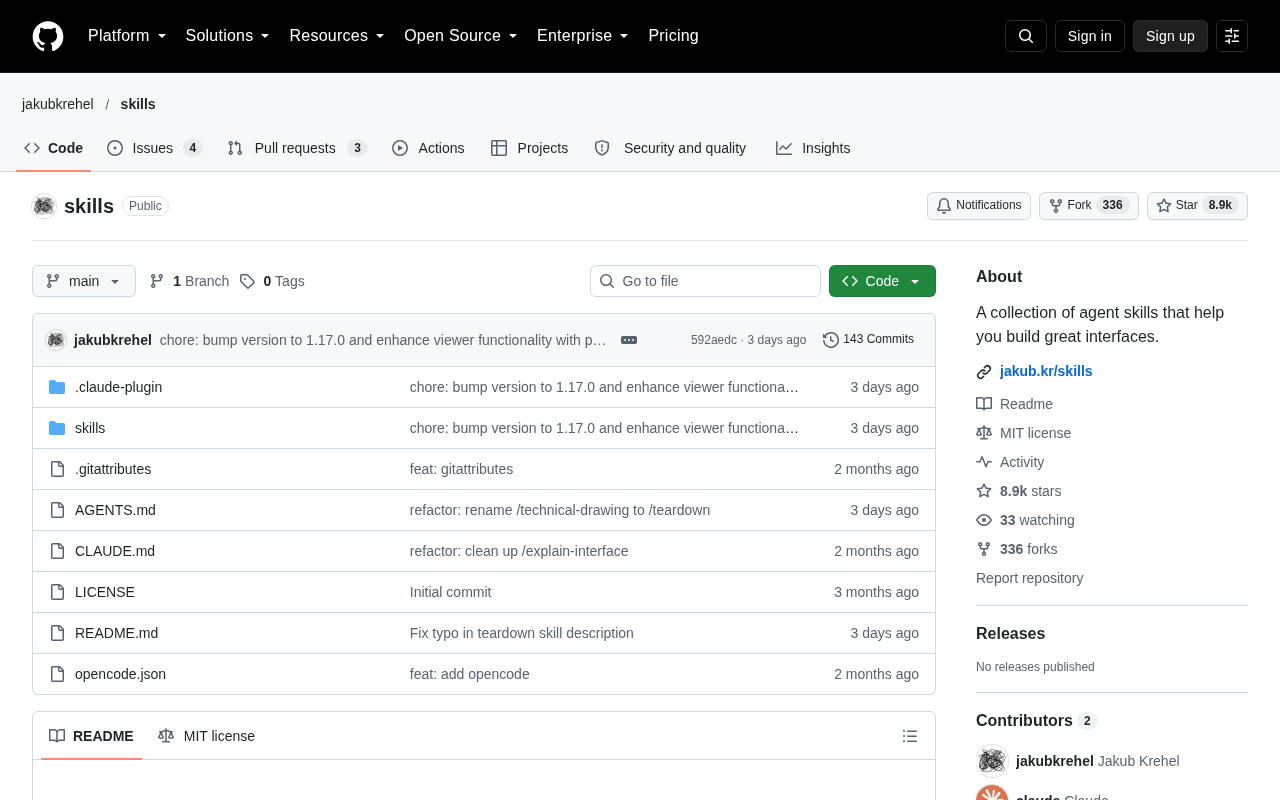
The project has surged in popularity recently, gaining 746 stars in a single week, bringing the total to 8,858 stars with 336 forks. These numbers indicate that more and more developers are paying attention to how to break down AI agent capabilities into reusable skill units.
Why Are Modular Agent Skills Needed?
From General-Purpose Assistants to Domain Experts
General-purpose AI agents often perform reasonably well on broad tasks, but they lack structured domain knowledge when it comes to specific frontend interface building. The idea behind Agent Skills is to break down interface design, component implementation, styling adjustments, and other capabilities into independent skill modules, each focusing on a specific sub-scenario. This way, agents can be more focused when invoked, and output quality is more consistent.
AI Agent refers to an artificial intelligence system capable of perceiving its environment, making autonomous decisions, and executing actions to accomplish goals. Unlike traditional single-turn question-answering large models, agents typically possess planning, tool-calling, memory, and multi-step reasoning capabilities, allowing them to iterate continuously across longer task chains. In frontend development scenarios, agents read requirements, retrieve relevant files, generate or modify code, and even run tests to verify results. Agent Skills are essentially a lightweight means of "role-constraining" agents: through structured skill documents, a general-purpose agent is temporarily shaped into an executor with specific interface-building expertise, thereby reducing hallucinations and style drift.
Reducing Complexity and Improving Reusability
Once skills are modularized, developers can combine different skills like building blocks. For example, when implementing a responsive card layout, layout skills and styling skills can be invoked together, without requiring the agent to understand the entire requirement from scratch. This reusability not only saves prompt engineering effort but also allows teams to accumulate best practices.
Core Features and Usage
How Skills Are Organized
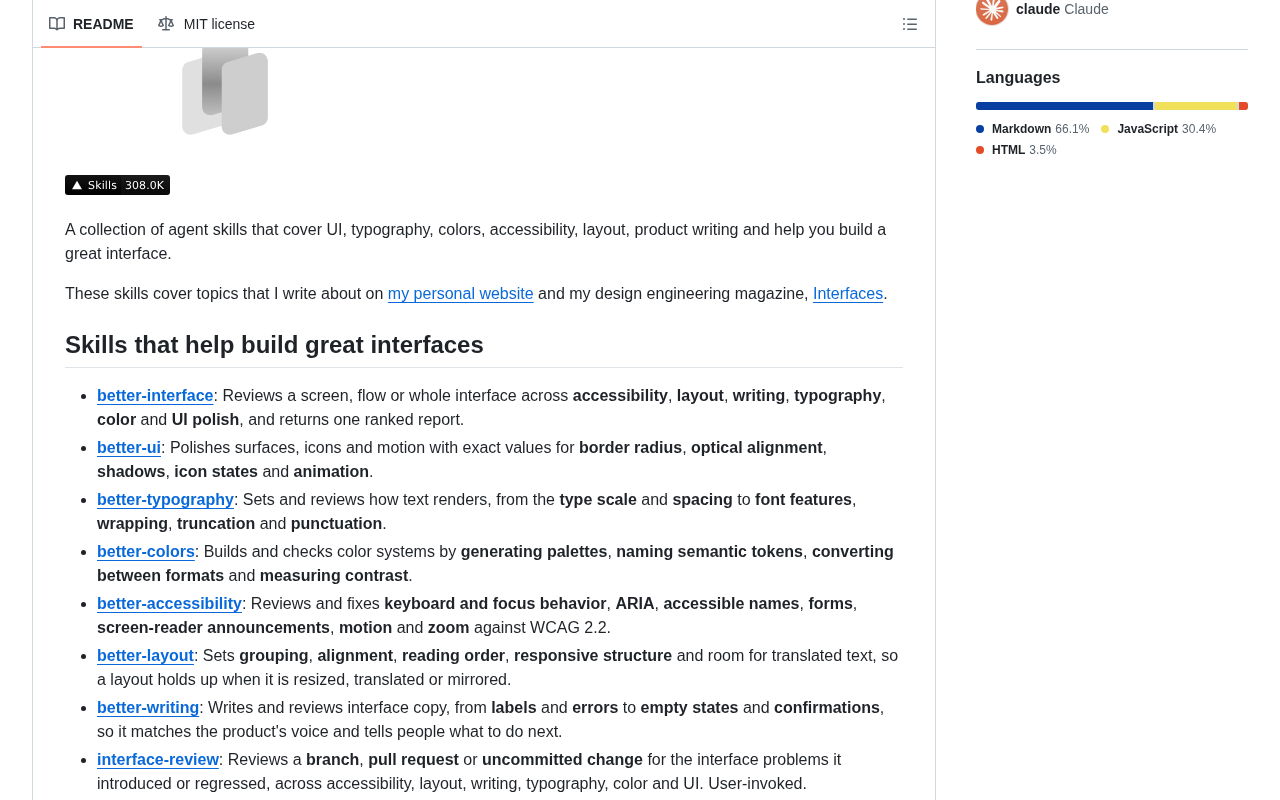
Judging from the project structure, jakubkrehel/skills uses Markdown as its primary language, which means each skill is likely defined as a document containing a skill description, trigger conditions, execution steps, and examples. This lightweight format facilitates version management and lowers the barrier to contribution—developers can write new skills directly in Markdown.
Markdown as a skill definition format is popular in the agent ecosystem because it is both human-readable and machine-parsable. Large language models are naturally adept at understanding Markdown's hierarchical headings, lists, and code blocks, so skill files can be loaded directly as prompt context without additional parsers or DSLs. Compared to JSON Schema or YAML configuration, Markdown allows natural language explanations, counterexamples, and example code to be embedded in descriptions, making it better suited for expressing fuzzy rules like "when to trigger, how to execute, and what to avoid." At the same time, Git's diff tracking for plain text is very friendly, facilitating versioned evolution and multi-person collaborative review of the skill library.
How to Integrate into Workflows
Although the project does not provide detailed integration documentation, based on common patterns of agent skills, developers can load these skill files into the context of AI coding assistants (such as Claude Code, Cursor, etc.), or inject them into agents through custom tool-calling mechanisms. Skill files serve as "operating manuals" that guide agents to follow established specifications in specific tasks.
Claude Code and Cursor are two mainstream forms of AI coding tools today. Claude Code is an agentic coding assistant launched by Anthropic that runs in the terminal, capable of reading and writing files in project directories, executing commands, and autonomously planning multi-step tasks; Cursor is an AI-enhanced editor based on VS Code that offers inline completion, conversational refactoring, and codebase-level context retrieval. Both support injecting domain knowledge into the model through project-level configuration files or rule files (such as .cursor/rules, CLAUDE.md). Agent Skills' Markdown files can be placed in such rule directories or explicitly referenced in conversations, enabling agents to follow established component specifications and style conventions when generating interface code, without having to repeatedly describe them in prompts each time.
Community Response and Ecosystem Significance
The Trend Behind 746 Stars in One Week
Gaining 746 stars in a week shows that the project has hit a developer pain point—AI agents' performance in interface building is still unstable, and modular skills offer an improvement approach. This popularity also reflects the trend in AI programming from "general-purpose models" toward "domain adaptation."
Domain Adaptation was originally a machine learning term referring to transferring models trained on large-scale general data to specific domains. At the LLM application layer, this concept has evolved into using prompt engineering, retrieval-augmented generation (RAG), fine-tuning, or skill injection to make general-purpose models perform more professionally in vertical scenarios. Agent Skills belong to the lowest-cost category: without changing model weights, they guide behavior solely through structured context. The background of this trend is that general models' capabilities on broad tasks have become saturated, and the bottleneck for further improving user experience has shifted to "how to make models understand team conventions, tech stack constraints, and business specifications"—modular skills fill exactly this layer.
Impact on AI-Assisted Frontend Development
The emergence of Agent Skills allows frontend developers to control AI agent behavior more precisely. By defining clear skill boundaries, agents deviate less from expectations when generating code, and the burden of code review is correspondingly reduced. In the long run, this model may give rise to skill marketplaces or shared repositories, further enriching the ecosystem.
Practical Recommendations and Caveats
Choosing the Right Skill Combinations
Developers should select matching skills based on their project's tech stack and team conventions. For example, if the project uses React and Tailwind CSS, priority should be given to skills defined for these technologies. At the same time, regularly review the effectiveness of skill files to avoid outdated specifications misleading the agent.
Beware of Over-Reliance
Although Agent Skills can improve efficiency, developers still need to retain the ability to review generated code. The quality of skill files directly determines output quality, so it is recommended to version-control and peer-review key skills to ensure their accuracy and maintainability.
Reference source: GitHub project jakubkrehel/skills (Stars: 8,858, Forks: 336, 746 stars this week).
Related articles

T3 Code: The Open-Source AI Coding Assistant's Comeback Story
T3 Code is an open-source AI coding assistant that unifies subscriptions like Codex and Claude, with powerful remote control and parallel task management.

Never Elected, Yet Ruled New York for 30 Years: The Ultimate Case Study in the Mechanics of Power
Robert Caro's biographies reveal how unelected Robert Moses ruled New York for 30 years through legal drafting and public authorities, and how Lyndon Johnson built leverage as a "powerless" Senate Majority Leader. Unpacking the underlying logic of accumulating and sustaining power.

The CPython 3.10 Recursion Trap and Synthetic Recovery in TokenGuard, an LLM Circuit Breaker
TokenGuard's author recounts a recursion crash caused by OrderedDict.pop in CPython 3.10 and introduces v0.3.0's Loop Nudge synthetic recovery, inline DLP scanning, and other new LLM agent circuit-breaker capabilities.