AI Agents for Flight Booking Customer Support: Real Needs and Implementation Challenges
Airline customer service AI should prioritize automating four types of repetitive work, positioned as burden reduction rather than replacement, piloting from low-risk scenarios.
The article analyzes a Reddit user's question about finding AI tools for a flight booking call center. Core needs include AI Agents handling basic Q&A, transferring complex issues to humans with context, real-time agent assist, and automatic call summarization and preliminary quality inspection. Basic Q&A can be automated but boundaries must be clear; agent assist and summarization are lower-risk starting points. Accuracy is the biggest concern, so selection should focus on knowledge base synchronization, source attribution, confidence-based transfer, and human takeover. The project should reduce burden rather than replace staff, starting with a narrow pilot.
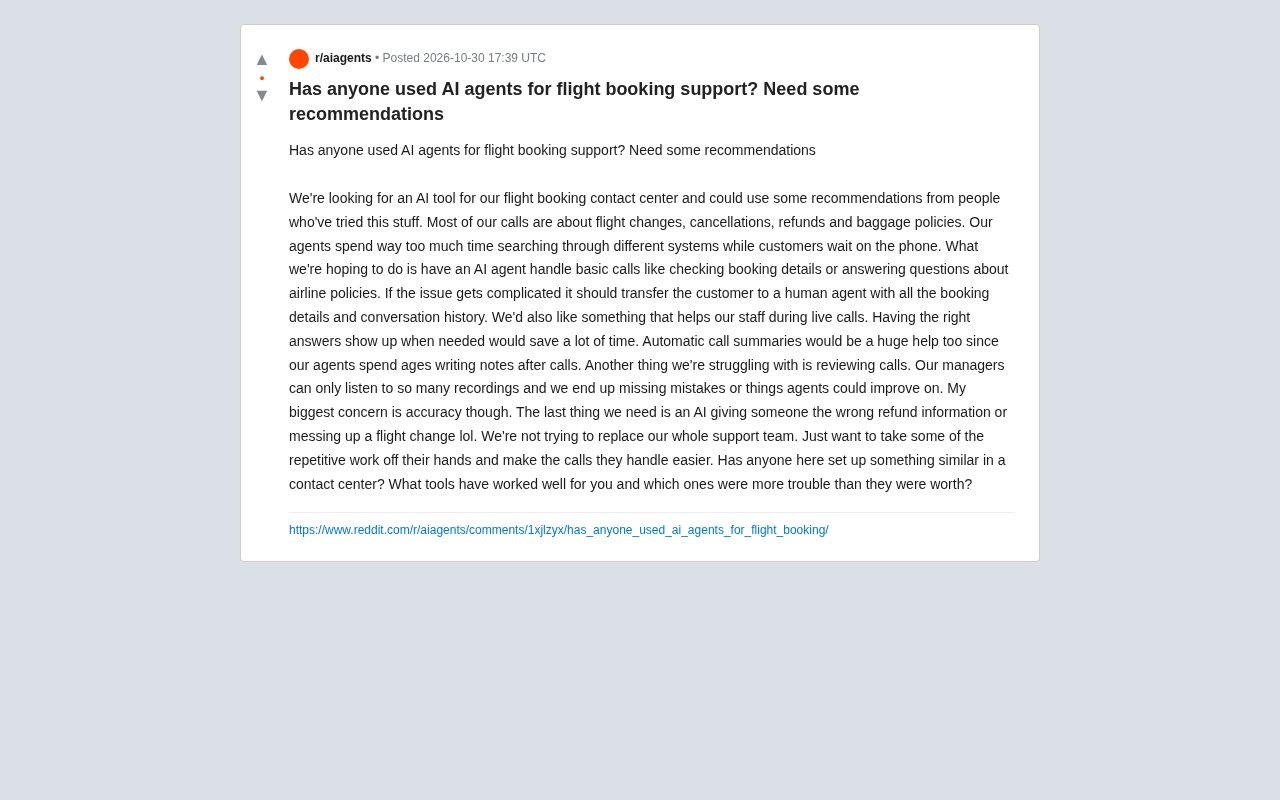
A Reddit user is looking for AI tools for a flight booking call center, hoping to use AI Agents to handle high-frequency questions like rebooking, refunds, and baggage policies, while also assisting human agents, automatically generating call summaries, and helping the QA team spot-check recordings. Although the post is just a question, it lays out the most typical needs and concerns in the airline customer service scenario, and is well worth analyzing in depth.
Breaking Down the Needs: Four Types of Repetitive Work Most Worth Automating First
From the post's description, this call center's pain points are very specific. During calls, agents must repeatedly switch between multiple systems to look up orders and policies while customers wait on the line; after calls end, they spend a lot of time writing notes; management can only spot-check a small number of recordings, missing many errors and improvement points.
Correspondingly, they expect AI to take on four types of work: first, directly answering basic incoming calls, such as querying booking details and answering airline policies; second, when complex issues arise, transferring the customer to a human along with complete booking information and conversation history; third, providing real-time answer prompts during live calls; fourth, automatically generating call summaries and assisting with quality inspection. All four needs essentially involve stripping repetitive information retrieval and recording work away from people.
AI Agent refers to a form of large language model application that can perceive its environment, make autonomous decisions, and execute actions to accomplish specific goals. Unlike traditional Q&A bots that can only reply according to preset scripts, AI Agents can call external tools (such as querying order databases, retrieving policy documents, and executing rebooking/refund interfaces), maintain context across multi-turn conversations, and dynamically adjust the next action based on task progress. In call center scenarios, the typical capabilities of an AI Agent include: understanding customers' natural language requests, autonomously determining the type of issue, retrieving relevant knowledge bases or business systems, generating structured responses, and triggering a handoff-to-human process when beyond its capability boundary. Its core value lies in automating the "information retrieval + judgment + recording" chain, rather than merely doing keyword-matching-style responses.
Basic Q&A Can Be Automated, but Boundaries Must Be Clearly Drawn
Questions such as querying booking details and explaining baggage policies have relatively structured answers and are suitable for an AI Agent to handle first. The key is to clearly define what counts as a "basic question." The post mentions rebooking, refunds, and cancellations—these look standard, but in practice often involve multiple conditions such as fare rules, cabin class, and time windows, and the slightest deviation can lead to incorrect information.
A safer approach is to let AI answer only general policy-level questions, and immediately transfer to a human when specific amount calculations and operational execution are involved. During transfer, complete booking context and conversation records must be included; otherwise, customers have to describe everything again, making the experience even worse. The post explicitly raises this point, showing that the questioner already recognizes that the transfer step is the watershed for experience.
Confidence Scoring is a reliability assessment metric attached to an AI system's output when providing an answer, usually expressed as a probability value between 0 and 1 or as high/medium/low levels. In customer service scenarios, the role of confidence scoring is to let the system proactively choose to transfer to a human when "uncertain," rather than forcing an answer. Implementation methods include: evaluating based on the model's probability distribution for the answer, using a rule engine to verify whether the answer hits an explicit knowledge base entry, or setting "answers must include verifiable source citations" as a mandatory condition. For domains like airline ticketing with complex rules and high costs of error, confidence thresholds should be set relatively conservatively—better to transfer to a human more often than to risk giving low-confidence answers on key information such as refund amounts and rebooking conditions.
Agent Assist and Call Summaries: Fast Results, Low Risk
Compared with having AI face customers directly, real-time agent assist and automatic summarization face less implementation resistance. The former pushes relevant knowledge to the agent's screen during a human call, while the final judgment is still made by the person; the latter generates a draft note after the call ends, which the agent saves after confirmation. These two types of applications do not directly output externally, and errors are backed up by humans.
The post mentions that agents spend a long time writing notes, and automatic summarization directly addresses this pain point. The same applies to quality inspection: managers cannot listen to all recordings, so AI can first perform full-volume preliminary screening and flag possible errors or improvement points, after which humans review the key segments. This path has less stringent accuracy requirements than direct customer service and is suitable as the first stop for接触ing AI.
Agent Assist refers to technology that, during a human call, uses AI to analyze conversation content in real time and push relevant knowledge, script suggestions, or operational prompts to the agent's screen. Unlike AI customer service that directly faces customers, the output of agent assist is delivered to trained human agents, and the final judgment and expression are still completed by people. Typical functions include: real-time speech-to-text, intent recognition, knowledge base snippet retrieval, compliance script reminders, and next-step action suggestions. Because there is human backup, agent assist has greater tolerance for accuracy and lower implementation resistance. Call summarization, meanwhile, means that after a call ends, AI automatically generates a structured draft note (such as customer request, resolution result, and follow-up items), which the agent saves after confirmation or modification, significantly reducing post-call recording time.
Accuracy Is the Biggest Concern and the Core Criterion for Tool Selection
The questioner repeatedly emphasizes that the biggest fear is AI giving incorrect refund information or getting rebooking wrong. This concern is entirely reasonable: airline ticketing rules are complex and change frequently, and once an answer is wrong, it can range from customer complaints to actual financial losses.
When selecting tools, several aspects deserve close examination: whether the knowledge base can be updated in sync with airline policies, whether answers include information sources for agents to verify, whether there is a confidence mechanism that proactively transfers to a human when uncertain, and whether human takeover is supported at any time. The post does not mention specific tool names or provide any deployment cases, so no specific product can be recommended here; only the evaluation dimensions can be clarified.
Synchronized knowledge base updates are the foundational guarantee of customer service AI accuracy. Airline ticketing policies (such as baggage allowances, rebooking and refund rules, and restrictions on special fare types) change frequently with airline policies, seasonal regulations, and promotional activities. If the knowledge base that AI relies on cannot stay in sync with business systems, it may provide outdated or even incorrect information. When evaluating, pay attention to: whether the knowledge base supports regular automatic synchronization or real-time API retrieval, whether updates are manually reviewed before going live, and whether version history is retained for tracing the source of errors. In addition, source attribution (i.e., answers accompanied by clickable policy clauses or system field references) allows agents to quickly verify AI suggestions before adopting them, which is especially important in high-risk scenarios such as refunds and rebooking.
The Positioning Is to Reduce Burden, Not Replace
At the end of the post, the author clearly states that the intention is not to replace the entire support team, but simply to reduce repetitive work and make live calls easier. This positioning actually determines the project's success criteria: not how many calls AI independently resolves, but whether the burden on agents per call decreases, whether transfers are smooth, and whether customers wait less.
From the perspective of community discussion, such needs are quite common in the call center field, but publicly available mature cases are not many. The experience-sharing the questioner wants—"which tools work well and which are traps"—is precisely the information that is currently scarcest. If advancing this internally, it is advisable to start with a narrow scenario pilot, such as only call summarization or only policy Q&A, and then expand the scope after validating accuracy and agent acceptance.
One-line Summary
Airline customer service AI should prioritize automating four types of repetitive work, positioning itself as burden reduction rather than replacement, and piloting from low-risk scenarios.
Paragraph Summary
The article analyzes a Reddit user's question about finding AI tools for a flight booking call center. Core needs include: AI Agents handling basic Q&A, transferring complex issues to humans with context, real-time agent assist, and automatic call summarization and preliminary quality inspection. The article points out that basic Q&A can be automated but boundaries must be clearly drawn, and that amount calculations and operational execution should be immediately transferred to humans; agent assist and call summarization have lower implementation risk because of human backup and are suitable as the first stop. Accuracy is the biggest concern, and tool selection should focus on knowledge base synchronization, source attribution, confidence-based transfer to humans, and human takeover capability. The project should be positioned as burden reduction rather than replacement, and it is recommended to validate through a narrow-scenario pilot before expanding scope.
Related articles

Android Developer Verification: Four Paths and Global Rollout Timeline
Android Developer Verification explained: Google unveils four verification paths—Play developers, independent distributors, students/hobbyists, and power users—plus developer console API automation, 24-hour safety delay, and global phased enforcement timeline.

Compose Performance Optimization: A Practical Guide to Outperforming Yourself
A deep dive into Jetpack Compose performance optimization: release-mode measurement, Baseline Profiles, Perfetto composition tracing, computed vs. derived state, effect API costs, and avoiding unnecessary recomposition.

Bitmap Memory Optimization in Practice: 5 Strategies to Reduce App Memory Usage
Based on Google I/O research across ~500 Android apps, this guide covers the Reduce, Reuse, Recycle Bitmap memory optimization strategies—CDN cropping, downsampling, Bitmap Region Decoder, cache deduplication, onTrimMemory handling, Play Console memory metrics, and local profiling toolchains.