AI Assistants Narrow the Skills Gap: Novices Boost Efficiency by 30%, Expert Advantage Diluted

A 5,000-person study shows AI assistants boost customer service efficiency by 15%, but novices gain 30%—far more than experts—compressing the skills gap.
A study of AI assistants involving over 5,000 customer service representatives reveals that AI improves problem-solving efficiency by 15% on average, but novices and low-skilled employees gain about 30%, while experts benefit little. The mechanism is that AI diffuses high performers' working methods to everyone, acting as a real-time tutor and compressing the skills gap. Experts face anxiety about their advantage being diluted, but the study did not address compensation changes. Multi-source analyses diverge: some believe the small gains for experts are a short-term phenomenon, while others argue skill compression is structural. For individuals and organizations, the anchor of value is shifting from "knowing how to do it" to "solving problems AI cannot solve," and organizations need to redesign incentives and promotion channels to respond to this change.
The AI Truth Revealed by a 5,000-Person Study
What happens when AI takes the experience that veteran employees spent years accumulating and hands it directly to new hires? A study of AI assistants involving over 5,000 customer service representatives offers a thought-provoking answer: AI helps novices and low-skilled employees far more than it helps experts.
According to a YouTube channel's analysis of the study, after using AI assistants, customer service representatives solved about 15% more problems per hour on average. But when broken down, novices and low-skilled employees saw gains of roughly 30%, while the most experienced and highly skilled employees benefited much less.
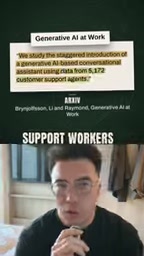
These data point to a key conclusion: AI does not benefit everyone equally—it is compressing the skills gap.
Why Do Novices Benefit More?
The researchers' explanation is that AI assistants "diffuse" the working methods of top performers to everyone. Novices can get immediate help when they hit a roadblock, and they can also learn from AI suggestions which approaches work. In other words, AI acts as an always-on "veteran mentoring novice" tutor.

This mechanism is not mysterious. In customer service scenarios, a large number of problems are repetitive and have standard solutions, and AI happens to excel at standardizing the handling paths for such problems. What novices often lack is not willingness, but "not knowing how to do it," and AI fills that gap.

For people just entering the field, this is indeed a real benefit: no need to fumble around helplessly, no fear of asking "stupid questions," and efficiency gains are immediate.
Knowledge Diffusion is a core concept in organizational learning theory, referring to the process by which knowledge spreads from individuals or small groups to a wider range. In traditional enterprises, knowledge diffusion often relies on mentorship, documentation, or internal training, with efficiency limited by the disseminator's time and willingness. AI assistants change this model: by analyzing behavioral data from high performers, they transform tacit experience (such as scripting strategies and problem-solving paths) into explicit suggestions and push them to all users in real time. This "decentralized" diffusion mechanism greatly lowers the barrier to knowledge acquisition, especially for inexperienced novices, effectively giving them a continuously available expert system. Research shows that in customer service scenarios, AI standardizes top employees' handling patterns, enabling novices to quickly replicate effective practices—this is the technical basis for compressing the skills gap.
Expert Anxiety: Advantage Diluted
The other side of the coin is the experts. If AI enables everyone to answer those simple questions, then some of the abilities that once made experts stand out can now be matched by others.

This is a subtle psychological shift. The "feel" and "intuition" that experts have accumulated over years are partly deconstructed by AI into replicable steps. The study did not measure compensation changes and cannot prove that experts will be devalued as a result—after all, someone still has to handle thorny cases. But it raises a question worth pondering: when AI helps everyone solve simple problems, what will companies still be willing to pay extra for?
The answer most likely points to the problems AI still cannot solve.
Skill-Biased Technological Change (SBTC) theory holds that new technologies usually favor high-skilled workers because they can amplify experts' productivity. However, AI assistants in customer service scenarios show the opposite pattern—they significantly improve the efficiency of low-skilled workers. This "skill compression" phenomenon challenges the traditional SBTC framework and has been called "reverse skill bias" by scholars. The reason is that AI excels at standardized, repetitive tasks, which are precisely the main content of low-skilled jobs; the core value of experts lies in handling exceptions and complex judgments, which AI currently cannot replace. Therefore, the introduction of AI may change the skill premium structure in the labor market, but the long-term impact depends on whether AI can evolve to assist experts in solving higher-order problems.
Consensus and Divergence Across Multiple Sources
The study's conclusions are corroborated by several other independent sources. According to analyses of the study by Bilibili creators and YouTube channels, multiple sources are highly consistent on the core facts: AI assistants improve the efficiency of low-skilled workers significantly more than that of high-skilled workers; one of AI's mechanisms is knowledge diffusion rather than mere tool substitution; and the study itself did not involve compensation data, so it cannot directly lead to the conclusion that "experts are being devalued."
Regarding divergence, some argue that the smaller gains for experts may be only a short-term phenomenon—as AI tools themselves evolve, experts will be able to use them to handle more complex problems, and the long-term benefit curve may differ. Others insist that the skill compression effect is structural, and the automation of simple problems will continue to squeeze the value space of junior to mid-level positions. Both views have their basis, and there is currently no definitive conclusion.
Implications for Individuals and Organizations
For individuals, the signal from this study is clear: if your value is built on "being able to do what everyone will eventually learn," AI will weaken your moat. What is truly worth investing in are the complex judgments that AI still gets wrong, cross-domain coordination, and decisions that require accountability.
For organizations, AI assistants are an efficient training lever that can quickly raise the team's floor. But they should also recognize that this may simultaneously weaken senior employees' sense of relative advantage. How to redesign incentives and promotion channels is a question managers need to answer in advance.
The study does not provide a definitive answer, but it points in a direction: in the AI era, the anchor of value is shifting from "knowing how to do it" to "being able to solve problems AI cannot solve."
Dynamic Capabilities refer to an enterprise's ability to integrate, build, and reconfigure internal and external resources to adapt to rapidly changing environments. In the AI era, organizations need to cultivate two key dynamic capabilities: first, AI deployment capability, i.e., selecting appropriate scenarios and training employees to use AI tools effectively; second, complementary asset building, such as redesigning incentive mechanisms and establishing knowledge renewal processes so that AI and human capital form synergy rather than substitution. For individuals, meta-skills—such as critical thinking, complex problem-solving, and cross-domain collaboration—become more valuable because these skills are difficult for standardized AI to replicate. Research shows that with AI assistance, low-skilled employees can quickly reach intermediate performance levels, but top performance still depends on human judgment and creativity, suggesting that individuals should focus beyond AI's "capability boundary."
One-line Summary
A 5,000-person study shows AI assistants boost customer service efficiency by 15%, but novices gain 30%—far more than experts—compressing the skills gap.
Paragraph Summary
A study of AI assistants involving over 5,000 customer service representatives reveals that AI improves problem-solving efficiency by 15% on average, but novices and low-skilled employees gain about 30%, while experts benefit little. The mechanism is that AI diffuses high performers' working methods to everyone, acting as a real-time tutor and compressing the skills gap. Experts face anxiety about their advantage being diluted, but the study did not address compensation changes. Multi-source analyses diverge: some believe the small gains for experts are a short-term phenomenon, while others argue skill compression is structural. For individuals and organizations, the anchor of value is shifting from "knowing how to do it" to "solving problems AI cannot solve," and organizations need to redesign incentives and promotion channels to respond to this change.
Related articles

Cursor AI in Practice: Weighing Efficiency Gains Against Costs in an AI IDE
An in-depth look at Cursor AI IDE's interface layout, four modes (Agent/Plan/Debug/Ask), model selection, and Git context integration, with hands-on demos weighing subscription costs against going direct to Claude.
Free Landing Page Design Rules Library: A Practical Guide for Claude Code and Cursor
A free landing page design skill for Claude Code and Cursor: MIT licensed, nearly 9,000 stars, asks about offer/audience/action before planning 12 sections with hard font and spacing constraints.

Cursor Keeps Writing Wrong Code? The Problem May Be Context, Not Prompts
Cursor keeps writing wrong code? The problem may be context, not prompts. Learn how to supply relevant files, full error messages, and expected results, plus a plan-first, small-step, test-driven workflow to reduce AI coding errors—while remembering code review remains the developer's job.