AI Circular Deals: Who Is Holding Your Investment Hostage?

Circular investment and procurement between AI giants and startups form $1.4 trillion in related-party deals, hiding systemic risk.
The article reveals a large-scale financial structure in the AI industry: big tech invests in AI startups, which commit to spending the money on the investors' compute or chips, creating a capital loop. The IMF has identified 14 such deals involving $1.4 trillion in future revenue commitments. While this can fund real product development, it deeply binds investor and startup balance sheets, and if a startup falters, the investor suffers both investment losses and customer loss. The IMF lists an AI correction as one of three risks that could abruptly tighten global financial conditions. The article notes that even without holding AI stocks, ordinary people's index funds and retirement portfolios may passively participate in this cycle, making it essential to understand these companies' financial structures.
When AI Companies Are Each Other's Customers: A $1.4 Trillion Circular Game
Big tech companies invest in AI startups, and those startups turn around and spend the money right back on their investors—buying compute, buying chips. According to analysis from a YouTube channel, this "invest-and-buy-back" circular structure is playing out on a massive scale across the AI industry. The International Monetary Fund (IMF) has already identified 14 such deals, tied to as much as $1.4 trillion in future revenue commitments.
This isn't a conspiracy theory—it's a financial structure worth watching closely. Money circulates among a handful of giants, the reported revenue looks good, but where is the real demand?

How Circular Deals Work
The basic playbook isn't complicated: a large tech company injects capital into an AI startup, and that money then flows back to the investor in the form of compute or chip purchases. For the startup, it gains startup resources; for the investor, it locks in a customer and inflates its revenue numbers.
According to analysis from a YouTube channel, this arrangement can genuinely fund product development that meets real market demand. The problem is that the companies' finances become entangled as a result—the investor's balance sheet and the startup's purchase commitments are deeply linked, sharing fortune and failure alike.
Related-party transaction is the key financial concept for understanding this structure. It refers to transactions between a company and its related parties (such as a parent company, subsidiaries, major shareholders, management, and other entities they control). In AI circular deals, a tech giant injects capital into a startup, which then purchases compute or chips from that giant—a classic related-party transaction. Accounting standards typically require public companies to disclose the nature, amount, and pricing policy of material related-party transactions, because such deals may not be based on fully arm's-length negotiation and leave room for tunneling or revenue manipulation. When analyzing financial statements, investors should pay close attention to the "related-party transactions" notes and assess whether pricing is fair and whether there is sustainable commercial substance—rather than merely inflating revenue figures.
The Risk Isn't "Will the Bubble Burst" but "Are They Too Tightly Bound"
The Structural Hazard of Double Losses
If a startup runs into trouble, the investor doesn't face a single loss: the investment may go down the drain, and it also loses a major customer that had committed to purchases. According to analysis from a YouTube channel, this double exposure amplifies risk within the system rather than diversifying it.

This isn't a doom-and-gloom take on the AI industry. Circular deals are a neutral financial tool in themselves, and many physical industries have used similar structures to support supply chains. What really deserves attention is concentration—when a large number of deals all point to a handful of investors, systemic risk is building up.
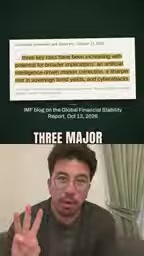
Systemic risk refers to the possibility that the failure or shock of one part of the financial system spreads through interconnected balance sheets and transaction networks to the entire system and endangers the real economy. Circular deals are a breeding ground for systemic risk: when the survival and purchasing power of many AI startups depend on continued funding from a few giants, a tightening of financing conditions or a decline in the giants' own performance could trigger a chain reaction—startups cut purchases, giants miss revenue expectations, stock prices fall, and financing tightens further. The reason the IMF lists an AI market correction as one of the three major risks that could abruptly tighten global financial conditions is precisely the concern that this highly concentrated, interconnected structure will amplify the initial shock rather than absorb losses the way diversified investment does.
The IMF Lists It as One of Three Major Risks
The International Monetary Fund has already listed an AI market correction as one of the three major risks that could abruptly tighten global financial conditions. According to a YouTube channel citation, this is only a risk assessment—no one can give a specific timetable for when the bubble will burst.
But the uncertainty of timing is exactly what makes risk management difficult. If you can't predict it, you can only understand your position in it in advance.
Even If You Don't Buy AI Stocks, You Can't Escape This Game
Many people think that as long as they don't touch AI concept stocks, this capital game has nothing to do with them. That's not the case. According to analysis from a YouTube channel, these AI giants are themselves packaged into the funds ordinary people hold—index funds, retirement portfolios, mutual funds—and it's almost impossible to avoid them.
In other words, you don't need to actively bet on AI; your savings may already be passively participating in this cycle. The real question becomes: how much of this boom rests on customers who can "keep spending after financing slows down"?

When the pace of financing slows, do companies that rely on investment funds to purchase compute still have real ability to pay? This is the key to judging the resilience of AI business models, and it's also a question worth asking one more time when ordinary investors review their fund holdings.
Three Angles of Observation for Ordinary People
The essence of circular deals is a question of demand validation. Revenue generated by money going around in circles within the system is fundamentally different in quality from real, hard-cash payments by end users.
When looking at AI companies' financial statements, it's worth paying attention to customer concentration and the proportion of related-party transactions. If revenue growth depends heavily on a few strategic investors, its sustainability should be discounted.
Finally, examine AI risk in the context of your personal asset allocation. Since the giants have already entered ordinary people's fund portfolios, understanding their financial structure means understanding a part of your own assets.
One-line Summary
Circular investment and procurement between AI giants and startups create $1.4 trillion in related-party transactions, harboring systemic risk.
Paragraph Summary
The article reveals a financial structure that exists on a large scale in the AI industry: large tech companies invest in AI startups, which commit to spending the funds on purchasing the investors' compute or chips, creating a capital flow-back loop. The International Monetary Fund has identified 14 such deals, involving $1.4 trillion in future revenue commitments. Although this model can fund real product development, it also deeply binds the balance sheets of investors and startups; if a startup runs into trouble, the investor faces the double blow of investment losses and customer loss. The IMF lists an AI market correction as one of the three major risks that could abruptly tighten global financial conditions. The article further points out that even without directly holding AI stocks, ordinary people's index funds and retirement portfolios may passively participate in this cycle, making it essential for personal asset management to understand these companies' financial structures.
Related articles

RAG Interview Essentials: Breaking Down the Full Offline Indexing and Online Retrieval Pipeline
A complete breakdown of the RAG retrieval-augmented generation workflow: offline document loading, chunking, vectorization, and indexing; online query rewriting, vector retrieval, reranking, and generation, plus core interview points and system optimization directions.

AI Large Models for Absolute Beginners: Principles and API Calling in Practice
From AI's evolution to large model training principles and core concepts like Token, Temperature, and Top-P, this article explains system prompts, Function Call, RAG, and memory with hands-on examples and four API call scenarios—ideal for beginners.

Will GitHub Die? Open Source Maintainer Burnout and the Collaboration Crisis in the AI Era
Lex Fridman podcast discussion on open source maintainer burnout and GitHub's predicament: massive pull requests overwhelm core maintainers, and AI worsens code bloat. Using math journal peer review and Poincaré conjecture verification as analogies, the article analyzes why verification in knowledge production must be deliberately slow, and how open source communities can avoid the failure mode of maintainers exiting.